

Every year, as the middle of Sha’ban approaches, the same questions return. Is the night of the 15th special? Should we fast the day? Are there prayers for it? Mosques fill in some countries and stay quiet in others, and ordinary Muslims are left between loud claims on both sides: one voice promises enormous rewards, another calls everything about the night an innovation.
The honest answer sits between the two extremes, and reaching it requires something most social media posts skip: actually reading the reports and what the scholars said about them. This guide does exactly that. It lays out the hadiths about the night of mid-Sha’ban, how the scholars graded them, what is not established no matter how widespread it is, and the balanced way a careful Muslim can spend this night.
What Is the Night of the 15th of Sha’ban?
Islamic nights begin at Maghrib, so the “night of the 15th” is the night that precedes the day of the 15th of Sha’ban. In Arabic it is called Laylat al-Nisf min Sha’ban, and in some cultures Laylat al-Bara’ah, “the night of acquittal.”
For 1448 AH, the night falls around the evening of Thursday, January 21 into Friday, January 22, 2027, by the Umm al-Qura calendar, subject to moon sighting. It comes about two and a half weeks before Ramadan 1448, which begins around February 8, 2027.
Learn to read the Quran correctly — Start Learning Quran →The night has been known to Muslims since the earliest generations, and reports about it circulated widely. The entire question is what those reports are actually worth, which is a question of hadith scholarship, not of slogans.
The Hadiths About the Night: What Do They Actually Say?
The most famous report comes from Abu Musa al-Ash’ari (may Allah be pleased with him), that the Prophet (ﷺ) said: “Allah looks down upon His creation on the night of the middle of Sha’ban and forgives all His creation, except the one who associates partners with Him and the one who harbors hatred.” (Narrated by Ibn Majah and others)
A second report, from Mu’adh ibn Jabal (may Allah be pleased with him), carries nearly the same meaning with the additional exceptions of the one who severs family ties, depending on the narration. Other companions, including Abdullah ibn Amr and Awf ibn Malik, have reports in the same direction: forgiveness descends on this night to all but specific categories of sinners.
A third cluster of reports speaks of the night in the language of virtue and worship more generally, and a fourth, weakest cluster assigns it specific prayers, specific numbers of rak’ahs, and extravagant promises.
So the raw material is mixed: a core of similar reports about forgiveness, surrounded by weaker and clearly fabricated additions. This mix is exactly why the scholars’ verdicts came out different, and why fairness requires hearing them all.
How the Scholars Judged These Reports
The stricter verdict. Imam Ibn al-Jawzi counted the reports of this night among the fabricated ones, and a number of hadith scholars, including Ibn al-Arabi al-Maliki, treated its virtues as baseless. On this reading, none of the night-specific reports are reliable enough to build worship upon, and the night is like any other night of Sha’ban.
The middle verdict. Imam Ibn Taymiyyah wrote that the reports about the night are weak individually but that some of the early generations acted upon them, and that a weak hadith about a virtuous night of general worship is not like an invented ritual with fixed forms. Al-Albani, the most influential hadith scholar of the modern era, graded the forgiveness report of Mu’adh “sahih due to its combined routes” (hasan li ghayrihi / sahih bi majmu’ at-turuq), meaning the many weak chains, taken together, strengthen one another to an acceptable level. On this reading, the night has a genuine virtue: a general forgiveness for creation, excluding the idolater and the one carrying hatred.
The accepting verdict. A body of scholars across the Shafi’i, Maliki and other schools accepted the night’s virtue and recommended spending it in prayer and dua, citing both the combined reports and the practice of scholars in cities like Jerusalem in the early centuries.
What unites all three verdicts matters more than what divides them: no major scholar ever approved the fixed rituals, the numbered rak’ahs, or the festival customs. Even the scholars who honored the night honored it with ordinary worship: prayer, dua, Quran, and istighfar.
What Is NOT Established, No Matter How Widespread
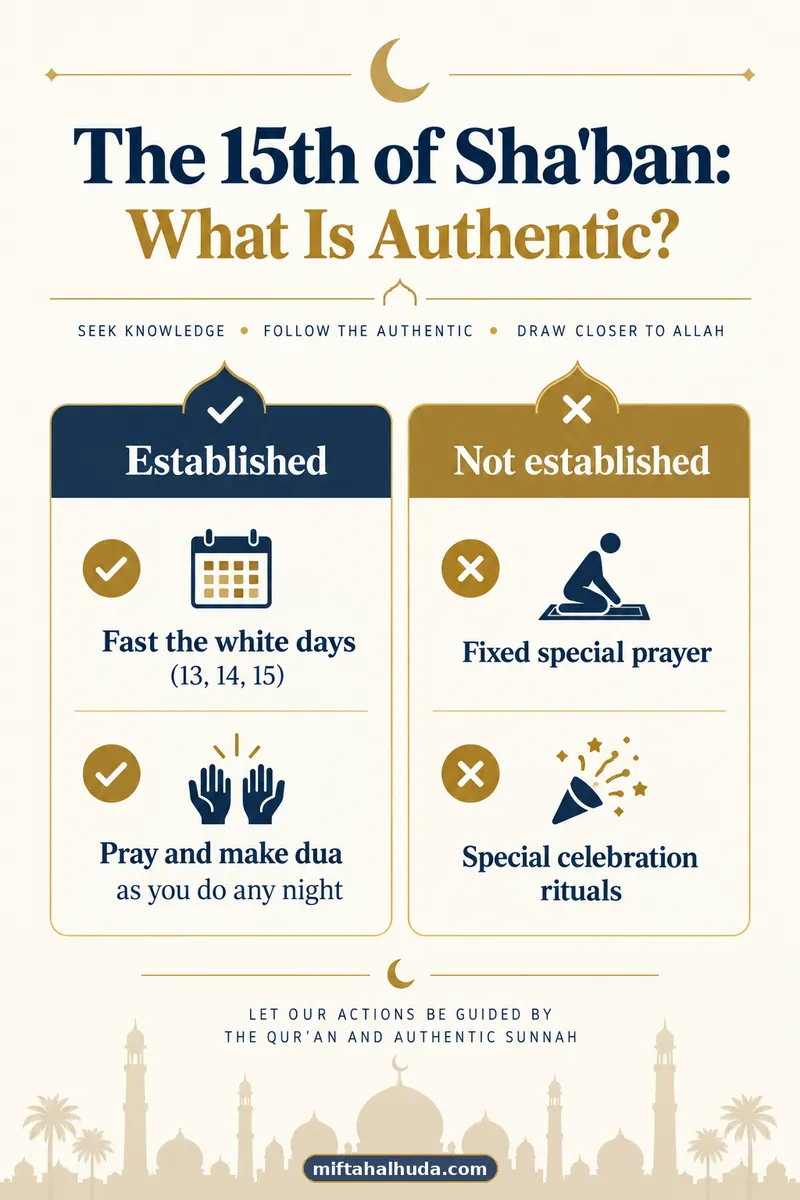
Whatever position one takes on the reports, the following have no authentic basis in the Sunnah, by agreement:
- The congregational mid-Sha’ban prayer in mosques with a fixed number of rak’ahs (often one hundred with Surah Al-Ikhlas repeated). Ibn Taymiyyah, Al-Nawawi and Ibn Rajab all ruled such fixed congregational prayers an innovation.
- Specific duas composed for the night treated as though the Prophet (ﷺ) said them. The long printed “dua of Laylat al-Bara’ah” found in booklets has no chain to him.
- Celebrating with decorations, sweets, fireworks or a holiday atmosphere. The early generations never made it a festival, and turning it into ‘Eid-like celebration adds to the religion.
- Believing the dead visit their families or that souls are told of their coming deaths on this night. These are folk beliefs without evidence.
- Believing the year’s provisions and decrees are assigned on this night as a fixed doctrine. The assignment of the year’s decree belongs to Laylat al-Qadr in the soundest understanding of the Quran’s words, and reports transferring it to mid-Sha’ban are weak.
Fasting the 15th of Sha’ban
What about the day that follows the night? Here the picture is simpler. The reports praising fasting the 15th of Sha’ban specifically are weak, as the hadith scholars state. But the 15th is the last of the three “white days,” the 13th, 14th and 15th of every lunar month, which the Prophet (ﷺ) recommended fasting throughout the year.
The balanced ruling: fast the white days of Sha’ban because they are white days. If the 15th falls within them, it shares their virtue. What to avoid is singling the 15th out with the belief that it carries a special fast unlike any other day, because that belief rests on reports that did not stand. Our guide to fasting in Sha’ban lays out the whole month’s schedule, including where the white days fall.
The Balanced Way to Spend the Night
For the Muslim who follows the scholars who affirmed the night’s virtue, the night is an opportunity for exactly the worship Allah legislated every night: voluntary prayer, Quran, dua and istighfar, alone or with family, with no fixed count and no fixed formula. The one thing the reports themselves highlight is the condition of the heart: forgiveness comes to all except the idolater and the one who carries hatred. The best preparation for the night is therefore to empty the heart of resentment before the night arrives, forgiving the people you have been avoiding.
For the Muslim who follows the stricter verdict, nothing is lost. The same night spent in ordinary worship is still worship in a month the Prophet (ﷺ) honored with his fasting, and no obligation was missed, because none was ever established.
Both roads meet at the same destination: a quiet night of prayer and dua, free of invented forms, with Ramadan two and a half weeks away. That destination is safe for every Muslim, whichever scholarly position their heart finds stronger.
From Mid-Sha’ban to Ramadan: The Real Deadline
However you spend the night, the date itself carries a warning that needs no hadith: when the 15th of Sha’ban passes, Ramadan is barely two weeks away. The night is the last checkpoint on the road. Missed fasts still owed should be nearly finished. The Quran pace should be at full speed. The dua list should be written, the house stocked, the sleep schedule shifted.
The early Muslims did not treat mid-Sha’ban as the destination; they treated it as the last signpost. If the night passes and the preparation is done, it was a blessed night. If the night passes in festival food while the Quran remains closed and the owed fasts remain unmade, then the night distracted from the very month it announces. Let it be the signpost: check your Ramadan preparation checklist, tighten what is loose, and walk into Ramadan ready.
Reading the Forgiveness Report Carefully
The core report deserves a closer look, because its exceptions teach as much as its promise. “Allah looks down upon His creation on the night of the middle of Sha’ban and forgives all His creation, except the one who associates partners with Him and the one who harbors hatred.”
The first exception is shirk, associating partners with Allah. Every door of forgiveness in Islam begins at the same threshold: la ilaha illallah. The one who turns to creation, graves, charms or saints alongside Allah has blocked the road at its start, on this night and every night, until he returns to worshipping Allah alone.
The second exception, al-mushahin, is the one who carries active hatred and rancor toward a fellow Muslim. Some narrations add the one who severs the ties of kinship. Notice what the reports are doing: they make the night’s forgiveness social as much as personal. Allah offers a general pardon, and the one who refuses to pardon his brother steps outside it. Whoever wants the mercy of this night, or any night, begins by forgiving the people he has cut off.
Live 1-to-1 classesLearn it properly, with a real teacherCertified teachers · Flexible times · Free trial classStart Learning Quran →This reading explains why the early generations emphasized settling hearts before Sha’ban ended. The month before Ramadan is the season of clearing accounts with people, so that the month of mercy finds no grudges in the chest. Whatever verdict a Muslim follows on the night’s reports, that lesson stands on its own feet.
Why Do Muslim Communities Treat the Night So Differently?
A Muslim who travels will notice the contrast immediately. In Egypt, the Levant and parts of South Asia, mosques glow, sweets are shared, and the night has a festival air. In the Gulf and among communities that follow the stricter hadith verdicts, the night passes like any other. Both communities love the Sunnah; they differ because their scholars read the same pile of reports and weighed them differently.
Understanding this protects your heart twice over. It protects you from looking down on the worshipper whose mosque is full, because his imam may be following the scholars who affirmed the night, and their case is not empty. And it protects you from absorbing the festival customs, because even the scholars who affirmed the night never legislated the sweets and decorations. Hold the middle: honor the difference, refuse the inventions, and keep your own worship simple and evidence-based.
The ummah has lived with this difference for centuries without it dividing the essentials. The month that ends this debate every year is Ramadan, where every community prays, fasts and reads Quran the same way, and it arrives within days of this night. That is the unity worth protecting.
Does Allah “Look Down” Only on This Night?
One confusion arises from the wording of the report itself: does divine attention to creation happen only on this night? The authentic hadith of the nightly descent answers this clearly. The Prophet (ﷺ) said: “Our Lord, Blessed and Exalted, descends every night to the lowest heaven when the last third of the night remains, saying: Who calls upon Me so that I answer him? Who asks of Me so that I give him? Who seeks My forgiveness so that I forgive him?” (Al-Bukhari and Muslim)
So the believer affirms what the texts affirm, without distortion and without asking how: Allah’s mercy opens every single night, and reports about particular nights add emphasis, not exclusivity. This keeps the mid-Sha’ban night in proportion. At most, it is one emphasized night among a year of open nights, and it sits far below the night Allah named in His Book, Laylat al-Qadr, which is “better than a thousand months” (Surah Al-Qadr 97:3).
With that proportion in place, the night becomes simple: an extra opportunity on the road to Ramadan, neither a invention-laden festival nor a night to quarrel over, but a quiet chance to pray, forgive and prepare.

A Word on Intention for the Night
Finally, guard the intention whichever path you take. If you worship the night because the people around you worship it, the worship is custom. If you worship it to be seen, it is showing off. And if you worship it because the combined reports, in the judgment of scholars you trust, point to a general mercy you hope to catch, then it is worship with knowledge, and that is the worship Allah accepts. The same humility belongs to those who leave the night’s special claims aside: do it with knowledge of why, not with contempt for those who disagree, and the night passes with the ummah’s heart intact.
The Night in the Lives of the Early Generations
What did the first centuries actually do on this night? The historical reports, collected by Ibn Rajab and others, mention that some of the worshippers of the Levant, including students of the companions such as Khalid ibn Ma’dan and Makhul, used to honor the night with prayer. The people of Jerusalem are reported to have gathered for it in the Al-Aqsa mosque, which is among the earliest recorded communal observances of the night.
Ibn Taymiyyah cited exactly this history when he explained his middle position: the reports are weak, yet a group of the early worshippers acted on them, so spending the night in prayer has a precedent among the righteous, while the fixed rituals attributed to it do not. The distinction between the early practice, simple prayer and dua, and the later additions of fixed rak’ah counts and festivals is the whole story of the night in one line.
That historical honesty serves both sides of today’s debate. It shows the night was not invented in recent centuries, and it shows that the festival forms were not the practice of the first generations either. The further the customs drifted from that early simplicity, the more the scholars pushed back, until the stricter verdicts set the boundary clearly: whatever you do on this night, let it look like the worship of the first centuries, not like the celebrations of the later ones.
The Night as a Family
If your household marks the night, mark it in the way every scholar would recognize: pray two rak’ahs together, read a page of Quran aloud, say the istighfar of the evening, and have each person name one person they forgive before sleeping. Children will remember a night of gentle worship far longer than a night of sweets. And if your household does not mark it, the month is still full: Sha’ban’s Mondays, Thursdays and white days carry a household toward Ramadan with evidence at every step, as our Sha’ban fasting guide lays out.
Frequently Asked Questions About the 15th of Sha’ban
1. Is the night of the 15th of Sha’ban special in Islam?
Scholars differed. Reports about a general forgiveness on this night were judged weak individually but were strengthened collectively by scholars like Al-Albani and treated as acceptable by others like Ibn Taymiyyah, while stricter scholars rejected them entirely. All agree the night has no fixed rituals, so ordinary worship on it is safe on every view.
2. Is there a special prayer for Laylat al-Nisf min Sha’ban?
No. The congregational prayers with fixed rak’ah counts, such as the one-hundred-rak’ah prayer, have no basis in the Sunnah and were ruled innovations by Al-Nawawi, Ibn Taymiyyah and Ibn Rajab. Voluntary night prayer in the ordinary way is open to everyone on every night.
3. Should I fast on the 15th of Sha’ban?
The reports singling out the 15th with a special fast are weak. What is established is fasting the white days (13th-15th) of every month, so you may fast them as part of that general Sunnah. Do not believe the 15th carries a unique obligatory-like fast of its own.
4. What is the dua for the night of mid-Sha’ban?
No specific dua is authentically reported from the Prophet (ﷺ) for this night, and the long printed duas attributed to it have no chain. Make dua in your own words, ask for forgiveness, and use the authentic daily supplications from the Sunnah, such as those in our Ramadan duas collection.
5. When is the night of the 15th of Sha’ban in 2027?
For 1448 AH, the night is expected on the evening of Thursday, January 21, 2027, with the day of the 15th on Friday, January 22, by the Umm al-Qura calendar. The confirmed date depends on the moon sighting in your country.
6. Is it true that Allah forgives everyone on this night except two types of people?
That is the content of the most famous report, which names the idolater and the one who harbors hatred as the exceptions. Scholars who accepted the combined reports affirmed this meaning, while stricter scholars held the report unproven. Either way, emptying the heart of hatred is a gain on any night.
7. Are the year’s decrees written on the night of mid-Sha’ban?
The reports assigning the year’s decree to this night are weak. In the soundest reading of the Quran, the blessed night of decree is Laylat al-Qadr in Ramadan, as our Laylat al-Qadr guide explains, so build that doctrine on the Quran’s own words.
8. What is the best thing to do on the night of the 15th of Sha’ban?
Pray voluntary prayers, read Quran, make sincere dua and istighfar, forgive those you hold things against, and then check your Ramadan preparation, because the month is two weeks away. No fixed forms, no festival, and no invented rituals.
Learn to read the Quran correctly
Start or improve your Quran reading with a certified teacher, one-to-one online.
One Response