

Between Rajab and Ramadan sits a month most Muslims pass through without noticing. The markets have no decorations for it, no Eid crowns its end, and many believers could not say what makes it different. Yet when the companions wanted to describe the Prophet’s (ﷺ) fasting outside Ramadan, it was this month they named: he fasted Sha’ban more than any other month of the year.
That single fact changes how a serious Muslim reads the calendar. Sha’ban is not filler between the sacred month and the holy month. It is the month the Prophet (ﷺ) chose as his personal training ground for Ramadan, and it carries a reason for fasting that no other month shares: the annual raising of deeds to Allah.
This guide covers what Sha’ban is, why the Prophet (ﷺ) fasted so much of it, how much of it he actually fasted, the rules about fasting right before Ramadan, making up missed fasts, and how to build your own Sha’ban fasting schedule for 1448.
What Is Sha’ban?
Sha’ban is the eighth month of the Islamic lunar year, coming after the sacred month of Rajab and immediately before Ramadan. Its name comes from a root meaning “to spread out” or “branch off,” which the Arabs used because tribes would disperse in this month in search of water and provision.
Learn to read the Quran correctly — Start Learning Quran →Sha’ban is not one of the four sacred months named in Surah At-Tawbah. Its honor comes from a different door: the practice of the Prophet (ﷺ) and what happens in it in the heavens. Usamah ibn Zayd (may Allah be pleased with him) said: “I said: O Messenger of Allah, I do not see you fasting in any month as you fast in Sha’ban. He said: That is a month people neglect, between Rajab and Ramadan, and it is a month in which deeds are raised to the Lord of the worlds, so I love that my deeds be raised while I am fasting.” (An-Nasa’i, hasan)
Read that hadith slowly. The Prophet (ﷺ) himself called Sha’ban “a month people neglect,” and then gave the reason he filled it with fasting: deeds ascend to Allah in this month, and he wanted his record to ascend while he was in the best state a servant can be in. Every believer can want the same thing for the same reason.
Why the Prophet (ﷺ) Fasted Sha’ban More Than Any Other Month
The evidence for Sha’ban fasting rests on the strongest possible narrators. Aisha (may Allah be pleased with her) said: “I never saw the Messenger of Allah (ﷺ) fast a complete month except Ramadan, and I never saw him fast more in any month than in Sha’ban.” (Al-Bukhari and Muslim) In another narration she said he would fast Sha’ban “except a little,” meaning he fasted most of it.
The scholars drew out several layers of wisdom from this practice:
- The raising of deeds. As the hadith of Usamah states, this is the month in which the year’s record ascends. Fasting, prayer and charity in Sha’ban mean the record rises carried on worship.
- Training for Ramadan. Ibn Rajab Al-Hanbali explained that fasting Sha’ban is like the voluntary warm-up before the obligatory race, just as the sunnah prayers prepare for the fard. Whoever enters Ramadan with weeks of fasting behind him finds the month familiar, while whoever fasts only in Ramadan spends its first week struggling.
- Reviving a neglected month. Worship in times of heedlessness carries a special reward. The Prophet (ﷺ) loved to act when others were distracted, because the worshipper in a crowd of the heedless is like the one holding embers.
- Honoring the neighbor of Ramadan. Scholars noted that Rajab and Sha’ban were honored because of what follows them, the way the sunnah prayers honor the obligatory ones they surround.

How Much of Sha’ban Did the Prophet (ﷺ) Actually Fast?
Precision matters here, because two authentic statements of Aisha (may Allah be pleased with her) can look contradictory at first. She said he fasted Sha’ban “except a little,” and she also said she never saw him complete a full month outside Ramadan. Al-Bukhari himself reconciled them in the chapter title he chose: he fasted most of the month without completing it.
The practical picture is a man fasting nearly every day of Sha’ban but deliberately leaving days unfasted, so that no one would mistake it for a second Ramadan. That is the Sunnah’s balance: intense worship that never confuses the voluntary with the obligatory.
For you, the lesson is not to count whether he fasted twenty-seven days or twenty-nine. The lesson is direction. If the Prophet (ﷺ) spent Sha’ban mostly fasting, then the believer who wants his company spends Sha’ban fasting more than his usual habit, in whatever amount his health and duties allow.
Live 1-to-1 classesLearn it properly, with a real teacherCertified teachers · Flexible times · Free trial classStart Learning Quran →Fasting the First Days vs the Last Days of Sha’ban
Sha’ban fasting has one clear boundary drawn by the Prophet (ﷺ) himself. Abu Hurayrah (may Allah be pleased with him) reported that he said: “Do not precede Ramadan by fasting a day or two before it, unless it is a day that a man would habitually fast, then let him fast it.” (Al-Bukhari and Muslim)
The scholars explain: as Ramadan approaches, in the last day or two of Sha’ban, stop fasting, so that no voluntary fast blurs into the obligatory month and no doubt enters the count of Ramadan’s days. The exception is the person whose regular habit lands there: the man who always fasts Mondays, and the last Monday of Sha’ban falls a day before Ramadan, fasts his usual Monday without concern.
Connected to this is the “day of doubt” (yawm ash-shakk), the 30th of Sha’ban when clouds prevent confirming the new moon. Ammar ibn Yasir (may Allah be pleased with him) said: “Whoever fasts the day of doubt has disobeyed Abul-Qasim (ﷺ).” (Abu Dawud and At-Tirmidhi) The safe practice is what Ibn Umar did: he would not fast it unless it matched his established routine. If the month is later confirmed to be Ramadan, that day must simply be made up afterward without any sin upon you.
So the Sha’ban schedule divides naturally: fast freely from the 1st through the 27th or so, then ease off in the final two days before Ramadan’s expected start, keeping only established personal habits.
Making Up Missed Ramadan Fasts in Sha’ban
Sha’ban carries a second, urgent role: it is the last month before the next Ramadan, which means it is the final comfortable window for making up the fasts you owe from the last one. Aisha (may Allah be pleased with her) said: “I would owe fasts from Ramadan, and I could not make them up until Sha’ban, because of my duties toward the Messenger of Allah (ﷺ).” (Al-Bukhari and Muslim)
Two lessons live inside this hadith. First, the Mother of the Believers herself delayed her make-up fasts to Sha’ban, so anyone in the same position should feel no shame, only resolve. Second, she did make them up in Sha’ban without fail. The deadline for qada fasts is the arrival of the next Ramadan, and Sha’ban is the last call.
If you owe days, count them now and spread them across the month. Ten owed days across twenty-five available fasting days is a gentle pace; the same ten days crammed into the last week is a burden and a risk. And if you want help reviewing the rulings that govern these fasts, our guides on the Ramadan fasting rules and the intention for fasting Ramadan cover the details.
Fasting the 15th of Sha’ban
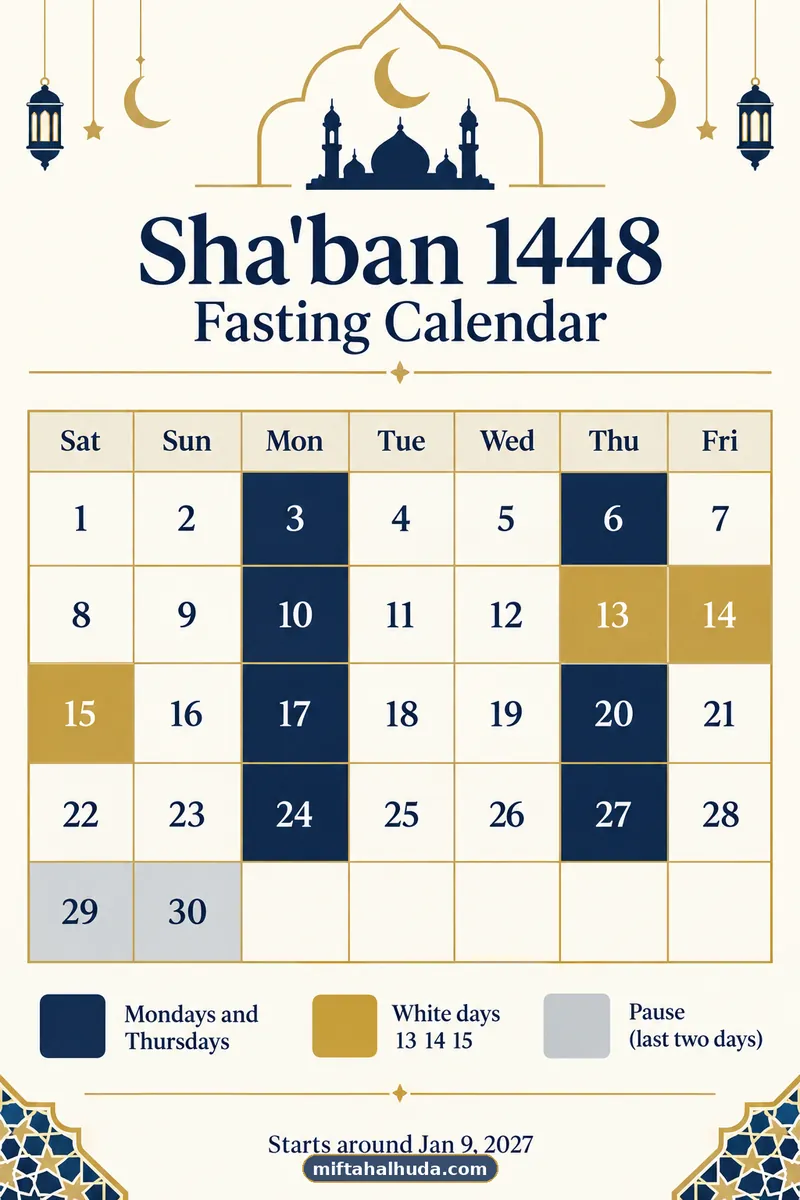
The middle of Sha’ban arrives with the three “white days” (the 13th, 14th and 15th of the lunar month), which the Sunnah recommends fasting in every month of the year. Fasting them in Sha’ban is therefore established and rewarded, and for Sha’ban 1448 they fall around January 21-23, 2027, by the Umm al-Qura calendar.
What is not established is a special fast unique to the 15th itself. The report praising fasting that specific day is weak, as the hadith scholars state, so the sound approach is simple: fast the white days because they are white days, and do not believe the 15th of Sha’ban carries a private fast of its own. Our article on the night of the 15th of Sha’ban examines the reports about the night itself with the same care.
A Practical Fasting Schedule for Sha’ban 1448
Sha’ban 1448 is expected to begin around Saturday, January 9, 2027. Here is a schedule that follows the Sunnah’s shape without exhausting you before Ramadan:
- Every Monday and Thursday: the Prophet’s (ﷺ) weekly habit, about eight days across the month.
- The white days (13th-15th): three more days, mid-month.
- Your make-up fasts: whatever you owe from last Ramadan, spread early in the month, not late.
- Extra days as you are able: add a day here and there if you are building toward the Prophet’s (ﷺ) level of “most of the month,” but never at the cost of arriving at Ramadan drained.
- The last two days before Ramadan: no voluntary fasting unless it is your fixed habit day.
Combining intentions is allowed and wise: a Monday that is also a make-up day can carry both the qada and the reward of the sunnah habit, as long as the qada intention is present.
Sha’ban: The Month of Preparation
Fasting is Sha’ban’s headline, but the Prophet (ﷺ) filled the whole month with readiness. This is the month to finish what Rajab started: your Quran reading pace should reach its Ramadan level now, your sleep should already be shifting, your dua list should be written, and your home should feel the month approaching. The Ramadan preparation checklist lays out the full plan week by week, and the Rajab guide shows how the two months work together as one preparation season.
Remember the farmers’ saying of the early generations: Rajab is the month of planting, Sha’ban is the month of watering, and Ramadan is the month of harvest. The farmer who waters in Sha’ban is the one who harvests in Ramadan. Fasting is the water; do not let the month pass dry.
Sha’ban Worship Beyond Fasting
Fasting leads Sha’ban’s worship, but the Prophet’s (ﷺ) reason for the month, the raising of deeds, covers every good deed, not only fasting. Fill the month with the rest of the record you want ascending:
- Quran at Ramadan pace. The early generations called Sha’ban “the month of the reciters” because they began their serious Quran work in it. If Ramadan’s goal is a full khatmah, Sha’ban is when your daily pages reach their target, as the Quran reading schedule for Ramadan plans out.
- Night prayer in small doses. Two rak’ahs after Isha or before sleep build the standing habit that taraweeh will need.
- Charity before the month of generosity. Warm up your giving hand now, quietly, so that Ramadan’s giving is a continuation and not a shock to the budget.
- Forgiveness and settling debts. Enter the raising of deeds with a clean page: repay what you owe, forgive what you hold, and write down anything unresolved.
The Last Week of Sha’ban: Final Ramadan Checks
The final week before Ramadan is for finishing, not starting. Use it to close every loop so the first night of taraweeh finds you ready:
- Finish your make-up fasts early in the week at the latest, leaving the final two days clear as the Sunnah directs.
- Plan your Ramadan calendar: work arrangements, suhoor and iftar times from your local timetable, taraweeh location, and the family routine.
- Shop once, calmly. Stock the house before the month so Ramadan’s hours are not spent in queues and traffic.
- Print your dua list and put it where the iftar happens, with the authentic supplications from the Ramadan duas collection at the top.
- Rest. The last two days of Sha’ban are the Sunnah’s own rest stop. Take it, and meet Ramadan fresh.
Sha’ban Mistakes to Avoid
- Ignoring the month completely. The Prophet (ﷺ) described it as neglected; the believer’s response is to be among those who do not neglect it.
- Fasting into Ramadan’s doorstep. Voluntary fasting on the final day or two, or on the day of doubt, crosses the boundary the Prophet (ﷺ) drew.
- Treating mid-Sha’ban as a festival. Fixed rituals, special congregational prayers and celebration foods tied to the 15th have no basis; the details are in our mid-Sha’ban article.
- Leaving qada fasts to the final days. It risks entering the new Ramadan with old debt, and illness or travel can suddenly shrink the window.
- Believing weak reports about enormous rewards for specific Sha’ban days without checking them. The authentic reasons to worship in Sha’ban are strong enough to need no exaggeration.
What If This Is Your First Serious Sha’ban?
If you have never fasted Sha’ban before, start with the structure that asks the least and gives the most: Mondays, Thursdays, and the three white days. That is roughly eleven days of fasting in the month, enough to transform your readiness for Ramadan without any risk of burnout.
Add one more element and your Sha’ban is complete: a fixed daily Quran portion, even fifteen minutes after Fajr. By the time the crescent of Ramadan is announced, you will have fasted regularly for weeks, read Quran daily, and made up any missed days. Compare that arrival with the person who spent Sha’ban on autopilot, and you will understand why the Prophet (ﷺ) loved this month. The harvest belongs to those who watered.
Deeds Are Raised: What Kind of Record Do You Want Ascending?
The Prophet’s (ﷺ) explanation of Sha’ban deserves a second reading, because it turns fasting from a physical act into a spiritual audit. “It is a month in which deeds are raised to the Lord of the worlds, so I love that my deeds be raised while I am fasting.” He did not only want to worship in Sha’ban; he wanted the record that ascends in Sha’ban to be beautiful.
Ask the question of yourself that the hadith asks of every reader: when this year’s record goes up, what will be in it? The prayers you rushed, or the ones you guarded? The money you gave, or the money you only intended to give? The relationships you repaired, or the grudges you carried through another year? Sha’ban offers a final editing window before the annual report closes.
This is also why the scholars paired Sha’ban fasting with Sha’ban repentance. Fasting polishes the record from the outside; istighfar cleans it from the inside. Spend a few minutes each night of this month reviewing the day honestly, seeking forgiveness for what failed and thanking Allah for what succeeded. Then when Ramadan arrives with its open doors of mercy, you meet it with a record already in good order, and the month can build on a clean foundation instead of repairing a damaged one.
And notice the gentleness of the Prophet’s (ﷺ) phrasing: “I love that my deeds be raised while I am fasting.” He spoke of love, not fear. Sha’ban is not a month to dread; it is a month to fall in love with, the quiet gift between Rajab and Ramadan that most of the world walks past without seeing.
Frequently Asked Questions About Fasting in Sha’ban
1. Did the Prophet (ﷺ) fast all of Sha’ban?
He fasted most of it without completing it. Aisha (may Allah be pleased with her) said she never saw him complete a full month outside Ramadan, and never saw him fast more than in Sha’ban, and Al-Bukhari reconciled the reports by noting he left some days deliberately so it would not resemble Ramadan.
2. Why do we fast in Sha’ban?
The Prophet (ﷺ) gave the reason himself: it is a neglected month in which deeds are raised to Allah, and he loved for his deeds to rise while he was fasting. Scholars add that it trains the body and soul for Ramadan, the way sunnah prayers prepare for the obligatory ones.
3. When should I stop fasting before Ramadan?
Stop voluntary fasting in the last day or two of Sha’ban, based on the hadith “Do not precede Ramadan with a day or two,” unless that day matches your established personal habit, such as your regular Monday or Thursday fast. The “day of doubt” before Ramadan should not be fasted as a precautionary Ramadan day.
4. Is it too late to make up missed Ramadan fasts in Sha’ban?
No, Sha’ban is the final window, and Aisha (may Allah be pleased with her) herself made up her owed fasts in Sha’ban because of her duties. Make up what you owe before the new Ramadan arrives, spreading the days comfortably across the month.
5. Is fasting the 15th of Sha’ban a special sunnah?
Not as a specific fast; the report singling it out is weak. What is established is fasting the white days (13th-15th) of every month, which include the 15th of Sha’ban, so fast them as part of that general Sunnah without believing the date carries a private fast.
6. Can I combine a make-up fast with a Monday or Thursday fast?
Yes. If you owe days from Ramadan and fast them on a Monday or Thursday, scholars hold that you receive the make-up obligation’s fulfillment and the reward of the sunnah day, since combining intentions in voluntary acts is accepted when the obligatory one is properly intended.
7. What if fasting Sha’ban makes me too tired for Ramadan?
Then fast less of it. The goal is to arrive at Ramadan eager, not exhausted. Even Mondays, Thursdays and the white days capture the month’s spirit, and whoever fasts nothing in Sha’ban but enters Ramadan strong has lost only extra reward, not sinned.
8. When does Sha’ban 1448 begin?
Sha’ban 1448 is expected around Saturday, January 9, 2027, by the Umm al-Qura calendar. The confirmed start depends on the official moon sighting in your country and may shift by a day.
Learn to read the Quran correctly
Start or improve your Quran reading with a certified teacher, one-to-one online.
One Response