
Rajab arrives quietly. There is no moon-sighting excitement like Ramadan, no Eid at its end, and no crowds outside the masjid. Yet Allah counted it among the four sacred months on the day He created the heavens and the earth, and the early Muslims treated it as the opening gate of the most important season of the year: the road to Ramadan.
That quiet arrival is exactly why Rajab matters for you. It is your chance to start warming up before the race begins, and to do it with correct knowledge. Rajab is also a month surrounded by invented practices and weak reports, so a believer needs two things at once: love for what Allah made sacred, and clarity about what the Prophet (ﷺ) actually did and taught.
This guide walks through both. You will learn what Rajab is, what is authentically reported about its virtues, what the scholars said about fasting in it, which popular practices have no basis, and how to turn the next few weeks into a practical preparation plan for Ramadan 1448.
What Is Rajab and Why Is It Sacred?
Rajab is the seventh month of the Islamic lunar calendar. Its name comes from the Arabic root ra-jeem-ba, which carries the meaning of respect and magnification, because the Arabs of old held this month in special regard. Islam came and confirmed the sanctity of the month while correcting the exaggerations that had grown around it.
Learn your deen with a qualified teacher — Explore Fiqh Classes →Allah says in the Quran:
إِنَّ عِدَّةَ الشُّهُورِ عِندَ اللَّهِ اثْنَا عَشَرَ شَهْرًا فِي كِتَابِ اللَّهِ يَوْمَ خَلَقَ السَّمَاوَاتِ وَالْأَرْضَ مِنْهَا أَرْبَعَةٌ حُرُمٌ ۚ ذَٰلِكَ الدِّينُ الْقَيِّمُ ۚ فَلَا تَظْلِمُوا فِيهِنَّ أَنفُسَكُمْ
“Indeed, the number of months with Allah is twelve months in the register of Allah from the day He created the heavens and the earth; of these, four are sacred. That is the correct religion, so do not wrong yourselves during them.” (Surah At-Tawbah 9:36)
The Prophet (ﷺ) named those four months in the sermon of his Farewell Pilgrimage. Abu Bakrah (may Allah be pleased with him) reported that he said: “Time has returned to its original state as it was on the day Allah created the heavens and the earth. The year is twelve months, of which four are sacred: three in succession, Dhul-Qa’dah, Dhul-Hijjah and Muharram, and Rajab, the month of Mudar, which comes between Jumada and Sha’ban.” (Narrated by Al-Bukhari and Muslim)
Notice the detail in this hadith. The Prophet (ﷺ) specified “Rajab of Mudar” because the tribe of Mudar honored Rajab consistently, while other tribes sometimes shifted the sacred months around for political convenience. His precision fixed the calendar for the entire ummah.
What does “sacred” mean in practice? Scholars explain that a sacred month carries two rulings. First, fighting and bloodshed were forbidden in it unless in direct self-defense. Second, and this applies to every one of us, sins committed in a sacred month are more serious, and good deeds carry a special weight. The command “do not wrong yourselves during them” is read by many commentators as a warning that injustice and sin are graver in these months, just as worship in them is more beloved.
Ibn Rajab Al-Hanbali described the sacred months as seasons in which Allah multiplies the reward of those who draw near to Him, comparing them to the special times of a merchant’s market season. The goods are the same; the prices are higher.
The Virtues of Rajab in the Quran and Sunnah
Here is the honest, accurate picture: no specific hadith about a unique virtue of Rajab over other months reaches the level of authenticity. Imam Ibn Hajar and other hadith masters stated clearly that the famous reports praising Rajab in isolation are either weak or fabricated. What is authentic, however, is more than enough:
- It is one of the four sacred months, by the explicit text of the Quran and the Prophet’s (ﷺ) sermon. This is the greatest documented virtue of Rajab, and it needs no addition.
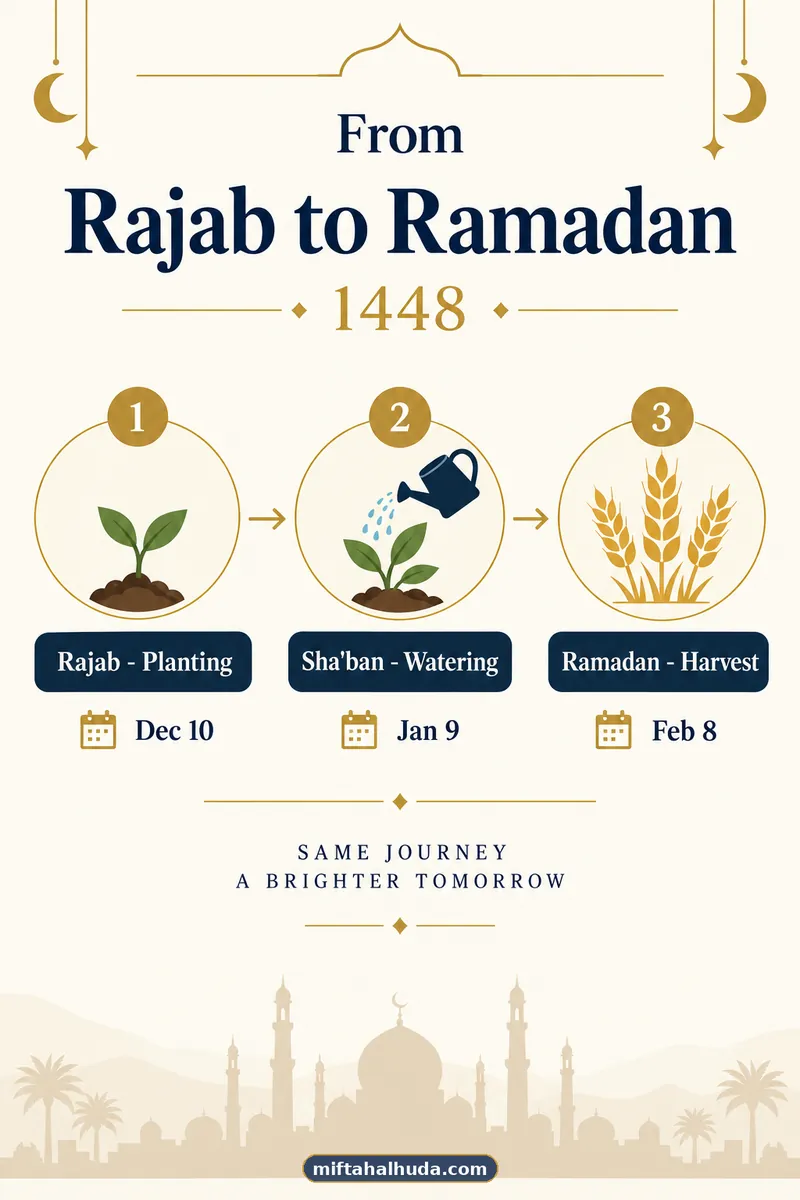
- It stands at the head of the Ramadan season. Rajab is followed by Sha’ban, then Ramadan. The early Muslims called Rajab “the month of planting,” Sha’ban “the month of watering,” and Ramadan “the month of harvest.” What you plant in Rajab, you gather in Ramadan.
- It is a month of general mercy and forgiveness, like every other month, for those who turn to Allah. The door of repentance is not seasonal, and a sacred month is a beautiful time to walk through it.
Some scholars also noted that Rajab sits between two months of heedlessness (Jumada al-Akhirah) and eagerness (Sha’ban), making it the natural moment of awakening. Abu Bakr Al-Warraq said: “In Rajab you sow the seeds, in Sha’ban you irrigate them, and in Ramadan you reap the harvest.” A person who begins now will meet Ramadan with a running start.

Fasting in Rajab: What Did the Prophet (ﷺ) Actually Do?
This is the question most people ask, and it deserves a careful answer.
There is no authentic report that the Prophet (ﷺ) fasted Rajab specifically or singled it out with a special fast. Imam Muslim narrated from Ibn Abbas (may Allah be pleased with him) that the Prophet (ﷺ) would sometimes fast so much that we would say he would never stop fasting, and at other times he would refrain so much that we would say he was not fasting at all, and that he never completed a full month of fasting outside Ramadan. Imam Ibn Umar was asked about fasting Rajab and answered plainly: he never saw the Prophet (ﷺ) complete any month in full except Ramadan, and he never fasted any month as much as he fasted Sha’ban.
Imam Al-Nawawi, Ibn Rajab, and Ibn Al-Qayyim all recorded that none of the specific “Rajab fast” reports are reliable. The report that “fasting one day of Rajab extinguishes the Fire for seventy years,” and similar narrations, are fabricated.
So is fasting in Rajab wrong? Not at all. The scholars drew a clear line:
- Fasting in Rajab with the belief that this month carries a special legislated fast is an innovation, because it adds to the religion what Allah did not legislate.
- Fasting in Rajab as part of your general habit of voluntary fasting is perfectly fine and rewarded. Mondays and Thursdays fall in Rajab too. The three “white days” of each lunar month (the 13th, 14th and 15th) fall in Rajab too. If you already fast these days, keep fasting them.
- Making up missed Ramadan fasts in Rajab is not only allowed but wise, since Sha’ban and Ramadan are coming.
Some of the early generations did fast much of Rajab out of love for the sacred months, and scholars who allowed this based it on the general virtue of fasting and of the sacred months, not on any Rajab-specific text. The safest and most balanced approach is the middle one: do not believe in a special “Rajab fast,” but do not leave the month empty either. Use the general voluntary fasts you already know.
Weak and Fabricated Reports About Rajab to Avoid
Because people love seasons of worship, Rajab attracted more invented material than almost any other month. Knowing the most widespread ones protects your worship:
- “Whoever fasts a day of Rajab, the Fire moves seventy years away from him.” Fabricated (mawdu’), by agreement of the hadith scholars.
- “Rajab is the month of Allah, Sha’ban is my month, and Ramadan is the month of my ummah.” Fabricated, as Ibn Hajar and others stated.
- The special prayer of the first Friday night of Rajab (Salat Al-Ragha’ib), with its fixed number of rak’ahs and fixed surahs. Ibn Taymiyyah, Al-Nawawi, and Ibn Rajab all ruled it an invented prayer with no basis in the Sunnah.
- Celebrating the night of the 27th of Rajab as the night of Al-Isra’ wal-Mi’raj with special prayers or gatherings. The event itself is true and glorious, but no authentic text fixes its date to this night, and the early generations did not single it out for celebration.
- Special foods, gifts, or greetings treated as religious duties of the month, such as considering it obligatory to cook certain dishes or congratulate one another with fixed phrases. Kind customs are fine as customs; the harm begins when they are believed to be part of the religion.
The principle that protects you is simple: worship is only valid in the form Allah legislated. When you hear a claim about Rajab, ask for its evidence, and check whether the evidence is authentic before building your worship on it.
The Famous Rajab Dua: Is It Authentic?
Every year, as Rajab begins, one supplication spreads across social media:
اللَّهُمَّ بَارِكْ لَنَا فِي رَجَبٍ وَشَعْبَانَ وَبَلِّغْنَا رَمَضَانَ
“O Allah, bless us in Rajab and Sha’ban, and let us reach Ramadan.”
The words are beautiful, and the meaning is sound. But the report behind it is weak. It comes through a chain that hadith scholars, including Ibn Rajab, Al-Albani, and Ibn Baz, classified as unreliable. No Muslim should present it as an established supplication from the Prophet (ﷺ).
Does that mean you cannot say it? Scholars such as Ibn Uthaymeen noted that when a supplication’s wording is sound and it is not treated as a fixed Sunnah practice tied to a specific time or number, asking Allah with those words is permissible, because the doors of dua are wide. The safe approach: make the dua in your own words, ask Allah sincerely to bless your Rajab and Sha’ban and to let you witness Ramadan, and do not attribute the specific formula to the Prophet (ﷺ).
If you want established supplications for this season, the most authentic supplication of the season is the one you make from your heart, plus the daily adhkar of morning and evening and the general duas of the Quran and Sunnah. Our Ramadan duas collection gathers many authentic ones you can start learning now, and the Ramadan preparation checklist builds them into a daily plan.
How to Use Rajab to Prepare for Ramadan
Rajab is roughly two months before Ramadan. That is enough time to change your spiritual condition completely if you use it well. Here is a practical plan you can start this week.
1. Close your account with last Ramadan. If you owe missed fasts from the previous Ramadan, Rajab is the time to begin making them up, not the last week of Sha’ban. Spread them across the coming weeks and enter Ramadan with a clean record.
2. Restart the Quran relationship gently. Do not jump from nothing to a juz a day; you will burn out by the second week. Start with ten pages a day in Rajab, raise it to fifteen in Sha’ban, and you will be ready for a full khatmah in Ramadan. A structured Quran reading schedule makes this far easier to keep.
3. Fix one prayer habit. Choose the single weakest point in your salah, whether it is praying Fajr on time, guarding the five prayers in congregation, or adding the regular sunnah prayers, and work on that one thing for the whole month. One fixed habit is worth more than ten abandoned resolutions.
4. Begin voluntary fasting on the general days. Mondays, Thursdays, and the white days. By Ramadan, fasting will feel familiar to your body instead of a shock.
5. Give something up before Ramadan asks you to. Reduce the habit that steals your time, whether it is endless scrolling, late nights, or something heavier. Ramadan’s power is that desire is already restrained; arriving with a trained will makes the month far sweeter.
6. Learn the rulings before you need them. Many worship mistakes happen simply because people never studied the fiqh of fasting. Review the essential Ramadan fasting rules and the rules of intention for fasting Ramadan while there is no pressure.
7. Make your dua list now. Write down the things you will beg Allah for in Ramadan, for yourself, your family, and the ummah. When the blessed nights arrive, you will not waste them searching for words.
8. Fix your sleep gradually. Ramadan nights are for taraweeh and qiyam, and Ramadan days start before dawn. Shift your bedtime earlier in small steps across Rajab and Sha’ban.
9. Clean your heart for the season. Rajab is a month to repent, forgive people, and settle grudges. Enter Ramadan light, not carrying the weight of old quarrels.
10. Bring your family in. Talk to your children about the coming months, put a small Quran time in the home routine, and let the household feel that something special is approaching. Rajab is the perfect month to build that atmosphere slowly.
Rajab and Fasting: Practical Rulings
Can I fast the whole month of Rajab? The Prophet (ﷺ) never completed a full month of voluntary fasting, and Imam Ahmad considered fasting an entire month other than Ramadan to be disliked. Keep some days without fasting, and your worship stays on the Sunnah’s pattern.
Are the white days of Rajab special? The white days (13th, 14th and 15th of each lunar month) are recommended every month, including Rajab, based on the general hadiths about them. For Rajab 1448, they fall around the 21st to 23rd of December 2026, depending on moon sighting.
What about fasting the 27th of Rajab? Singling out that date with fasting because of Al-Isra’ wal-Mi’raj has no authentic basis. If it happens to be your Monday or Thursday, fast it as a general voluntary fast without the occasion in mind.
Can I perform umrah in Rajab? Umrah is valid in Rajab as it is all year. There is simply no special virtue for a “Rajab umrah,” despite the reports claiming otherwise, which scholars graded as weak or fabricated. Go for umrah when you can, and do not believe the month changes the ruling.
Is fasting on a day of doubt before Ramadan allowed? That concern belongs to the end of Sha’ban, not Rajab. What matters now is building the habit, and you can read the details in our fasting rulings guides linked above.
If you want a model of how the Sunnah treats a voluntary fasting day tied to a real event, look at the virtues of fasting on Ashura, where the Prophet (ﷺ) himself explained the reason and even taught us to add the 9th to the 10th. That is what an established seasonal fast looks like, and it shows by contrast why invented Rajab fasts cannot stand.
The Sunnah of Welcoming the Months
Step back and see the wisdom in how Allah arranged the year. Dhul-Hijjah closes the season of Hajj, Muharram opens the new year with Ashura, and Rajab opens the road to Ramadan. Between the great pillars, Allah scattered seasons of mercy so that the believer’s heart never goes too long without a revival.
The Prophet (ﷺ) lived this rhythm. In Sha’ban he fasted more than any other month outside Ramadan, as Aisha (may Allah be pleased with her) described, and he taught us that deeds are raised to Allah in Sha’ban. Ramadan he met with total devotion. Rajab, he left without special ceremony, which is itself a teaching: the sacred months are honored by more taqwa, not by invented rituals.
So welcome Rajab the way the Prophet (ﷺ) and his companions welcomed every good season: with gratitude, with repentance, and with more of the worship you already know to be true. Correct intention, authentic practice, and steady consistency. That is how a quiet month becomes the strongest beginning of your best Ramadan yet.
Frequently Asked Questions About Rajab
Is fasting in Rajab a Sunnah?
No specific Rajab fast is established in the Sunnah. The Prophet (ﷺ) never singled out Rajab for fasting, and the reports praising a special Rajab fast are weak or fabricated. General voluntary fasting, such as Mondays, Thursdays and the white days, remains recommended in Rajab as in every month.
What is the dua for Rajab?
The famous dua “O Allah, bless us in Rajab and Sha’ban and let us reach Ramadan” has a weak chain of narration and should not be attributed to the Prophet (ﷺ). You may ask Allah with its meaning in your own words, and the best supplications remain the authentic daily adhkar and sincere personal dua.
Why is Rajab a sacred month?
Allah named four sacred months in Surah At-Tawbah (9:36), and the Prophet (ﷺ) identified Rajab as one of them in his Farewell Sermon. In a sacred month, sins are graver, good deeds carry greater weight, and bloodshed was forbidden, so a believer honors it with extra care and taqwa.
When does Rajab 1448 begin?
Rajab 1448 is expected to begin around Thursday, December 10, 2026, based on the Umm al-Qura calendar. The confirmed start depends on the official moon sighting in your country, which may shift the date by a day.
Is Salat Al-Ragha’ib an authentic prayer?
No. The prayer attributed to the first Friday night of Rajab, with its fixed rak’ahs and surahs, has no basis in the Sunnah. Scholars including Al-Nawawi, Ibn Taymiyyah and Ibn Rajab ruled it an innovation, and the correct practice is to pray voluntary night prayers in the general way taught by the Prophet (ﷺ).
Can I make up missed Ramadan fasts in Rajab?
Yes, and it is encouraged not to delay. Making up missed fasts may be done any time before the next Ramadan, and starting in Rajab spreads the days comfortably instead of crowding them into the end of Sha’ban.
Is there a special reward for umrah in Rajab?
No authentic text singles out umrah in Rajab for extra reward. Umrah is valid and rewarding all year, so perform it whenever you are able without attaching the month to the virtue.
How can I prepare for Ramadan during Rajab?
Start small and steady: make up missed fasts, read ten pages of Quran daily, fix one prayer habit, fast the general voluntary days, prepare your dua list, and review the rulings of fasting. Two calm months of preparation will transform your Ramadan, and our preparation checklist walks you through it step by step.
Keep reading
Learn your deen with a qualified teacher
Live one-to-one Fiqh classes that explain the rulings clearly and practically.
2 Responses