

“The month of Ramadan in which the Quran was revealed” (Surah Al-Baqarah 2:185). Ramadan and the Quran are bound together in the verse that legislated the fast, and every Ramadan the same question returns to millions of homes: how do I actually finish the Quran this year?
The answer is not motivation; motivation evaporates by day nine. The answer is arithmetic, a schedule, and a few rules for the days that go wrong. This guide gives you all three: the standard 30-day khatmah plan, alternatives for faster and slower readers, the daily time slots that make the plan stick, and the catch-up rules for when life interrupts. Ramadan 1448 begins around February 8, 2027, so the reading runway starts now.
Why Finishing the Quran in Ramadan Matters
The Prophet (ﷺ) reviewed the entire Quran with Jibril every Ramadan, and in the Ramadan of his final year they reviewed it twice (Al-Bukhari). The month was his annual appointment with the whole Book, and the ummah inherited the appointment.
A khatmah in Ramadan is not a race for a certificate. It is the simplest way to guarantee that the month of the Quran actually contains the Quran in bulk, not only in the background of cooking shows. When you commit to finishing, every day of the month has a fixed meeting with Allah’s words, and the structure carries you even when enthusiasm dips.
Learn to read the Quran correctly — Start Learning Quran →One caution from the scholars before we begin: completing the Quran is a means, not the goal. The goal is a heart the Quran lands in. The schedules below are built to serve that goal, including for readers who should choose less reading with more understanding.
The Basic Math of a 30-Day Khatmah
The Madani mushaf has 604 pages, divided into 30 ajza’ (parts) of about 20 pages each. Ramadan has 29 or 30 days. The standard plan follows directly:
- One juz per day finishes the Quran in 30 days, with a spare day if the month has 29.
- One juz is roughly 20 pages, which is 4 pages after each of the five daily prayers. That is the classic formula of the early Muslims, and it still works because it attaches reading to fixed events instead of to free time you will never find.
- In minutes: 20 pages at a calm reading pace is 30 to 45 minutes a day for a fluent reader, and up to an hour and a half for a slower one. Be honest about your pace when choosing a plan below.
The Standard 30-Day Schedule
The structure is simple: juz 1 on day 1, juz 2 on day 2, and so on through juz 30. A few details make it practical:
- Mark the juz boundaries in your mushaf now, before Ramadan, with small sticky tabs at the start of each juz. Searching for boundaries mid-month breaks momentum.
- Read today’s juz today. The plan’s power is that debt never accumulates; protect that rule before anything else.
- If Ramadan has 29 days where you live, use the spare capacity of the first week (read a few extra pages on the easy early days) or simply finish on the morning of Eid eve; both are fine.
- Ramadan 1448 note: if the month begins on February 8, 2027, juz 30 lands around March 8-9, with Eid al-Fitr expected around March 9.
Three Alternative Schedules
The two-khatmah plan (40 pages a day). For strong readers who want the Prophet’s (ﷺ) final-year pattern of two completions. Split it as 8 pages after each prayer, or 20 pages after Fajr and 20 after Taraweeh time. Only choose this if you tested the pace in Sha’ban; ambition here is the classic cause of total collapse.
The 15-day plan, twice. Two ajza’ a day for fifteen days, then repeat. Some readers prefer it because the second pass consolidates what the first skimmed. The daily load is the same 40 pages, so the same caution applies.
The tadabbur plan for beginners (10 pages a day). If your recitation is slow or you are reading with translation and reflection, commit to half a juz daily with understanding, finishing the Quran in about sixty days. A half-khatmah with a moved heart outranks a rushed full one. Build recitation speed separately with a teacher, as our online Qirat courses are designed to do, and aim higher next Ramadan.
When to Read: Slots That Survive Real Life
A schedule is only as good as its time slots. The four that history and experience keep proving:
- After Fajr. The golden slot. The mind is fresh, the house is quiet, and Allah swears by the Quran of dawn (Surah Al-Isra 17:78). Give it the largest share.
- Before or after Dhuhr. The midday pause; twenty minutes here keeps the evening light.
- The last hour before iftar. The fasting person’s answered-dua window doubles as a reading window; the kitchen can wait.
- After Taraweeh. Only for the strong; use it as the catch-up slot, not the main one, because the nights are long.
Attach each reading block to its prayer and the schedule runs on rails. Detach them, and the reading migrates to “later,” which is where khatmahs go to die.
If You Fall Behind: The Catch-Up Rules
Everyone falls behind. The difference between finishers and quitters is having decided the rules in advance:
- Rule one: never let debt pass three days. One missed juz is an evening; three is a crisis. Catch up within 48 hours by splitting the debt across the five prayer slots.
- Rule two: use Friday. With no work for most people, Friday absorbs a full missed juz painlessly.
- Rule three: adjust, don’t abandon. If week one proves the pace impossible, drop to the tadabbur plan immediately rather than quitting altogether. Half a khatmah completed beats a full one abandoned at juz 7.
- Rule four: protect the last ten nights. Plan to finish juz 30 by the 27th so the odd nights stay free for prayer and dua, as the Laylat al-Qadr guide recommends.
Reading With Understanding
Allah asks: “Then do they not reflect upon the Quran?” (Surah An-Nisa 4:82). For most non-Arabic readers, Ramadan reading should run on two tracks: the Arabic recitation for worship and reward, and a reliable translation or tafsir for understanding. Read your four pages in Arabic after each prayer, then give five minutes to the translation of what you read, perhaps after Maghrib when the day slows.
Keep a small notebook for the verses that stop you. A single ayah written down with its meaning, carried through the day, is often what Ramadan was sent to do. And when a passage raises a question you cannot answer, note it for a teacher instead of guessing; questions are the seeds of study.
Memorization in Ramadan
Should you memorize during a khatmah month? The scholars’ practical guidance: unless you are an experienced hifz student, let Ramadan’s reading be completion and review, not new memorization targets. The month already asks much, and divided goals feed neither.
The exception is the one already on a memorization path, for whom Ramadan is the year’s best review season: revise what you have memorized in your night prayer, which is exactly how the early huffaz spent their Ramadan nights. If you want to begin a structured memorization journey after Ramadan, our Quran memorization programs set that up with a teacher, and the Juz Amma surahs guide is the natural first territory.
The Family Khatmah
Children watch whether the house treats Ramadan as the month of the Quran. A family khatmah turns the schedule into a shared project: assign each reader a portion, gather for fifteen minutes after one prayer a day where each person reads their share aloud, and mark the family’s progress on a wall chart. Slow readers and little children listen and follow; the counting is collective.
For the youngest, the goal is not pages but love: one short surah recited beautifully at iftar, with applause. Our guide to teaching Quran to kids at home has the age-by-age detail, and the Ramadan for kids guide builds the whole month around them.
Tools: The Tracker and the Apps
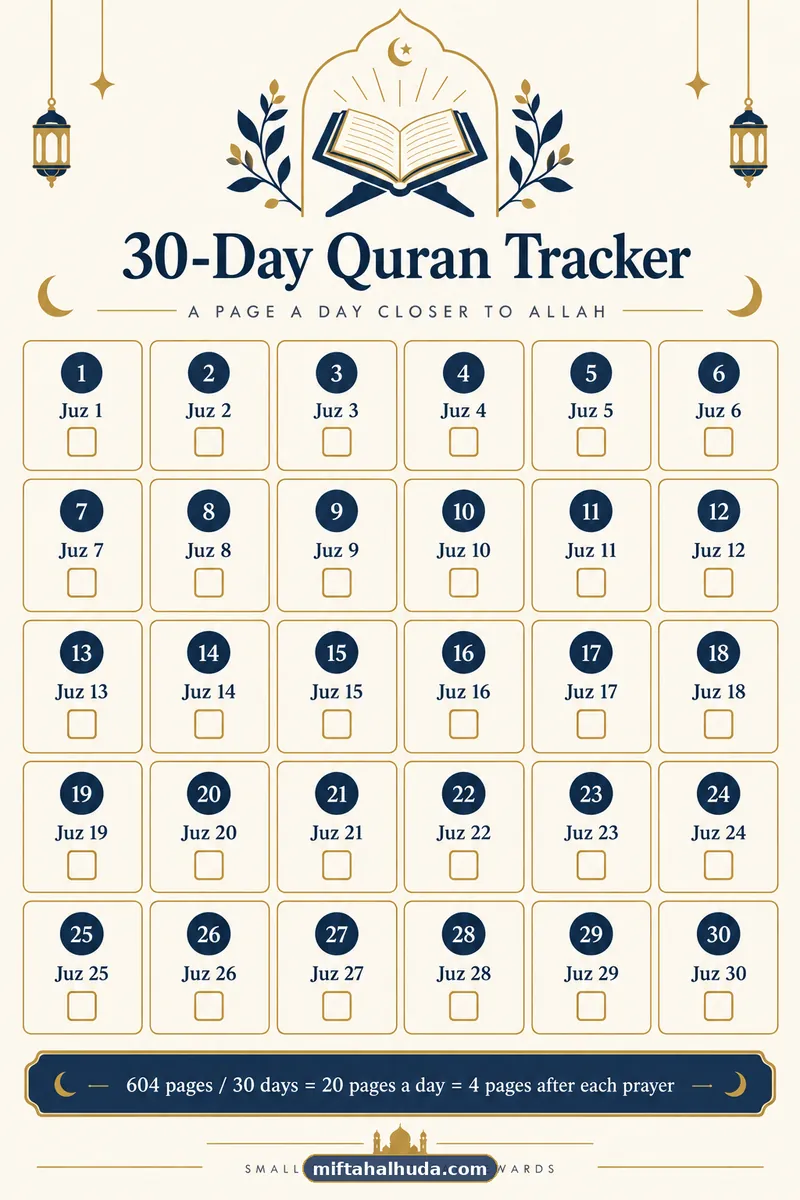
Print a 30-box tracker and put it where you pray; crossing out a box is a small daily victory that keeps the chain alive. A mushaf app with bookmarks helps travelers, but keep the physical mushaf as the main copy if you can; the relationship with the page is part of the worship. Whatever the tool, the rule above them all: today’s juz today.

The 30-Day Schedule, Juz by Juz
Here is the full map. The traditional opening words mark each juz, so you can follow along in any standard mushaf:
Day 1: Alif Lam Meem (Al-Fatihah to Al-Baqarah 141). Day 2: Sayaqool (Al-Baqarah 142-252). Day 3: Tilkar-Rusul (Al-Baqarah 253 to Aal-Imran 92). Day 4: Lan Tanaalu (Aal-Imran 93-200). Day 5: Wal-Muhsanat (An-Nisa 1-23). Day 6: La Yuhibbullah (An-Nisa 24-147). Day 7: Wa Idha Sami’u (An-Nisa 148 to Al-Ma’idah 81). Day 8: Wa Law Annana (Al-Ma’idah 82 to Al-An’am 110). Day 9: Qalal-Mala’u (Al-An’am 111 to Al-A’raf 87). Day 10: Wa A’lamu (Al-A’raf 88 to Al-Anfal 40). Day 11: Ya’tadhiroon (Al-Anfal 41 to At-Tawbah 92). Day 12: Wa Ma Min Dabbah (At-Tawbah 93 to Hud 5). Day 13: Wa Ma Ubarri’u (Hud 6 to Yusuf 52). Day 14: Rubama (Yusuf 53 to Ibrahim 52). Day 15: Subhanalladhi (Al-Hijr to An-Nahl 128). Day 16: Qal Alam (Al-Isra to Al-Kahf 74). Day 17: Iqtarabat (Al-Kahf 75 to Ta-Ha). Day 18: Qad Aflaha (Al-Anbiya to Al-Hajj). Day 19: Wa Qalalladhina (Al-Mu’minun to Al-Furqan 20). Day 20: Amman Khalaq (Al-Furqan 21 to An-Naml 55). Day 21: Utlu Ma Uhiya (An-Naml 56 to Al-Ankabut 45). Day 22: Wa Man Yaqnut (Al-Ankabut 46 to Al-Ahzab 30). Day 23: Wa Mali (Al-Ahzab 31 to Ya-Sin 27). Day 24: Fa-Man Azlamu (Ya-Sin 28 to Az-Zumar 31). Day 25: Ilayhi Yuraddu (Az-Zumar 32 to Fussilat 46). Day 26: Haa Meem (Fussilat 47 to Al-Jathiyah 37). Day 27: Qala Fa-Ma Khatbukum (Al-Ahqaf to Adh-Dhariyat 30). Day 28: Qad Sami’a (Adh-Dhariyat 31 to Al-Hadid). Day 29: Tabarakalladhi (Al-Mujadilah to At-Tahrim). Day 30: ‘Amma (Al-Mulk to An-Nas).
Save this list or print it with the tracker. Crossing off “Rubama” on day 14 is one of Ramadan’s quiet joys.
Taraweeh Reading vs Personal Reading
A common question: if the imam completes the Quran in taraweeh, does my personal khatmah still matter? Yes, and the two serve different purposes. Taraweeh is listening with the congregation, a communal khatmah of the ears and the heart. Your daily pages are your own tongue meeting the Book, which is where pronunciation, fluency and personal reflection grow. The Prophet (ﷺ) both prayed the nights and recited with Jibril by day; the month holds both.
If time forces a choice on some nights, prioritize in this order: never abandon the five prayers, keep the personal reading alive even at half pace, and let taraweeh at the masjid flex with your energy. The schedule above has the slack to absorb it.
Women and the Reading Schedule
Ramadan rarely gives anyone thirty uninterrupted days, and women may lose several to the monthly cycle. The schedule survives this with a little planning. Many scholars permit reading the Quran during this time from a phone or tablet without touching a physical mushaf, and all agree listening, reading translation, and dhikr remain open. The practical approach: read ahead during the first weeks to build a buffer of two or three ajza’, let the pause days consume the buffer, and resume at the schedule’s point rather than at a deficit.
The khatmah of a woman who planned her buffer is exactly the khatmah of anyone else, and Allah does not waste the intention of the one He excused.
The Sunnahs of Completing the Quran
Finishing carries its own etiquette, and it is a shame to reach the last page and not know them:
- The dua of completion. The early generations described the completion of the Quran as a moment when mercy descends, and they would gather their families to make dua at it. Anas ibn Malik (may Allah be pleased with him) would gather his household at his khatmah and supplicate. Plan yours: who will be there, and what will you ask?
- Begin again. The salaf compared the Quran to a beloved friend you do not part with: “Their work after a khatmah is a new beginning.” The best response to finishing on day 29 is Surah Al-Fatihah on the morning of Eid’s eve, not a closed mushaf until Rajab.
- Carry one thing forward. Choose a single verse or habit from this khatmah to keep after Ramadan: a daily page, a memorized passage, a verse for your sujood. The khatmah that changes nothing was a reading; the one that leaves a permanent trace was an encounter.
Setting Up Your Reading Life Before the Month
A smooth khatmah is built in small physical details that nobody thinks about until they go wrong:
- Choose one mushaf and stay with it. Switching copies mid-month costs you the visual memory of where you are. The standard Madani mushaf’s 604-page layout is what the schedules above assume.
- Mark the ajza’ boundaries with tabs and keep a pencil inside the mushaf for notes. Searching for your place is the most avoidable time leak of the month.
- Fix your reading corner: the same chair, the same light, the mushaf waiting open. A prepared place invites; a scattered one resists.
- Decide your recitation support. If your reading stumbles on rules of tajweed, Ramadan with a teacher fixes it permanently; the tajweed for adults program is built for exactly this, and children learn even faster in the kids’ recitation track.
- Tell one person your plan. A spouse, a friend, a parent. A khatmah spoken aloud has a witness, and witnesses keep promises alive on day seventeen.
A Brief Word on the Juz Division
The thirty ajza’ are not revelation; they are a gift of Muslim scholarship, a practical division of the Book into equal daily portions traced back to the early centuries. That is worth knowing for two reasons. It removes any anxiety about the “right” way to split your reading, since the division exists to serve you, and it explains the tradition you are joining: for over a thousand years, Muslims in every land have spent Ramadan walking the same thirty stations you are about to walk. When you open juz one on the first night, you are taking your place in that caravan.
The Night You Finish
Plan for it now: the night the thirtieth box is crossed, gather whoever shared the journey, make the dua of completion, and thank Allah aloud for letting you live to finish His Book in His month. Then sleep, and wake for Fajr on a new khatmah’s first page. The Quran’s people are not the ones who finished it once; they are the ones who never left it.
Live 1-to-1 classesLearn it properly, with a real teacherCertified teachers · Flexible times · Free trial classStart Learning Quran →Frequently Asked Questions About the Ramadan Quran Schedule
1. How many pages of the Quran should I read daily in Ramadan?
Twenty pages (one juz) a day completes the Quran in 30 days, which works out to about four pages after each of the five daily prayers. Slower readers can follow the ten-page tadabbur plan with translation and finish in about sixty days instead.
2. What if Ramadan has only 29 days?
Read the spare pages early: add a few pages in the easy first week, or read the final juz on the morning before Eid. The 30-day schedule absorbs a 29-day month with almost no adjustment.
3. Is it better to finish the Quran quickly or read slowly with understanding?
Both are worship, and the best plan combines them: a steady Arabic recitation for the khatmah, plus five daily minutes with a translation or tafsir of what you read. If you must choose, the scholars favor the reading that actually reaches your heart.
4. What should I do if I miss a day in the schedule?
Apply the catch-up rules: repay the debt within 48 hours by splitting it across prayer slots, use Friday’s free hours, and never let the debt pass three days. Adjust the plan downward if week one proves too fast rather than abandoning it.
5. When is the best time of day for Quran reading in Ramadan?
After Fajr is the prime slot: quiet house, fresh mind, and the blessing Allah attached to the Quran of dawn. Attach the remaining blocks to the other prayers so the schedule rides fixed events instead of free time.
6. Should I memorize new surahs or complete a khatmah in Ramadan?
Unless you are already an active hifz student, give Ramadan to completion and review rather than new memorization. Those on a memorization path should spend the month reviewing what they have in night prayer, as the early huffaz did.
7. Can I count listening to Quran toward my khatmah?
Listening is worship and reward, but a khatmah by recitation is a different achievement. Use listening for commutes and cooking, and keep the daily pages for your own tongue; the combination fills the month beautifully.
8. How do I prepare for the schedule before Ramadan begins?
Build the pace gradually: ten pages a day in Rajab, fifteen in early Sha’ban, a full juz by the last week of Sha’ban. Mark the juz boundaries in your mushaf, print the tracker, and test your real reading speed once so you choose the right plan.
Learn to read the Quran correctly
Start or improve your Quran reading with a certified teacher, one-to-one online.
One Response