

The last ten nights of Ramadan are not the end of the month; they are its point. Everything before them is the climb; they are the summit. Hidden inside them is the single greatest night of the year, a night Allah declared better than a thousand months, and the Prophet (ﷺ) treated these nights differently from everything that came before: he tightened his belt, stayed awake through them, and woke his family (Al-Bukhari and Muslim).
Yet every year the same tragedy repeats: Muslims arrive at the 20th of Ramadan depleted from three weeks of bad pacing, and the ten nights that were meant to be the harvest become the collapse. This guide exists to prevent that. It lays out what these nights are, the Prophet’s (ﷺ) own program for them, a sustainable night-by-night worship plan, the rules and spirit of i’tikaf, and how to seek Laylat al-Qadr without burning out. For Ramadan 1448, the last ten nights are expected to begin around the evening of February 26, 2027.
What Makes the Last Ten Nights Different
Three things converge in these nights and nowhere else in the year.
First, Laylat al-Qadr hides among them. “And what can make you know what the Night of Decree is? The Night of Decree is better than a thousand months.” (Surah Al-Qadr 97:2-3) The Prophet (ﷺ) said: “Seek it in the last ten nights” (Al-Bukhari and Muslim), and the strongest emphasis falls on the odd nights: the 21st, 23rd, 25th, 27th and 29th.
Learn to read the Quran correctly — Start Learning Quran →Second, the Prophet (ﷺ) changed his own state for them. Aisha (may Allah be pleased with her) described his last ten nights as a different regime entirely: no sleep as before, family woken, maximum effort. If the best worshipper who ever lived shifted gears for these nights, they deserve our rearranged schedules too.
Third, they are the last call. Ramadan’s forgiveness, its answered duas, its open doors are about to close for a year. The last ten nights carry the urgency of a departing guest: whatever you meant to ask this month, ask it now.
The Prophet’s (ﷺ) Program for the Ten Nights
The authentic descriptions give us his schedule in outline, and it is worth copying deliberately:
- He stayed awake the nights. Not in one heroic marathon but in sustained nightly worship: prayer, recitation, supplication.
- He woke his family. These nights are a household affair. Aisha (may Allah be pleased with her) and his wives prayed behind him and beside him; later, his wives continued his i’tikaf after he passed.
- He withdrew from commerce and social life. “Tightened his belt,” the Arabic idiom for full seriousness: no shopping, no visiting, no distraction.
- He performed i’tikaf, residing in the masjid for the full ten days, every year of his Madinan life, and twenty days in his final year (Al-Bukhari).
- He sought the night on the odd nights especially, teaching us the dua of the night through Aisha (may Allah be pleased with her): “Allahumma innaka ‘afuwwun tuhibbul-‘afwa fa’fu ‘anni.”
A Sustainable Night-by-Night Plan
The most common failure of the last ten nights is pacing: two huge nights followed by collapse. Build instead a steady structure you can repeat ten times:
The day (for those fasting): protect it lightly. Work, then a short nap after Dhuhr or before Maghrib. The companions understood the qaylulah as the fuel of night worship, and even thirty minutes transforms the night. Keep the day’s Quran reading short; the nights own this part of the month.
Maghrib to Isha: break the fast calmly with the sunnahs of iftar, pray Maghrib, and resist the gravitational pull of the sofa. This is the danger hour. Use it for light things: dinner with family, a short rest, wudu.
Isha and taraweeh: pray with the imam until he finishes. The Prophet (ﷺ) said: “Whoever stands with the imam until he leaves, it is recorded for him as a whole night.” (At-Tirmidhi, sahih) For most working people, this single hadith is the realistic core of the ten nights: guard taraweeh completely, and every night counts as a night of qiyam.
The home session: after taraweeh or before suhoor, add one focused block: two rak’ahs of tahajjud, a portion of Quran, and unhurried dua from your written list, with the taught dua of the night repeated through it. Thirty to sixty minutes, every night, odd nights longer.
Suhoor: end the night as Allah described His righteous servants, “and in the hours before dawn they would seek forgiveness” (Surah Adh-Dhariyat 51:18).
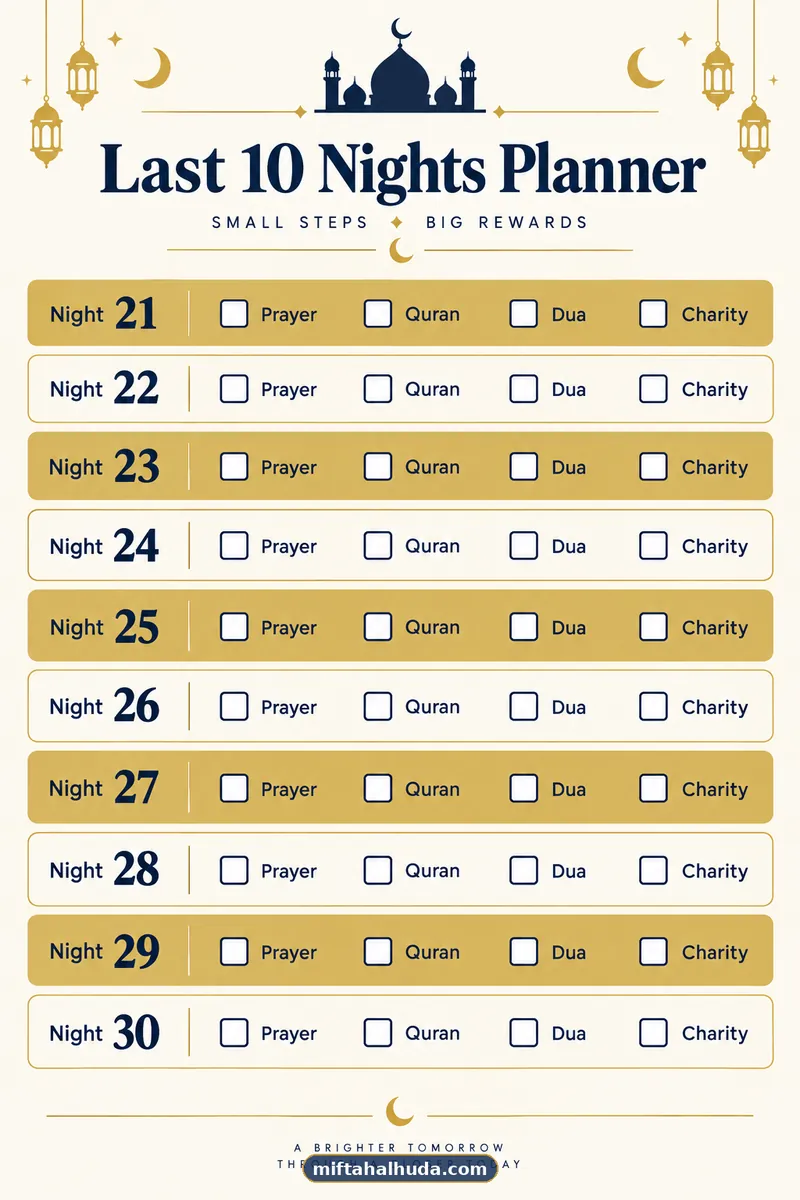
On the odd nights, extend the home session and add one more element: special dua by name for the things that matter most, and an act of charity, so that no possible Laylat al-Qadr passes without your sadaqah in it.
I’tikaf: The Prophet’s (ﷺ) Own Method
I’tikaf is staying in the masjid for a period with the intention of devotion, and the last ten days of Ramadan are its legislated season. The Prophet (ﷺ) never left it in Madinah, and Aisha (may Allah be pleased with her) said: “The Prophet (ﷺ) used to perform i’tikaf in the last ten days of Ramadan until Allah took him, then his wives performed i’tikaf after him.” (Al-Bukhari and Muslim)
Its wisdom is obvious to anyone who has tried to worship seriously at home: the world does not leave you alone. I’tikaf is the Sunnah’s answer: step out of the world entirely. No errands, no scrolling, no small talk; only prayer, Quran, dua and rest inside Allah’s house. People emerge from ten days of i’tikaf describing it as the closest they have ever felt to Allah.
Practical rulings in brief: the minimum is any moment in the masjid with intention, but the full sunnah is the ten days. The mu’takif leaves only for necessities: the bathroom, essential food if not provided, and unavoidable obligations. Women may perform i’tikaf in the masjid with proper arrangements, as the Prophet’s (ﷺ) wives did, and scholars recommend a separate, secure space.
If full i’tikaf is impossible this year, imitate its spirit: fixed nightly hours in one room with the phone in another, as our Laylat al-Qadr guide suggests. And if you intend masjid i’tikaf, arrange it now: ask your masjid, agree with your family, and pack light.
Seeking Laylat al-Qadr Without Missing It
The strategy is built into the hiding: since nobody knows the night, the only guaranteed method is to seek it in all ten, with special intensity on the odd ones. A few practical notes:
- The 27th has the strongest scholarly support as the most likely single night, based on reports from Ubayy ibn Ka’b and Ibn Abbas (may Allah be pleased with them), but the Prophet (ﷺ) was shown the night and then made to forget it, so certainty belongs to no date.
- Worship on the even nights too. Ibn Umar (may Allah be pleased with him) reported companions seeing it on different nights, including even ones. Whoever worships all ten is mathematically certain to have caught it.
- The taught dua is the core: “O Allah, You are Pardoning and You love pardon, so pardon me.” Repeat it constantly, then pour out your own needs, as the guide to the Laylat al-Qadr dua details.
- Do not spend the night hunting signs. The famous signs, a calm mild night and a rayless white sunrise, are known after the fact. Worship is the seeking, not sky-watching.
What to Fill the Nights With
Beyond the structure, the content matters. The best filling of the last ten nights, in the Prophet’s (ﷺ) pattern:
- Qiyam (night prayer), even two rak’ahs beyond taraweeh, prayed slowly.
- Quran, with reflection rather than speed; if you are mid-khatmah, these nights are for savoring, not racing, as the Ramadan Quran schedule notes.
- Dua from your written list, the one prepared weeks ago in the preparation phase, now finally spent at full strength. The Ramadan duas collection covers the authentic supplications for every moment.
- Istighfar in the pre-dawn hour, the mark of Allah’s righteous servants.
- Charity every night, even small, so the night of decree never catches you with a closed hand.
- Salawat on the Prophet (ﷺ), the worship with no time or place restriction and no chance of rejection.
Common Mistakes in the Last Ten Nights
- Arriving exhausted. If the first twenty days ran you into the ground, the plan failed upstream; next year, pace Ramadan from day one.
- The two-night sprint. Huge effort on the 21st, collapse by the 23rd, and the 27th spent asleep. Steady beats heroic.
- Spending the nights on Eid shopping. The markets of the last ten nights are full of people trading a thousand months for new shoes. Shop in Sha’ban or after Eid, never now.
- Only the 27th. Single-night worshippers gamble the whole year on one date the Prophet (ﷺ) himself was not allowed to keep.
- Worship without forgiveness. The night’s taught dua is about pardon; enter the nights having forgiven people, or your own heart blocks the road.
- Forgetting the family. He (ﷺ) woke his family. Wake yours, gently, at whatever level each can sustain.
After the Ten Nights
When the crescent of Shawwal is sighted, do not measure your Ramadan by feelings. Measure it by residue: the prayer habit that outlives the month, the verse that will not leave your sujood, the grudge that died in the last ten nights. Then close the season the way the Sunnah closes it, with zakat al-fitr before the Eid prayer and the takbeer of Eid morning. The zakat al-fitr guide and Eid al-Fitr guide carry you through both.
The 27th Night and the Odd Nights: A Balanced View
Many Muslims single out the 27th night as Laylat al-Qadr, and there is real evidence behind the instinct. Ubayy ibn Ka’b (may Allah be pleased with him) used to swear that it is the 27th night (Muslim), and Ibn Abbas (may Allah be pleased with him) reported the Prophet (ﷺ) describing its morning: the sun rises white, without harsh rays (Muslim). A number of scholars, including Ibn Taymiyyah, held that in a given year the night is most likely the 27th.
But the Prophet (ﷺ) himself did not fix it. He said: “Seek it in the odd nights of the last ten” (Al-Bukhari and Muslim), and he was once about to announce the exact night when two men quarreling distracted him and the knowledge was lifted, which he described as better for us. The wisdom is plain: certainty about one night would empty the other nine. The believer who treats only the 27th as sacred gambles nine opportunities on one opinion; the believer who seeks every odd night, or every night of the ten, cannot miss.
The practical rule is simple: give the 27th its due as the most likely candidate, and give every other night enough worship that you would have no regrets whichever night it turns out to be.
Charity and Dua: The Other Two Pillars of These Nights
Prayer and Quran dominate the plans people make for the last ten nights, but the Prophet’s (ﷺ) example elevates two more deeds to the same tier.
Charity. Ibn Abbas (may Allah be pleased with him) described the Prophet (ﷺ) as the most generous of people, and most generous of all in Ramadan (Al-Bukhari and Muslim). Giving in the last ten nights carries the combined weight of the month’s generosity and the night’s multiplication: a small amount given on Laylat al-Qadr is, by Allah’s promise, better than the same amount spread over a thousand months. Practical method: set a nightly automatic donation for all ten nights, however modest, so that one of your gifts is guaranteed to land on the Night of Decree. Feeding a fasting person’s iftar adds the reward of their fast to yours without reducing theirs (At-Tirmidhi).
Dua. These are the nights of answered supplication. Prepare a written dua list before the 20th: for yourself, your parents, your children, the sick, the oppressed, and the ummah. Ask in sujood, between adhan and iqamah, and in the last third of the night, and open with the taught words of the Laylat al-Qadr dua before your personal requests. Keep the wording of your Ramadan duas collection close; repetition with presence beats improvisation with distraction.

Sharing the Last Ten Nights as a Family
The Prophet (ﷺ) woke his wives for these nights; the household was part of his plan, not an obstacle to it. Families can borrow that spirit in realistic ways: pray two rak’ahs together after taraweeh before everyone scatters to bed, read the dua of Laylat al-Qadr aloud at suhoor so the children memorize it by hearing, and give each child a small charity amount to donate nightly so giving becomes their habit. Older children who stayed engaged through Ramadan activities for kids will treat the last ten nights as the finale they have been waiting for, and a child who catches even part of one odd night awake with the family will remember it for decades.
When the Masjid Is Not Possible: I’tikaf’s Spirit at Home
Most readers of this guide will not spend ten days in a masjid. Work, childcare, distance, and health make classical i’tikaf impossible for many, and Allah does not burden a soul beyond its capacity. The spirit of i’tikaf, however, is portable: it is withdrawal from distraction into worship, and that can be built anywhere.
Set aside a corner of your home as your musalla for the ten nights. Treat it the way a mu’takif treats the masjid: no phone inside it, no conversation that does not serve worship, and a fixed nightly appointment you do not cancel. Tell your household the hours you are “in i’tikaf” so interruptions stop. Between sessions, carry the same restraint into ordinary life: less scrolling, fewer outings, shorter small talk. Many scholars note that a person who protects ten nights of focused worship at home may take more than one who sits in the masjid with a wandering heart. The address is not the point; the attention is.
Frequently Asked Questions About the Last 10 Nights of Ramadan
1. When do the last ten nights of Ramadan 2027 begin?
For Ramadan 1448, the last ten nights are expected to begin at Maghrib on around February 26, 2027, with the odd nights falling on the 21st, 23rd, 25th, 27th and 29th of the month. Exact dates follow the moon sighting in your country.
2. Which night is Laylat al-Qadr?
It is hidden within the last ten nights, with the odd nights most emphasized and the 27th carrying the strongest scholarly support. The only guaranteed way to catch it is to worship all ten nights, which is exactly why Allah concealed it.
3. Is i’tikaf obligatory in the last ten days?
No, i’tikaf is a confirmed sunnah, not an obligation. The Prophet (ﷺ) never left it in Madinah, so it is strongly emphasized for whoever can manage it, and its spirit can be imitated at home by fixed, undistracted nightly worship for those who cannot.
4. What is the best dua for the last ten nights?
The dua the Prophet (ﷺ) taught Aisha (may Allah be pleased with her) for Laylat al-Qadr: “Allahumma innaka ‘afuwwun tuhibbul-‘afwa fa’fu ‘anni – O Allah, You are Pardoning and You love pardon, so pardon me.” Repeat it through the nights alongside your own personal supplications.
5. Do I have to stay awake all night to catch Laylat al-Qadr?
No. Praying Isha and Fajr in congregation carries the reward of half and full nights in the sound reports, and whoever stands with the imam until he finishes taraweeh is recorded as standing the whole night. Consistent, sustainable worship across all ten beats one sleepless marathon.
6. Can women perform i’tikaf?
Yes. The Prophet’s (ﷺ) wives performed i’tikaf during his life and after his death, and scholars permit it for women in the masjid with a suitable, secure space and their guardian’s permission. Where that is not available, devoted worship at home keeps the spirit of the practice.
7. What if I am working during the last ten nights?
Guard the core: taraweeh with the imam until he finishes, a focused home session even of thirty minutes, the taught dua through your commute and breaks, charity each night, and istighfar before dawn. Allah rewards the seeking according to capacity, and many workers have caught the night on three hours of sleep and a sincere heart.
8. Should I finish my Quran khatmah during the last ten nights?
Ideally, plan to complete the khatmah by the 27th so the final odd nights stay free for prayer and dua. If you are still finishing, recitation is itself among the best worship of these nights, so continue with reflection and let the completion dua coincide with the season of acceptance.
9. Is the 27th night of Ramadan definitely Laylat al-Qadr?
No. The 27th is the strongest single candidate on the testimony of Ubayy ibn Ka’b (may Allah be pleased with him) and the description of its sunrise, but the Prophet (ﷺ) left the exact night hidden and told us to seek it in the odd nights of the last ten. Treat the 27th as the most likely night, not the only one, and worship through all ten.
10. What duas should I make in the last ten nights?
Start with the taught dua of Laylat al-Qadr: “Allahumma innaka ‘afuwwun tuhibbul-‘afwa fa’fu ‘anni” (O Allah, You are Pardoning and love pardon, so pardon me), reported by At-Tirmidhi. Then make your personal dua list: ask for forgiveness, guidance, healing, and provision for yourself and your family, and widen the circle to parents, the sick, and the ummah. The best moments are sujood, the last third of the night, and the time before iftar.
Learn to read the Quran correctly
Start or improve your Quran reading with a certified teacher, one-to-one online.