

Every evening of Ramadan, after Isha, something happens in masjids from Jakarta to Johannesburg that has no parallel the rest of the year: rows of believers standing for an hour or more in a prayer that exists only in this month. Taraweeh is Ramadan’s nightly gathering, its shared heartbeat, and for millions of Muslims the most beloved ritual of the year. Yet many who pray it every year are unsure of its ruling, its count, and its correct form.
This guide gathers what a worshipper actually needs: what taraweeh is, the authentic evidence for its virtue, the scholarly positions on eleven versus twenty rak’ahs, a step-by-step description of the prayer, how to pray it at home when the masjid is out of reach, and how it fits into the last ten nights. For Ramadan 1448, taraweeh begins on the evening of February 8, 2027, the night that follows the first day of fasting.
What Is Taraweeh?
Taraweeh is the voluntary night prayer of Ramadan, prayed after Isha and before Witr. The word comes from the Arabic “rawha,” a rest or pause, because the early worshippers rested briefly after every four rak’ahs. Its other name is qiyam Ramadan, the standing of Ramadan, and the Prophet (ﷺ) called standing this month one of the greatest doors to forgiveness.
Two things distinguish taraweeh from ordinary night prayer. First, its season: it belongs to Ramadan alone, and it disappears with the crescent of Shawwal. Second, its congregation: while tahajjud is usually private, taraweeh was established as a communal prayer, prayed behind an imam who recites the Quran aloud, in most communities completing the entire Book across the month.
Learn to read the Quran correctly — Start Learning Quran →Around the world the prayer carries local color. In Cairo the streets outside the masjid fill with rows; in Indonesia it anchors the pesantren night; in Turkey the minarets glow with mahya lights between them; in the Gulf the qunoot of the final nights draws worshippers in the tens of thousands. Wherever you pray it, the form is one and the promise is one.
The Virtue of Taraweeh
The Prophet (ﷺ) said: “Whoever stands in prayer during Ramadan out of faith and seeking reward, his previous sins are forgiven” (Al-Bukhari and Muslim). Scholars explain that this standing includes taraweeh, and its condition is worth pausing on: faith and seeking reward. Not habit, not social pressure, not the fear of missing out, but a heart that believes the promise and wants the payment.
A second hadith raises the ceiling further: “Whoever stands with the imam until he finishes, it is recorded for him as if he prayed the entire night” (At-Tirmidhi, who graded it sound). This single sentence reframes the whole prayer. The tired worker, the mother who slips in late, the elderly man leaning on a chair: if they remain with the imam to the end, the ledger writes a full night of worship. No other act in the religion offers this exchange rate.
And a third dimension: taraweeh is the month-long companionship of the Quran. A worshipper who attends from the first night to the khatmah has heard the entire revelation recited in prayer, a privilege previous generations traveled to find.
How Many Rak’ahs: Eleven or Twenty?
This is the question that divides masjids, and the honest answer calms both sides.
The eleven-rak’ah position. Aisha (may Allah be pleased with her) was asked how the Prophet (ﷺ) prayed in Ramadan, and she answered: “He would not exceed eleven rak’ahs, in Ramadan or outside it” (Al-Bukhari and Muslim). The practice of Madinah in the Prophet’s (ﷺ) era and immediately after followed this count, with long recitation filling the night.
The twenty-rak’ah position. When Umar ibn al-Khattab (may Allah be pleased with him) gathered the people behind one imam, the practice that settled in Madinah was twenty rak’ahs with shorter recitation. The four major schools of fiqh all endorse twenty as the established count, and it has been the practice of the Haram in Makkah and the Prophet’s (ﷺ) masjid for most of Islamic history.
What this means for you. Both counts trace to the earliest generation, and scholars across the spectrum, including Ibn Taymiyyah, have said the matter is flexible. Pray what your masjid prays, do not split your community over a sunnah, and remember that the reward is tied to standing with the imam until he finishes, whatever his count. For the rulings of prayer in other seasons, see our guide to sunnah prayers throughout the year.
How to Pray Taraweeh Step by Step
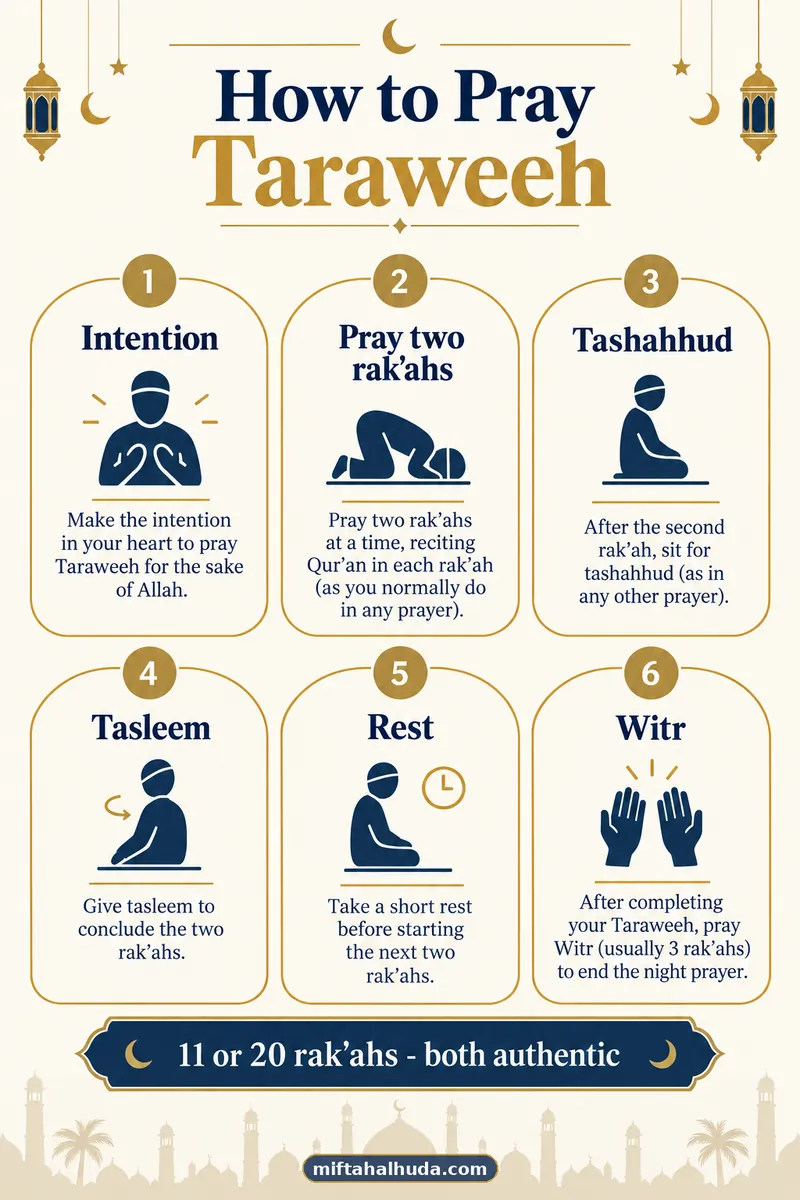
Taraweeh follows the same form as any two-rak’ah prayer. Here is the sequence:
- Pray Isha with its sunnah. Taraweeh begins after Isha and its confirmed sunnah, not before.
- Make the intention. A quiet resolve in the heart to pray the night prayer of Ramadan; no spoken formula is required.
- Pray in units of two. Each pair of rak’ahs has its own tashahhud and tasleem. Recitation is aloud when praying behind an imam, or your choice at home.
- Pace yourself. There is no obligation to match anyone’s speed or length. Recite what you know with presence.
- Rest between sets. The pauses are part of the tradition; drink water, stretch, renew intention.
- Close with Witr. Witr seals the night. If you pray behind an imam, follow his witr; if you plan more prayer later, you may delay your witr and let the imam’s count as your earlier one.
Taraweeh at Home vs. the Masjid
The congregational taraweeh in the masjid is a stressed sunnah for men who can attend, carrying the twenty-seven-fold multiplication of congregational prayer and the full-night reward of staying with the imam. Nothing at home replaces that.
But home taraweeh is real worship, not a consolation prize. The Prophet (ﷺ) himself prayed in his house to keep the practice from becoming obligatory on his ummah (Al-Bukhari and Muslim). Home taraweeh suits the mother managing small children, the sick, the worker on a night shift, and anyone whose masjid is far. Pray two rak’ahs at a time with whatever Quran you have memorized, read from a mushaf if you need to, and involve the family: children who pray alongside their parents absorb Ramadan’s rhythms for life. Our guide to Ramadan with kids has more on weaving worship into family evenings.
A practical middle path many families keep: masjid taraweeh on weekends and the odd nights, home taraweeh on school and work nights. Consistency beats intensity.
The History of Congregational Taraweeh
The Prophet (ﷺ) prayed taraweeh in congregation for three nights, and the masjid filled. On the fourth night he did not come out, and in the morning he explained: “I feared it would be made obligatory upon you” (Al-Bukhari and Muslim). He protected his ummah from a burden by withholding a blessing, and he left the door of reward wide open.
Through the caliphate of Abu Bakr (may Allah be pleased with him), people prayed in scattered groups. Then Umar ibn al-Khattab (may Allah be pleased with him) entered the masjid one Ramadan night, saw the people praying separately behind different reciters, and gathered them behind Ubayy ibn Ka’b (may Allah be pleased with him) as one imam. Seeing the unity, he said: “What an excellent innovation this is,” meaning innovation in its linguistic sense, a revived arrangement of a practice the Prophet (ﷺ) himself had led. Ali ibn Abi Talib (may Allah be pleased with him) later prayed that Allah illuminate Umar’s grave as he illuminated the masjids with Ramadan’s nights. From that night to ours, the congregation has never stopped.
What to Recite in Taraweeh
Behind an imam, the recitation is his; your work is listening with presence, which the Quran itself commands: “When the Quran is recited, listen to it and be silent, that you may receive mercy” (Surah Al-A’raf 7:204). If the imam’s pace is fast, follow the meanings you know and let the rest wash over the heart; the reward of the congregation does not depend on catching every word.
Praying at home, recite what you have memorized, in any order. There is no requirement to follow the mushaf’s sequence, and short surahs repeated with presence outrank long passages rushed without it. If you hold a mushaf or a phone, read at a measured pace, and treat the standing as your personal audience with the words of your Lord. Many worshippers use home taraweeh to cement new memorization: reciting in prayer what you learned that week is the strongest review method the tradition knows. If building that habit interests you, our Quran memorization programs apply the same loop for children, and online qirat courses refine recitation for adults.
Taraweeh for the Working Muslim
The worshipper who works full days faces taraweeh’s hardest math: sleep before dawn for suhoor, work all day, then stand for ninety minutes at night. A few adjustments make it livable:
- Guard a twenty-minute nap after work or after iftar. It is the single highest-yield recovery tool of the month.
- Choose the masjid’s schedule that fits you. Some masjids pray a lighter eleven, others a long twenty; both are authentic, so pick the one your body can sustain for thirty nights.
- Use your commute. Listening to the surahs the imam will recite tonight primes your attention and shortens the distance between ear and heart.
- Accept the imperfect nights. Some nights you will stand distracted and heavy. Showing up tired still counts; the hadith promises the full night to whoever stays with the imam to the end, not to whoever felt most serene.
Common Questions About the Details
Holding the mushaf while praying. Most scholars permit reading from the mushaf in voluntary prayer for one who has not memorized, as Aisha’s (may Allah be pleased with her) servant would lead her while reading. Keep movements minimal, and prefer a phone app set to airplane mode if paper is cumbersome.
Sitting through long rak’ahs. Voluntary prayer may be prayed sitting for one who needs it, though standing carries the full reward. Elderly worshippers and those with back or knee conditions should pray as their bodies allow; the imam’s recitation continues whether you stand or sit.
Live 1-to-1 classesLearn it properly, with a real teacherCertified teachers · Flexible times · Free trial classStart Learning Quran →Falling behind or losing concentration. Nobody maintains presence through twenty rak’ahs every night. When you notice your mind has wandered, return gently at the next verse, as you would in any prayer. The month is training, not an exam.
Women’s rows and children. Women may attend the masjid; the Prophet (ﷺ) said not to prevent Allah’s female servants from His houses. Their prayer at home is equally valid and, per many scholars, preferable for its quiet. Children who can stand calmly are welcome; the Sahabah brought theirs.
Taraweeh in the Last Ten Nights
In the last ten nights, taraweeh changes character. The Prophet (ﷺ) lengthened his standing, and masjids extend the prayer, often adding qunoot supplications and, in the final nights, the emotional completion of the Quran. These are the nights of Laylat al-Qadr, and the hadith of standing with the imam applies with doubled urgency: to be recorded as praying a whole night, on a night better than a thousand months.
Prepare practically: nap after work if you can, eat a light iftar, and arrive early for a place in the row. Keep the taught Laylat al-Qadr dua on your tongue in the pauses. And plan your nights deliberately with our last ten nights of Ramadan plan, so taraweeh anchors rather than exhausts your worship schedule.

Taraweeh and the Fasting Body
A few physical details decide whether the prayer is a pleasure or a trial. Hydrate steadily between iftar and sleep rather than flooding at suhoor, and go easy on the evening tea and coffee: caffeine at Maghrib is a loan repaid at Fajr. Eat the fried and heavy foods after taraweeh, not before, and leave at least thirty minutes between the main meal and the first takbir. Comfortable clothing, a light jacket for air-conditioned masjids, and a spot near a pillar if your back needs support are not luxuries; they are the logistics of thirty consistent nights.
Building a Personal Taraweeh Habit
The gap between intending taraweeh and finishing thirty nights of it is bridged by small, boring decisions made once:
- Fix your masjid and your exit time. Ambiguity kills habits. Choose one masjid and one nightly departure time, and let your family plan around it.
- Eat for the prayer. A heavy iftar ends taraweeh before it starts. Break your fast lightly, pray Maghrib, eat the main meal after, and you will stand the night with energy.
- Pair the prayer with the Quran plan. Listening to what you will recite, or reciting what you will hear, doubles retention. Our Ramadan Quran reading schedule maps the juz-by-juz rhythm most masjids follow.
- Travel with a partner. One friend who expects you in the row is worth ten resolutions.
- Protect suhoor and sleep. Taraweeh is sustained by the pre-dawn meal and a defended bedtime. Read why in our suhoor guide.
Qunoot in the Last Ten Nights
In many masjids the second half of Ramadan brings the qunoot: the imam pauses in the final rak’ah of witr and supplicates aloud while the rows raise their hands and answer ameen. The practice traces to the early generations, and the Hanafi school holds a quiet qunoot in witr year-round. Whether your masjid raises its hands or not, the moments are precious: collective dua at the season of answered dua. Follow your imam with an present heart, ask your own needs silently within his words, and do not let unfamiliarity with the practice rob you of its sweetness.
Presence Over Performance
One final caution, and it is the one the tradition stresses most: taraweeh is worship, not endurance sport. Communities sometimes compete in speed or in length, and both miss the point. A prayer rattled through at record pace leaves the tongue tired and the heart untouched; a prayer stretched to impress leaves the elderly suffering in the back rows. The Prophet (ﷺ) described his own night prayer as beautiful and unhurried, reciting a single verse with deliberation, pausing at verses of mercy to ask and at verses of warning to seek refuge.
Aim for that: a taraweeh you can taste. Fewer rak’ahs with presence are better than many without it, a home prayer savored is better than a masjid prayer endured in resentment, and a month of steady standing is better than a heroic first week followed by collapse. Ramadan is a marathon of the heart; run it at the pace of sincerity.
Frequently Asked Questions About Taraweeh
1. Is taraweeh obligatory?
No. Taraweeh is a confirmed sunnah, one of the most emphasized voluntary acts of the year, but no sin falls on the one who leaves it. The loss is one of reward, not guilt, and it is a large loss: standing Ramadan with faith wipes out previous sins.
2. How many rak’ahs is taraweeh?
The Prophet’s (ﷺ) own practice was eleven rak’ahs including witr, while the practice established under Umar (may Allah be pleased with him) and followed by the four schools is twenty. Both are authentic; pray what your congregation prays and do not divide over a flexible matter.
3. Can I pray taraweeh at home?
Yes, in units of two rak’ahs with whatever Quran you know or read from the mushaf. You will miss the congregational multiplication and the recorded “full night” of staying with an imam, but home taraweeh is genuine worship, and for many circumstances it is the sustainable choice.
4. When does taraweeh begin and end each night?
It begins after Isha prayer and its sunnah, and it ends before Fajr. In most masjids it runs one to two hours; at home it is whatever you can sustain. Witr seals the night and is prayed last.
5. What if I join the masjid late?
Join wherever the imam is and make up nothing; taraweeh has no missed units to repay. To earn the “full night” recording, scholars say you should join before the imam’s final tasleem and remain until he finishes, adding what you missed of Isha first if you arrived during it.
6. Can women attend taraweeh at the masjid?
Yes. Women attended in the Prophet’s (ﷺ) era, and he said: “Do not prevent the female servants of Allah from the masjids of Allah.” Modest dress and a designated space apply, and her prayer at home remains fully valid.
7. Do I have to listen to the whole Quran in taraweeh?
No. Completing the Quran with the imam is a tremendous blessing but not a condition of the prayer. Attending part of the month, or praying with short surahs at home, carries the reward of what you actually stood.
8. Is there a specific dua between the rak’ahs of taraweeh?
No fixed formula is reported from the Prophet (ﷺ) for the rests between sets. Worshippers may make any dua, remember Allah, or sit quietly. The common four-rak’ah litanies of some communities are cultural additions, beloved but not binding.
9. Can I hold the Quran or my phone during taraweeh?
Most contemporary scholars permit reading from a mushaf in voluntary prayers for one who has not memorized, and a phone showing the mushaf takes the same ruling, ideally in airplane mode. Hold it still, and put it down for ruku’ and sujood.
10. What is the difference between taraweeh and tahajjud?
In Ramadan, taraweeh is the early part of the night’s standing, prayed after Isha, while tahajjud is the later standing after sleep. Outside Ramadan only tahajjud exists. In the last ten nights, the Prophet (ﷺ) merged the two into one long night of worship.
Learn to read the Quran correctly
Start or improve your Quran reading with a certified teacher, one-to-one online.