

The iftar dua is the supplication every fasting Muslim waits for all day. After hours of patience, hunger, and worship, the moment of breaking the fast arrives, and with it one of the greatest opportunities for an answered prayer in the entire year.
This guide brings you the authentic iftar duas from the Sunnah, with the Arabic text, transliteration, translation, and source for each one, plus what the scholars say about when to say them and how to make the most of this blessed moment. At Miftah Al-Huda Academy, we teach Muslims to understand every word they recite, so worship comes from the heart.
Why the Iftar Moment Is So Special
Not every moment is equal in the sight of Allah. The Prophet (ﷺ) told us that three people are never turned away when they call upon Allah: “the just ruler, the fasting person until he breaks his fast, and the supplication of the oppressed” (recorded by al-Tirmidhi).
Another narration makes the iftar moment itself explicit: “Indeed, the fasting person has, at the time of breaking his fast, a supplication that is not rejected” (recorded by Ibn Majah). Every day of Ramadan, you carry an unanswered-prayer guarantee in your hands. The wise fasting person prepares for it.
Learn your deen with a qualified teacher — Explore Fiqh Classes →The Authentic Iftar Dua From the Sunnah
Ibn ‘Umar (may Allah be pleased with them) reported that when the Messenger of Allah (ﷺ) broke his fast, he would say:
“ذَهَبَ الظَّمَأُ، وَابْتَلَّتِ الْعُرُوقُ، وَثَبَتَ الْأَجْرُ إِنْ شَاءَ اللَّهُ”
“Dhahabadh-dhama’u, wabtallatil-‘uruqu, wa thabatal-ajru in sha Allah.”
(The thirst is gone, the veins are refreshed, and the reward is confirmed, if Allah wills.) – Recorded by Abu Dawud, graded hasan.
Notice the beautiful order: the physical relief is mentioned first, then the spiritual reality. Your body is refreshed, and your reward with Allah is secured. This short sentence teaches the fasting person to connect the feeling of iftar with the meaning of fasting.
The Well-Known Iftar Dua
Across the Muslim world, the most commonly recited words at iftar are:
“اللَّهُمَّ لَكَ صُمْتُ، وَعَلَى رِزْقِكَ أَفْطَرْتُ”
“Allahumma laka sumtu, wa ‘ala rizqika aftartu.”
(O Allah, for You I have fasted, and with Your provision I break my fast.) – Recorded by Abu Dawud.
Honesty matters in religion: scholars note that this narration’s chain is not strong, but its meaning is entirely sound, and it has been beloved to Muslims for centuries. If you grew up saying it, keep saying it, and add the Prophet’s (ﷺ) own words above to your routine.
What to Ask For at Iftar
The transmitted duas are short, and that leaves the door wide open for your own words. Before the dates and the soup, take a minute for the things only you know you need. Ask Allah for forgiveness and a accepted fast. Ask for your parents, your children, your health, your studies, and your work. Ask for the Muslims suffering around the world. Ask for Paradise and protection from the Fire.
Many families keep a small written list by the iftar table so the precious minute is never lost to hunger or hurry. A dua you prepared is a dua you will actually make.
Dua When You Break Your Fast at Someone’s Home
If you are a guest at an iftar, the Sunnah gives you a generous way to repay your host’s kindness:
“أَفْطَرَ عِنْدَكُمُ الصَّائِمُونَ، وَأَكَلَ طَعَامَكُمُ الْأَبْرَارُ، وَصَلَّتْ عَلَيْكُمُ الْمَلَائِكَةُ”
“Aftara ‘indakumus-sa’imun, wa akala ta’amakumul-abrar, wa sallat ‘alaykumul-mala’ikah.”
(May the fasting break their fast with you, may the righteous eat your food, and may the angels pray for you.) – Recorded by Abu Dawud.
Common Mistakes at the Iftar Moment
A few small habits protect the most valuable minute of your day. Break your fast on time rather than delaying it; the Prophet (ﷺ) praised those who hasten iftar. Avoid letting the whole family’s iftar become so busy that nobody supplicates. And do not limit your dua to the exact second of the adhan; the fasting person’s supplication is accepted throughout the fast, with iftar as its crown.
If you are unsure about the rulings around breaking the fast, our complete guide to Ramadan fasting rules and our article on kaffarah for a broken fast explain them clearly.
The Fasting Person’s Answered Dua
The iftar dua is not a ritual formula to rush through before the food. It sits inside one of the most hopeful promises in the Sunnah. The Prophet (ﷺ) said: “There are three whose supplication is not rejected: the fasting person when he breaks his fast, the just leader, and the supplication of the oppressed.” (Narrated by At-Tirmidhi, who graded it hasan)
Think about what that means. Allah has set a moment, every single day of Ramadan, in which your dua is promised a hearing. The fasting person does not need to search for it or wonder whether tonight is special. It arrives with the sunset. The only real loss is to reach that moment and spend it pouring tea or photographing the table while it slips away.
Scholars explained that this promise covers the fasting person throughout the fast, with its completion at the breaking of the fast. That is why the righteous early Muslims treated the minutes before Maghrib as prime time for supplication, sitting with hands raised as the adhan approached. You can build the same habit: ten minutes before Maghrib, pause the kitchen work, sit facing the qiblah if you can, and begin asking.
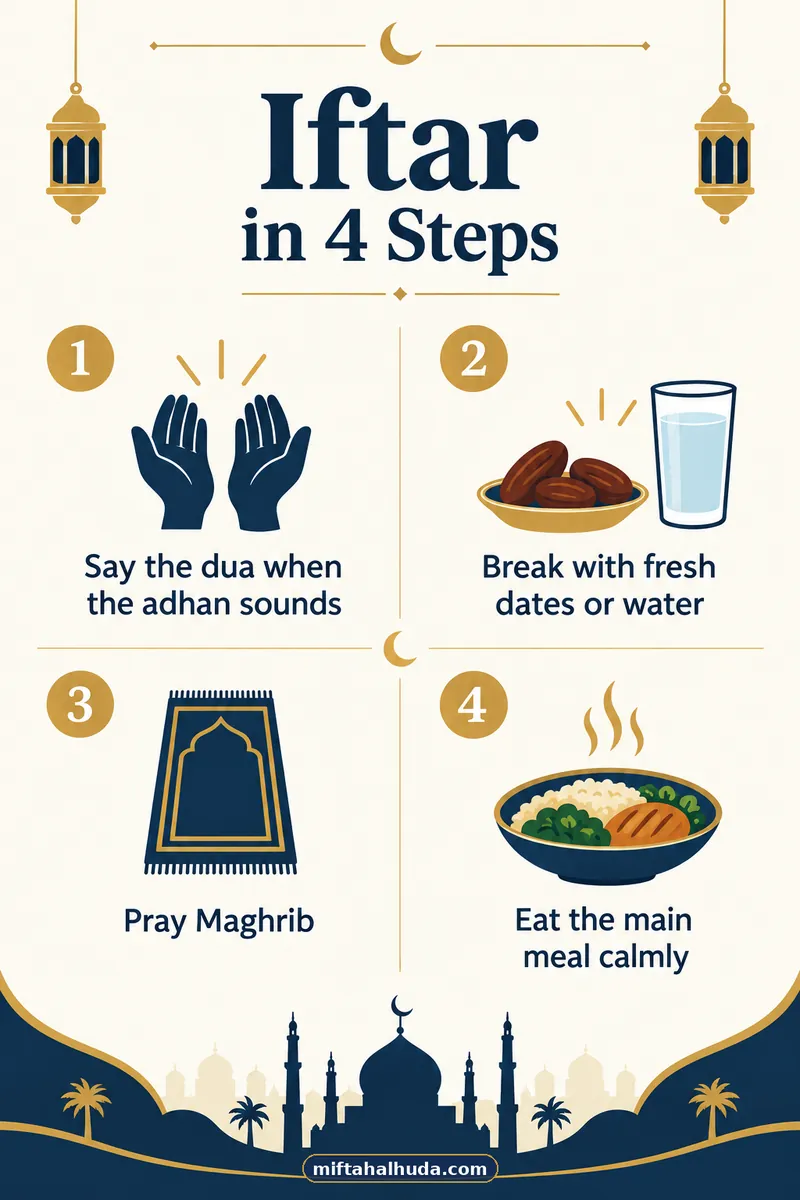
This also explains the order of things at iftar. The Prophet (ﷺ) would break his fast first, with fresh dates, or dried dates, or water, and then pray. The dua “Dhahaba al-zama’…” is reported as what he said after breaking the fast, while the wider window of answered dua fills the moments around it. So do both: ask before the adhan, break your fast calmly, say the reported words, and keep asking after.

Iftar Etiquette From the Sunnah
The Prophet (ﷺ) left us a complete picture of how a believer meets this moment. Following it turns a daily meal into worship:
- Hasten to break the fast. He said: “The people will remain upon goodness as long as they hasten to break the fast.” (Al-Bukhari and Muslim) Delaying iftar without a reason goes against the Sunnah, so do not wait for the table to be perfect.
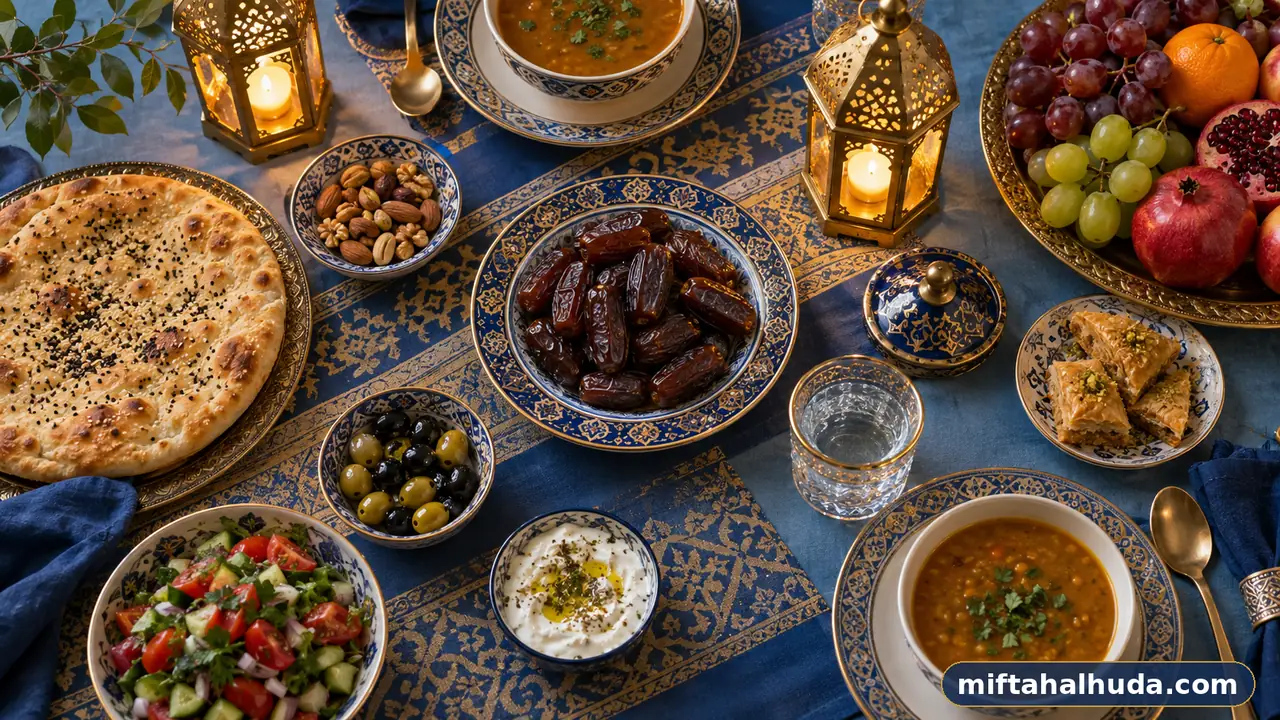
- Break with dates or water. Anas (may Allah be pleased with him) said the Prophet (ﷺ) would break his fast with fresh dates before praying; if there were none, then dried dates; if none, then sips of water. (Abu Dawud and At-Tirmidhi) Dates carry a quick, gentle energy, and following the Sunnah in something this small brings barakah into the whole meal.
- Say the reported dua, then eat without greed. Ramadan trains restraint, and the iftar table is its first exam.
- Feed a fasting person when you can. The Prophet (ﷺ) said: “Whoever feeds a fasting person will have a reward like his, without anything being decreased from the fasting person’s reward.” (At-Tirmidhi, sahih) Hosting an iftar, sending a plate to a neighbor, or sponsoring iftar meals abroad all fall under this.
- Pray Maghrib before the full meal when possible. Breaking the fast lightly, praying, then returning to eat keeps the evening’s worship at its center instead of its margins.
More Authentic Duas for the Iftar Table
After the dua of breaking the fast, the evening is wide open for personal supplication. The best words after the Quran and the Sunnah are your own sincere ones, but the Quran itself supplies beautiful supplications to carry:
رَبَّنَا تَقَبَّلْ مِنَّا ۖ إِنَّكَ أَنْتَ السَّمِيعُ الْعَلِيمُ
“Rabbana taqabbal minna innaka Antas-Sami’ul-‘Alim – Our Lord, accept this from us. Indeed, You are the Hearing, the Knowing.” (Surah Al-Baqarah 2:127)
رَبَّنَا آتِنَا فِي الدُّنْيَا حَسَنَةً وَفِي الْآخِرَةِ حَسَنَةً وَقِنَا عَذَابَ النَّارِ
“Rabbana atina fid-dunya hasanah wa fil-akhirati hasanah wa qina ‘adhaban-nar – Our Lord, give us good in this world and good in the Hereafter, and protect us from the punishment of the Fire.” (Surah Al-Baqarah 2:201)
رَبِّ اغْفِرْ لِي وَلِوَالِدَيَّ
“Rabbi ighfir li wa liwalidayya – My Lord, forgive me and my parents.” (from Surah Ibrahim 14:41)
These short Quranic duas are easy for every member of the family to learn before Ramadan, and they are part of the daily routine in our Ramadan duas collection.
What to Do in the Last Ten Minutes Before Maghrib
Many families experience the last minutes before iftar as the most chaotic of the day: food coming out, children hungry, phones ringing. A small plan rescues the most valuable minutes of your fast:
- Finish the cooking and serving fifteen minutes early, not five. The last ten minutes belong to dua, not to the stove.
- Gather everyone in one place before the adhan. A family that asks together teaches its children that dua is real.
- Keep a short written dua list nearby: your top needs, your family, the sick, the ummah. Hunger makes minds wander, and the list brings them back.
- When the adhan begins, answer it, then break your fast as the Prophet (ﷺ) did, without hurry and without delay.
Making Iftar Dua With Your Children
A child who grows up watching dua at iftar learns that Allah is close and answering. Keep it simple and joyful. Teach them one short dua per week of Ramadan, in Arabic with its meaning, and let them say it out loud at the table. Ask each child what they want to ask Allah for tonight; you will be moved by what they carry in their hearts.
For younger children, the meaning matters more than the memorization. “Say: O Allah, forgive me. O Allah, Jannah. O Allah, keep grandma healthy.” These small sentences are real dua, and they build the habit that the longer supplications will later rest on. If you want structured help, our guide on teaching Quran to kids at home covers age-by-age routines that fit dua memorization naturally into the day.
Common Iftar Mistakes That Weaken the Moment
Beyond the fiqh mistakes covered earlier, a few habits quietly steal the spiritual value of iftar:
- Spending the answered-dua window on screens. The minutes before Maghrib pass once a day; the video will still be there after.
- Overloading the table. Excessive cooking exhausts the cook (often a fasting mother) through the day and leaves no energy for taraweeh. Simple iftars are closer to the Sunnah and kinder to the family.
- Arguing at the table. Fasting protects the tongue all day; the iftar table should not be where it is released.
- Eating until prayer feels heavy. The Prophet (ﷺ) and his companions prayed Maghrib and taraweeh with lightness. Leave room for the night.
Hosting and Attending Iftar Gatherings
Iftar gatherings are one of Ramadan’s joys, and the Sunnah wraps them in manners worth keeping. As a host, remember the reward: feeding a fasting person earns you a reward like his fast. Keep the menu simple enough that the host family still reaches taraweeh with energy, and begin the gathering with the dua so the evening starts with its purpose.
As a guest, two sunnahs protect the gathering. First, the dua for your host: “Aftara ‘indakumus-sa’imun, wa akala ta’amakumul-abrar, wa sallat ‘alaykumul-mala’ikah – May the fasting break their fast with you, may the righteous eat your food, and may the angels pray for you.” (Abu Dawud, sahih) Second, if you are not fasting and food is served, do not refuse to join in a way that embarrasses your host; if you are fasting a voluntary fast and prefer to keep it, make the dua for the host and explain gently.
One caution the scholars repeat every year: do not let gatherings eat the night. If the invitation will cost you taraweeh, shorten the visit, pray with the host, or choose another day. The gathering serves the worship, never the reverse.
Pronouncing the Iftar Dua Correctly
Many Muslims know the words “Dhahaba al-zama’u wabtallatil-‘urooqu wa thabatal-ajru in shaa Allah” by sound but stumble on the letters. Take it slowly, word by word:
- Dhahaba – “has gone.” The dh is like the English “th” in “this.”
- al-zama’ – “the thirst.” It ends with a hamzah, a small catch in the throat.
- wabtallat – “and have been moistened.” The t is heavy, pronounced with the tongue raised.
- il-‘urooq – “the veins.” The ‘ayn comes from the middle of the throat; beginners can aim for a deep “a” sound and improve with practice.
- wa thabatal-ajru in shaa Allah – “and the reward is confirmed, if Allah wills.”
Do not let imperfect pronunciation stop you. Allah hears the heart before the tongue, and improving gradually is part of the path. If you want guided pronunciation with a qualified teacher, our online Qirat courses train exactly these sounds, and children pick them up fastest of all.
Iftar When You Are Traveling or Alone
Not every iftar comes with a full table. If you are traveling, the Sunnah travels with you: break your fast when the sun sets where you are, with whatever dates or water you have, and say the same dua. Airport lounges, office desks and roadside stops have all hosted this Sunnah. If you are a student or living away from family, the moment can feel lonely; remember that the promise of answered dua does not depend on company. Some of the most sincere iftar duas in history were made by one person, alone, with a piece of bread.
And if your work forces you to break your fast on shift, plan it the night before: pack two dates and a bottle of water, know your Maghrib time, and protect five quiet minutes for the dua. Small preparation keeps the moment sacred anywhere.
Live 1-to-1 classesLearn it properly, with a real teacherCertified teachers · Flexible times · Free trial classExplore Fiqh Classes →From Iftar to Taraweeh: Guarding the Evening
The hour after iftar decides the night. Families that drift from the table to the sofa to the phone often find taraweeh has slipped away; families that move from the table to wudu to the masjid catch the whole evening. Build a fixed sequence before Ramadan starts: iftar, Maghrib, a short rest or a page of Quran, then Isha and taraweeh. When the sequence is fixed, the evening runs itself.
If the masjid is far, pray taraweeh at home with the family, alternating who leads, or follow the imam’s recitation from a recorded prayer while standing in prayer yourself. And keep some space in the night for the dua you began at iftar, because the fasting person’s acceptance does not end with the meal. The day of fasting, the dua at its close, and the prayer of its night form one connected act of worship, and our Ramadan duas collection ties them together with the words for each stage.
Frequently Asked Questions About the Iftar Dua
1. Do I say the iftar dua before or after eating?
The reported practice is to break the fast first, usually with dates or water, and then say “Dhahabadh-dhama’u wabtallatil-‘uruqu wa thabatal-ajru in sha Allah.” Personal supplication fits naturally around this moment, before the meal or while eating.
2. Is “Allahumma laka sumtu” an authentic dua?
It is recorded by Abu Dawud, and scholars note its chain is not strong. Its meaning is sound and it is widely recited, so there is no harm in saying it, and it is good to also learn the words reported directly from the Prophet (ﷺ).
3. Can I make my own dua in English at iftar?
Yes. Allah understands every language. Learn the transmitted Arabic duas with their meanings, and pour your personal hopes, fears, and requests into whatever language flows from your heart most sincerely.
4. What if I am not fasting but I am sitting at an iftar?
Anyone present can make dua at iftar time, and it is a beautiful moment for children to join in. The specific promise of an unanswered supplication belongs to the fasting person, so let them lead, and add your ameen.
5. Should I say the dua out loud or silently?
Dua is an act of the heart and tongue together, and saying it softly to yourself is the norm. At a family iftar, saying it aloud gently helps children and new Muslims learn it, which is itself a reward.
For the full collection of the month’s supplications, from suhoor to Laylat al-Qadr, read our complete guide to authentic Ramadan duas, and our guides to the travelling dua and dua e Qunoot.
6. Can I say the iftar dua in my own language?
Yes. The reported supplications are best learned in Arabic, but personal dua in any language is valid and beloved to Allah. Speak to Him in the words your heart knows, and learn the Arabic formulas gradually with their meanings.
7. Is there a dua for the one who provides iftar?
Yes, the Prophet (ﷺ) taught the fasting guest to say: “May the fasting break their fast with you, may the righteous eat your food, and may the angels pray for you.” (Abu Dawud) Feeding a fasting person also earns the host a reward like the fasting person’s, as the hadith in this article explains.
8. What if Maghrib comes in while I am still making dua?
Break your fast first, as the Prophet (ﷺ) did, then continue your dua. The window of acceptance covers the moments around iftar, and hastening to break the fast is itself a sunnah that should not be delayed, even for worship.
9. Should the iftar dua be said before Maghrib prayer or after?
The reported dua “Dhahaba al-zama’…” was said when the Prophet (ﷺ) broke his fast, which happens before Maghrib prayer. The wider window of personal dua fills the minutes before and after the adhan. So: make your personal dua before Maghrib, break your fast with the reported words, pray, and keep asking through the evening.
10. Is the iftar dua only for Ramadan?
No. The reported words “Dhahaba al-zama’…” apply to breaking any fast, including voluntary fasts such as Mondays, Thursdays, the white days and Ashura. Every fast ends with the same answered-dua moment, so use the sunnah words all year.
Keep reading
Learn your deen with a qualified teacher
Live one-to-one Fiqh classes that explain the rulings clearly and practically.