

You check your phone calendar in late June and notice a small note you almost missed: the Islamic New Year already passed. No countdown, no fireworks, nothing on the radio to remind you it was coming.
That’s the strange part about the new Hijri year. Unlike January 1st, it never lands on the same date twice, so even people who grew up around the Islamic calendar end up double checking when it actually falls.
This guide lays out exactly when the new Hijri year begins, why the date keeps moving, and how the twelve months of the Hijri calendar are structured, so you can stop guessing and start tracking it with confidence.
What the New Hijri Year Actually Marks?

The new Hijri year is the first day of Muharram, the opening month of the Islamic lunar calendar. It’s also called the Hijri New Year or the Islamic New Year, and all three names point to the same date.
The word “Hijri” comes from Hijrah, the migration of Prophet Muhammad from Makkah to Madinah. That journey became the reference point the entire Islamic calendar is built around.
A few quick facts about the hijri calendar:
- The Hijri calendar is purely lunar, based on moon cycles rather than the sun.
- A Hijri year runs about 354 or 355 days, roughly 11 days shorter than a Gregorian year.
- Years are labeled “AH,” short for Anno Hegirae, meaning “in the year of the Hijrah”.
When Does the New Hijri Year Begin?
The most recent Hijri New Year, 1448 AH, began at sunset on June 15th and was observed on June 16th, 2026. If you’re reading this after that date, that year has already started.
Looking ahead, the next new Hijri year, 1449 AH, is projected to begin around June 6th, 2027, based on calculated lunar charts. That date can still shift by a day or two depending on local moon sighting.
A short pattern to keep in mind:
- 1447 AH began June 26, 2025
- 1448 AH began June 16, 2026
- 1449 AH is expected around June 6, 2027
Notice the gap. Each new Hijri year arrives about 10 to 11 days earlier on the Gregorian calendar than the one before it.
Why the Date Keeps Moving Every Year?
A solar year, the one your regular calendar follows, takes about 365.25 days to complete. A lunar year only needs about 354 days, since it’s measured by twelve full moon cycles instead of the earth’s orbit around the sun.
That 11 day gap doesn’t reset itself. It compounds year after year, which is why Muharram drifts backward through the seasons over time rather than sitting in the same month forever.
Over roughly 33 Gregorian years, the Hijri calendar completes a full rotation through every season. A Hijri New Year that falls in summer now will eventually land in winter, then spring, then summer again.
Why the New Hijri Year Matters to Muslims?
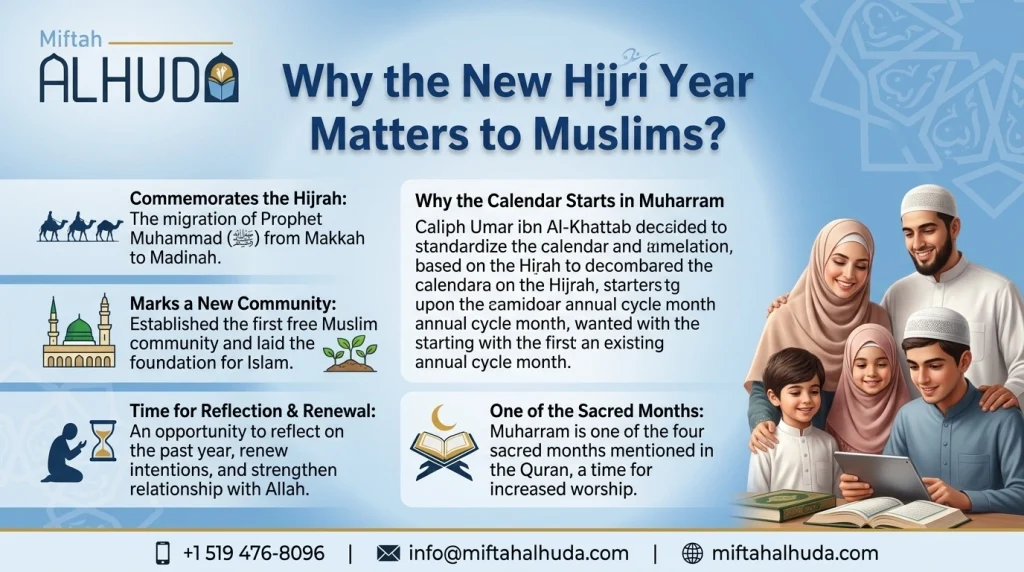
The Islamic New Year, also known as the Hijri New Year or Muslim New Year, marks more than the beginning of another year on the Islamic calendar. It serves as a reminder of one of the most significant events in Islamic history: the Hijrah, the migration of Prophet Muhammad ﷺ and his companions from Makkah to Madinah.
That migration wasn’t simply a change of location. It marked the beginning of the first Muslim community living freely according to Islamic teachings and laid the foundation for the growth of Islam. Because of its importance, Muslims count every Hijri date from this historic event.
The first day of Muharram is also the start of a new chapter in the Islamic calendar, giving many Muslims an opportunity to reflect on the past year, renew their intentions, and strengthen their relationship with Allah.
While the Islamic New Year is generally observed with reflection rather than large public celebrations, it reminds believers of the values of faith, perseverance, and trust in Allah demonstrated during the Hijrah.
Adding to its significance, Muharram is one of the four sacred months mentioned in the Quran, making it a time when Muslims are encouraged to increase acts of worship and avoid wrongdoing.
Why Does the Hijri Calendar Start with Muharram if the Hijrah Happened in Rabi’ al-Awwal?
If the Hijrah took place during Rabi’ al-Awwal, why does the Islamic calendar begin with Muharram?
The answer goes back to the time of Caliph Umar ibn Al-Khattab (رضي الله عنه). As the Muslim community grew, there was a need for a standardized calendar to organize official documents, correspondence, and important events.
After consulting with the Prophet’s companions, Umar chose the Hijrah as the starting point for counting Islamic years because it marked the beginning of the Muslim community’s new era.
Although the migration itself occurred in Rabi’ al-Awwal, Muharram was selected as the first month because it already marked the beginning of the annual cycle used by the Arabs. It also followed the period of Hajj and the major pledges that eventually led to the Hijrah, making it a natural point to begin a new year.
As a result, every Hijri date is counted from the year of the Hijrah, while the first day of Muharram became the official start of each new Islamic year.
How the Twelve Islamic Months Are Structured?
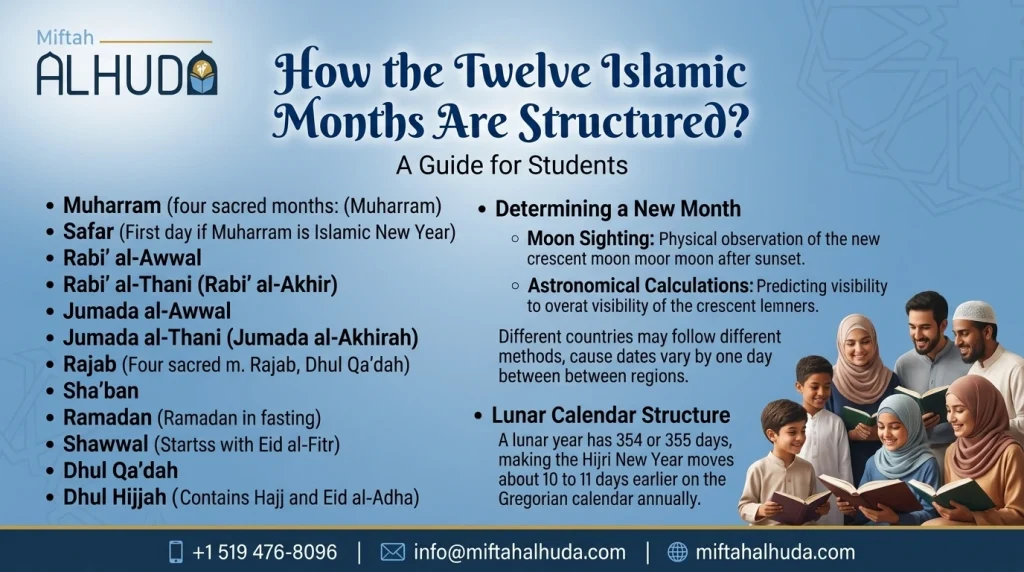
The Islamic calendar follows a lunar calendar consisting of twelve months. Each month begins when the new crescent moon is confirmed, either through physical moon sighting or, in some countries, astronomical calculations. Because a lunar year contains only 354 or 355 days, the Hijri New Year moves about 10 to 11 days earlier on the Gregorian calendar every year.
The twelve Islamic months, in order, are:
- Muharram
- Safar
- Rabi’ al-Awwal
- Rabi’ al-Thani (Rabi’ al-Akhir)
- Jumada al-Awwal
- Jumada al-Thani (Jumada al-Akhirah)
- Rajab
- Sha’ban
- Ramadan
- Shawwal
- Dhul Qa’dah
- Dhul Hijjah
While every month has its place in the Islamic year, several are especially well known:
- Muharram opens the year and is one of Islam’s four sacred months, making the first day of Muharram the beginning of the Islamic New Year.
- Rajab is another of the sacred months and holds special significance in Islamic history.
- Ramadan is the month of fasting, increased worship, and the revelation of the Quran.
- Shawwal begins with the celebration of Eid al-Fitr after Ramadan.
- Dhul Hijjah includes the annual Hajj pilgrimage and Eid al-Adha, and it is also one of the sacred months.
How Does a New Hijri Month Begin?
There are two primary methods used to determine the start of a new month on the Islamic calendar:
- Moon sighting, where the new crescent moon is physically observed after sunset.
- Astronomical calculations, which predict when the new moon becomes visible.
Because different countries and Islamic authorities may follow different methods, the start of a new month, including the Hijri New Year, can sometimes vary by one day between regions.
Understanding how the Islamic months are determined makes it much easier to follow important dates such as Ramadan, Hajj, Eid celebrations, and the beginning of every new Hijri year.
Hijri Calendar vs Gregorian Calendar
| Feature | Hijri Calendar | Gregorian Calendar |
| Basis | Moon cycles | Sun cycles |
| Year length | ~354–355 days | 365–366 days |
| Number of months | 12 | 12 |
| Start of new year | Shifts each year | Always January 1 |
| Era label | AH (Anno Hegirae) | AD / CE |
| Reference event | Hijrah, 622 CE | Birth of Christ (traditional) |
The shorter year length is the entire reason the new Hijri year date can’t sit still on a fixed calendar square the way January 1st does.
Seeking to discover more about the Hijri new year and the Islamic history? The Fiqh course at Miftah Alhuda walks you through the Hijrah, the new hijri year and more. so you stop guessing and start understanding the reasoning for yourself.
Not sure where to start? Book a free trial session and get matched with a teacher who builds a plan around your level.
Contact Us
WhatsApp: +1 519 476-8096
E-Mail: in**@**********da.com
Facebook: https://www.facebook.com/MiftahAlhudaOfficial
Instagram: https://www.instagram.com/miftahalhudaa
Youtube: https://www.youtube.com/@MiftahAl-huda
Tiktok: https://www.tiktok.com/@miftahalhuda00“.
Frequently Asked Questions
When is the new Hijri year?
The most recent new Hijri year, 1448 AH, began June 16, 2026. The next one, 1449 AH, is expected around June 6, 2027.
Why does the Hijri New Year fall on a different date every year?
Because the Hijri calendar follows the moon, and a lunar year is about 11 days shorter than a solar year.
What is the first month of the Hijri calendar?
Muharram. The first day of Muharram is the same day as the Hijri New Year.
How many days are in a Hijri year?
Either 354 or 355 days, depending on the lunar cycles of that particular year.
Is the Hijri New Year the same date worldwide?
Not always. Some countries confirm it by moon sighting and others by calculation, so the date can differ by a day.
What does “AH” mean next to a Hijri year?
It stands for Anno Hegirae, marking years counted from the Hijrah in 622 CE.
The Date Worth Marking on Your Own Terms
Most people don’t need a notification to track January 1st. The new Hijri year asks for a bit more attention, since it moves, and that’s honestly part of what makes it interesting to follow.
Once the lunar logic clicks, the shifting date stops feeling confusing and starts feeling like a calendar that’s simply telling time a different way.