

The Muharram family group chat lights up every year with the same question. Someone asks is Fasting on Ashura Obligatory or Sunnah, someone else says they heard it’s compulsory, and a third person admits they have no idea and just fasted last year because their mother told them to.
By the time Ashura actually arrives, half the household is fasting out of guilt and the other half skipped it without knowing whether that was even allowed.
This confusion usually comes from mixing Ashura up with Ramadan. Ramadan has a fixed obligation stated directly in the Quran, so missing a day without a valid excuse carries real weight. Ashura does not work the same way, yet because both involve fasting and both fall in a sacred month, people quietly assume the same rules apply.
So is fasting on Ashura obligatory or Sunnah? The short answer is Sunnah, and the longer answer explains exactly why, using the hadith that record how this ruling changed over the Prophet’s ﷺ lifetime.
By the end, you will know what the fast means, what reward it carries, and whether skipping it is something to worry about at all.
Is Fasting on Ashura Obligatory or Sunnah?
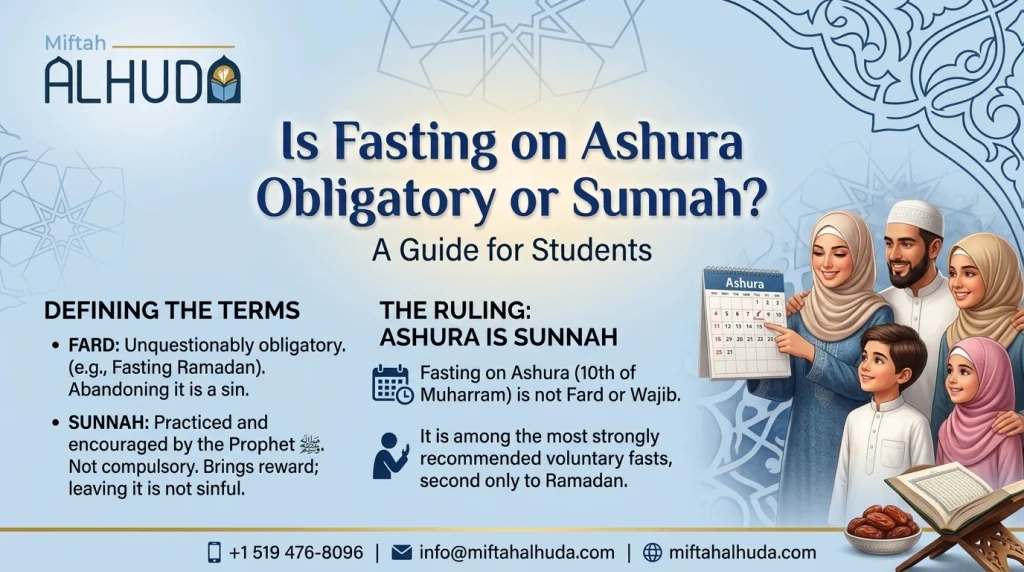
Fasting on Ashura, the tenth day of Muharram, is Sunnah. It is not Fard, and it is not Wajib. It sits among the most strongly recommended voluntary fasts in Islam, second only to the fast of Ramadan in how often the Prophet ﷺ encouraged it.
That single distinction settles most of the confusion. A Fard act is one Allah has made compulsory, like the five daily prayers or fasting Ramadan. A Sunnah act is one the Prophet ﷺ practiced and encouraged, and a Muslim is rewarded for doing it but not held accountable for leaving it.
What Is the Difference Between Fard, Wajib, and Sunnah?
Understanding these terms makes the ruling on Ashura much easier to remember.
Fard refers to an act that Allah has made unquestionably obligatory through clear evidence, such as the five daily prayers or fasting during Ramadan. Deliberately abandoning a Fard act without a valid excuse is sinful.
Wajib is a term used mainly in the Hanafi school for acts that are also considered binding, although they are established through a different level of textual evidence than Fard. In practical terms, both Fard and Wajib are obligations that should not be neglected.
Sunnah, by contrast, refers to actions the Prophet ﷺ regularly practiced and encouraged without making them compulsory. Performing a Sunnah brings reward, while leaving it does not incur sin, although consistently neglecting emphasized Sunnah acts means missing valuable opportunities for closeness to Allah.
Because fasting on Ashura falls into this last category, Muslims are highly encouraged to observe it, but they are not sinful if they are unable to fast or choose not to.
Ibn Abbas, may Allah be pleased with him, described how much the Prophet ﷺ valued this particular day. He said he never saw the Prophet ﷺ so eager to fast any day above another except this one and the month of Ramadan (Sahih al-Bukhari 2006). That eagerness is what gives Ashura its weight, even without obligation attached to it.
The Hadith Evidence Behind the Ruling
Aisha, may Allah be pleased with her, narrated that the people of Quraysh used to fast on Ashura even before Islam. Once the Prophet ﷺ migrated to Madinah, he continued the practice and instructed the Muslims to fast it too, and at that point in time, it functioned as a required fast (Sahih al-Bukhari 1893).
Ibn Umar confirmed the same sequence. The Prophet ﷺ fasted Ashura himself and ordered the community to do likewise, and this was the standing instruction for a period before anything else replaced it (Sahih al-Bukhari 1892).
When the Obligation Was Lifted
Everything shifted once Ramadan was made obligatory. Aisha narrated that after this command came down, the Prophet ﷺ told the people that whoever wished to fast Ashura could fast it, and whoever wished to leave it could leave it (Sahih al-Bukhari 1893).
Ibn Umar’s narration carries the same conclusion in plain terms. Once Ramadan fasting was prescribed, fasting on Ashura was no longer required, though Abdullah ibn Umar himself still observed it on most years out of personal devotion (Sahih al-Bukhari 1892).
This is the abrogation scholars refer to when explaining the ruling. Ashura started as something close to obligatory, then became permanently voluntary the moment Ramadan took its place as the fixed annual fast.
Why Did the Prophet ﷺ Choose to Fast This Day?
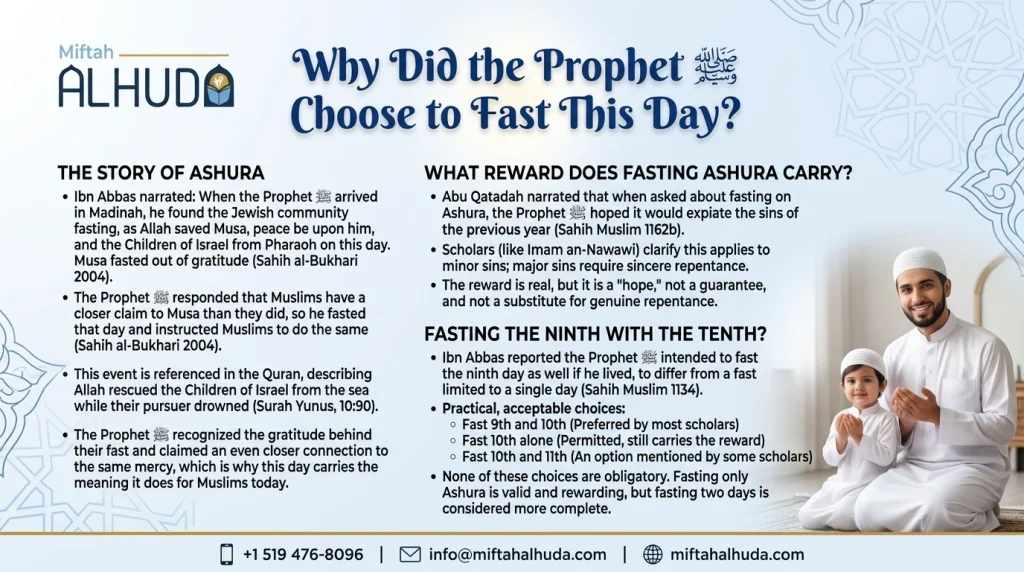
Ibn Abbas narrated the story behind it. When the Prophet ﷺ arrived in Madinah, he found the Jewish community fasting on this day. He asked them why, and they explained that it was the day Allah saved Musa, peace be upon him, and the Children of Israel from Pharaoh, so Musa fasted out of gratitude (Sahih al-Bukhari 2004).
The Prophet ﷺ responded that the Muslims have a closer claim to Musa than they did, and he fasted that day himself and instructed the Muslims to do the same (Sahih al-Bukhari 2004).
The same event is referenced in the Quran, where Allah describes rescuing the Children of Israel from the sea while their pursuer drowned (Surah Yunus, 10:90).
There is something worth sitting with in that response. The Prophet ﷺ did not dismiss what the Jewish community valued. He recognized the gratitude behind their fast and claimed an even closer connection to the same mercy, which is part of why this day carries the meaning it does for Muslims today.
What Reward Does Fasting Ashura Carry?
Abu Qatadah narrated that the Prophet ﷺ was asked about fasting on Ashura, and he replied that he hoped it would expiate the sins of the previous year (Sahih Muslim 1162b).
Scholars including Imam an-Nawawi clarified that this expiation applies to minor sins, since major sins require sincere repentance on their own.
It is worth being honest about what this hadith does and does not promise. The Prophet ﷺ used the word “hope,” which scholars read as humility before Allah rather than a guarantee written in stone. The reward is real, but it is not a substitute for genuine repentance.
Should You Fast the Ninth With the Tenth?
Ibn Abbas reported that when the Prophet ﷺ fasted Ashura, his companions mentioned that the day held meaning for Jews and Christians too.
He responded that if he lived to see the following year, he intended to fast the ninth day as well (Sahih Muslim 1134).
He passed away before that next Muharram arrived, so the companions and later scholars carried the intention forward as a recommended practice.
A few practical options come out of this hadith, and each one is acceptable:
Fast the ninth and tenth together, which most scholars consider the preferred approach.
Fast the tenth alone, which is permitted and still carries the reward of the hadith.
Fast the tenth and eleventh, an option some scholars mention as another way to differ from a fast limited to a single day.
None of these choices is obligatory. A Muslim who fasts only the tenth of Muharram has still observed the Sunnah and can hope for the reward mentioned by the Prophet ﷺ.
However, many scholars recommend fasting the ninth along with the tenth because of the Prophet’s ﷺ expressed intention to do so, while others also permit adding the eleventh as another way to distinguish the Muslim fast from the practice of other communities.
Whenever possible, fasting two days is considered more complete, but fasting only Ashura remains valid and highly rewarding.
Who Is Excused From Fasting Ashura?
Since fasting on Ashura is a voluntary act of worship, Islam does not require every Muslim to observe it. The same general concessions that apply to other voluntary fasts also apply here.
Those who are excused from fasting include:
- People who are ill and fear fasting could worsen their condition or delay recovery.
- Travelers who find fasting difficult during their journey.
- Women who are menstruating or experiencing postnatal bleeding, as they are not permitted to fast during that time.
Anyone whose health would genuinely be harmed by fasting, based on trustworthy medical advice or personal experience.
Unlike missed days of Ramadan, there is no obligation to make up a missed Ashura fast because it is a recommended Sunnah rather than an obligatory act of worship. If someone is unable to fast this year, they can simply intend to observe it the following Muharram, in sha Allah.
Obligatory Fast vs Sunnah Fast at a Glance
| Obligatory Fast (Fard) | Sunnah Fast |
| Ramadan | Ashura |
| Must be observed by every eligible Muslim | Voluntary, left to personal choice |
| Sin if abandoned without valid excuse | No sin if missed |
| Fixed obligation stated directly | Strongly recommended, not commanded |
Seeing the two side by side clears up the misconception that comes up most often, which is whether Ashura somehow replaces or equals Ramadan in status. It does not, and it was never meant to. The two fasts serve different purposes within the same religion, one as a pillar and the other as a gift of extra reward.
Learning the hadith behind a single day of fasting is a small taste of what a structured Fiqh education gives you for every ruling you will ever ask about. The Fiqh course at Miftah Alhuda walks you through how scholars derive rulings like this one, so you stop guessing and start understanding the reasoning for yourself.
If you would rather speak with a teacher first and see how the classes work before committing to anything, you can book a free trial session and ask your Ashura or fiqh questions directly.
Contact Us
WhatsApp: +1 519 476-8096
E-Mail: in**@**********da.com
Facebook: https://www.facebook.com/MiftahAlhudaOfficial
Instagram: https://www.instagram.com/miftahalhudaa
Youtube: https://www.youtube.com/@MiftahAl-huda
Tiktok: https://www.tiktok.com/@miftahalhuda00“.
Frequently Asked Questions
Is fasting on Ashura obligatory?
No. It is Sunnah. It was close to obligatory before Ramadan was prescribed, and it became fully voluntary after that.
Is it a sin to skip fasting on Ashura?
No. Leaving a Sunnah fast carries no sin, unlike leaving a day of Ramadan without a valid excuse, which does.
Can I fast only the tenth of Muharram?
Yes, fasting only the tenth is permitted and still earns the reward mentioned in the hadith. Adding the ninth is simply more rewarding, not required.
Does fasting Ashura forgive all my sins?
It is hoped to expiate minor sins of the previous year, according to the hadith narrated by Abu Qatadah. Major sins still require sincere repentance on their own.
Should women fast Ashura?
Yes, the same voluntary ruling applies to women, with the usual exception for those experiencing menstruation or postnatal bleeding, who make up the missed days later if they choose to.
What if I already missed Ashura this year?
There is no make-up fast for a missed Sunnah. You simply intend to observe it again next Muharram, in sha Allah.