

For years reading the Quran correctly has been on the list, somewhere below work deadlines and school pickups, and it never quite makes it to the top.
Flexible Noorani Qaida online classes exist for exactly this hour, the one squeezed between everything else, because that is when most adults actually have the energy to learn.
The usual advice does not help much here. Local mosque classes run on a fixed weekday schedule that rarely matches a working parent’s calendar.
Group classes go at the speed of the most vociferous person in class, either very quickly or very slowly. Although self-study applications are convenient, without a teacher to correct you on the spot in terms of your pronunciation, Makharij mistakes are just as easily memorized as the letters.
The article describes the typical nature of Noorani Qaida classes in an environment dictated by the hectic schedule of an adult rather than a classroom-based schedule.
The topics covered include the actual lessons in the Qaida, the solution of the time problem by one-to-one online classes and what a certified course consists of from day one.
What Is Noorani Qaida?
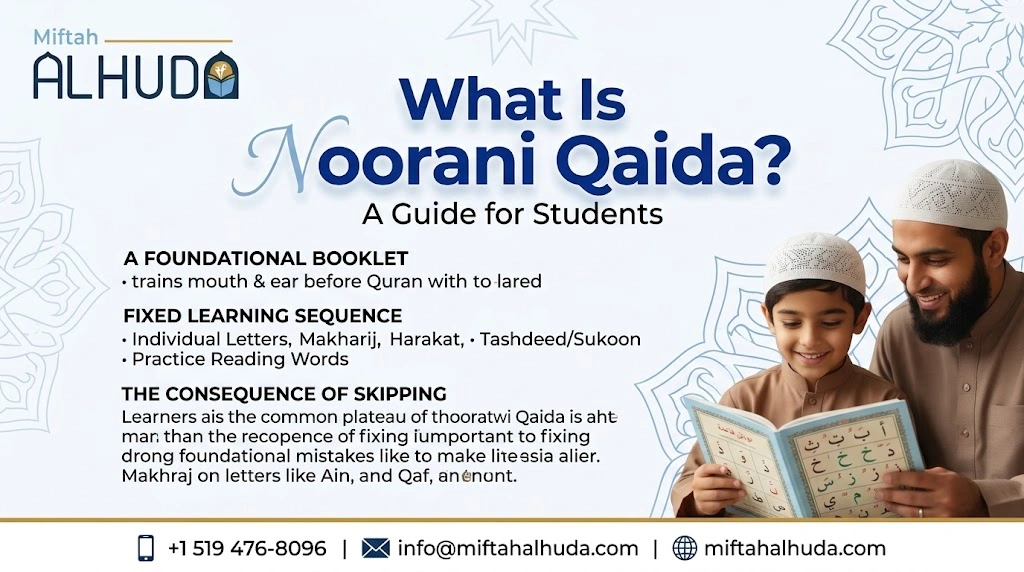
The Noorani Qaida is a short foundational booklet, not the Quran itself. It exists to train the mouth and ear before a student ever opens a Quranic page.
The book moves through a fixed sequence:
- Individual Arabic letters and their shapes in different positions
- Makharij, the exact point in the mouth or throat where each letter originates
- Harakat, the short vowel marks that change how a letter sounds
- Tashdeed, Sukoon, Tanween, and Madd, the rules that control stress, pause, and elongation
- Practice reading short combined words before moving to full verses
Skipping this stage is the most common reason adult learners plateau. A student who never mastered Makhraj on letters like Ain or Qaf will carry that same mistake into every surah they read afterward, because nothing in later lessons goes back to fix it.
Why Busy Students Choose Flexible Noorani Qaida Online classes?
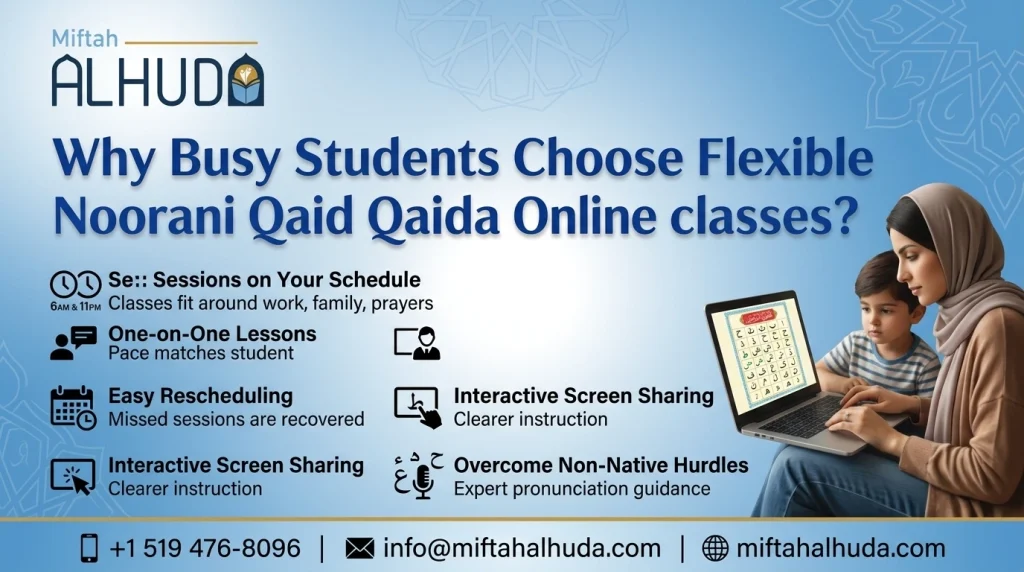
The physical classroom makes the student adapt to the school, while online Noorani Qaida lessons reverse the situation, which is more important than one might think for a person who has a profession, family, or five prayers every day to offer.
A few things change once the class moves online:
- Sessions can be booked at 6 am before work or 11 pm after the kids sleep, since teachers are available around the clock
- Classes are one-on-one, so the pace matches the student rather than the average of a group
- A missed session can usually be rescheduled instead of simply lost for the week
- Screen sharing lets the teacher point directly at the letter or Harakah being corrected, which is harder to do from the back of a crowded room
None of this replaces the discipline of showing up. But it removes the excuse of “there was no class that fit today,” which is usually what ends a student’s Quran journey in month two.
The Non-Native Speaker Problem When Learning Arabic
English learners have one particular difficulty that learners whose native tongue is Arabic lack. There are no sounds like Ain (ع), Ha (ح), Kha (خ), and Ghain in Western languages; therefore, there has been no practice of pronunciation for such sounds. A teacher capable of explaining how to make those sounds in English would help solve the problem much faster than any recording or an application could.
Noorania Qaida Ijazah Program
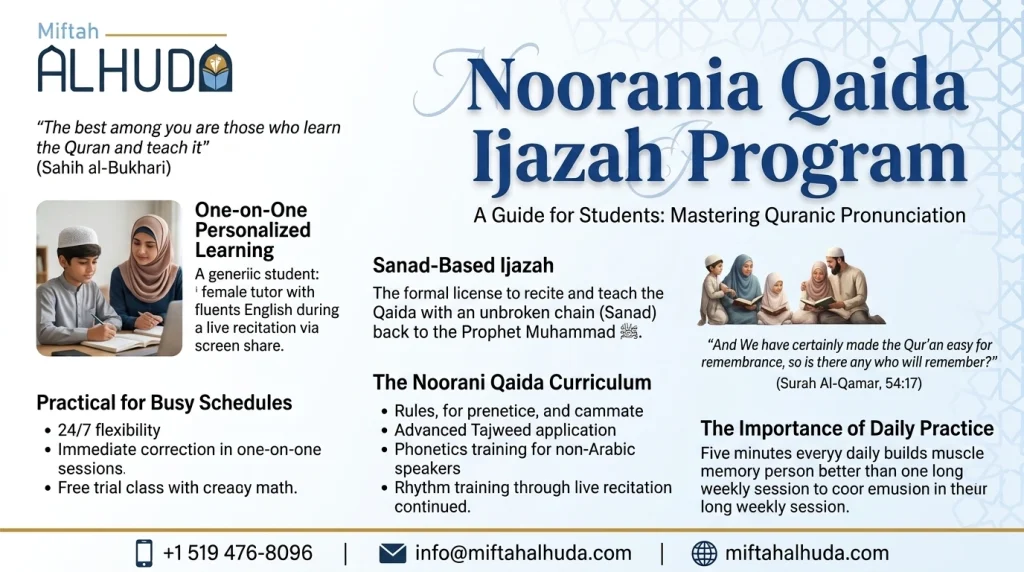
Miftah Alhuda‘s Noorania Qaida Ijazah program takes a student from the first Arabic letter through to a certified Ijazah, a formal license to recite and teach the Qaida with an unbroken chain, or Sanad, back to the Prophet Muhammad ﷺ. Classes run one-on-one with male and female tutors who are fluent in English, so explanations never get lost in translation.
This course includes Noorani Qaida rules, Advanced Tajweed Application, phonetics training designed specifically for non-Arabic speakers, and rhythm training through live recitation. Upon completion, students receive a Sanad-based Ijazah certificate that holds value for those aspiring to teach at a later point in time.
What makes it practical for a busy schedule:
- Classes run 24 hours, so anywhere book around their own timezone
- Every session is one-to-one, with immediate correction instead of waiting a turn
- A free trial class is available before any commitment, so a student can test the teaching style first
What a Real Class Session Looks Like
A typical session opens with a short review of the previous lesson, since repetition is what actually locks in correct pronunciation. From there, the teacher introduces the next rule or letter combination and has the student repeat it aloud, correcting the articulation point in real time through screen share.
Homework is usually light. A few minutes of daily practice between sessions matters more than one long session a week, because Makharij is a muscle memory skill, not a memorization task. Students who practice five minutes daily tend to progress faster than those who cram thirty minutes once a week.
The Prophet ﷺ is reported to have said: “The best among you are those who learn the Quran and teach it.” This hadith is recorded in Sahih al-Bukhari, narrated by Uthman bin Affan (may Allah be pleased with him). It is often the first thing a Qaida teacher mentions in an opening class, not as decoration, but as the actual reason the course exists.
Allah says in the Quran, “And We have certainly made the Qur’an easy for remembrance, so is there any who will remember?” (Surah Al-Qamar, 54:17). For a student who has put this off for years out of fear of failing, that verse is usually the more comforting one to sit with before the first class.
Who Is the Noorani Qaida Course is For?
- Adults who never learned to read Quran as children and feel embarrassed starting now
- Parents who want a structured foundation for their kids before Hifz or Tajweed begins
- Converts building Arabic reading skills from zero
- Anyone preparing to eventually pursue an Ijazah and teach others
- A student does not need any prior Arabic knowledge to start. The entire point of the Qaida is to build that knowledge from the first letter.
Ready to stop putting it off? Book your free trial session and meet your teacher before committing to anything.
Prefer to see the full course details first? Reach out about the Noorania Qaida Ijazah program and get your questions answered directly.
Contact Us
WhatsApp: +1 519 476-8096
E-Mail: in**@**********da.com
Facebook: https://www.facebook.com/MiftahAlhudaOfficial
Instagram: https://www.instagram.com/miftahalhudaa
Youtube: https://www.youtube.com/@MiftahAl-huda
Tiktok: https://www.tiktok.com/@miftahalhuda00“.
Frequently Asked Questions
What is Noorani Qaida and why is it important?
It is a beginner booklet that teaches Arabic letters, pronunciation, and basic Tajweed before a student starts reading the Quran itself. Skipping it usually leads to mispronunciation later.
How long does it take to finish the Noorani Qaida online?
Most students finish in a few months with consistent short sessions. Pace depends on how often the student practices between classes, not just class time.
Can adults really start from zero with no Arabic background?
Yes. The Qaida is designed for absolute beginners, and one-on-one online classes let an adult learn at their own pace without feeling rushed by younger classmates.
Do online Noorani Qaida classes include Tajweed?
Yes. Tajweed basics such as Makharij, Madd, and Qalqalah are built directly into the Qaida lessons rather than taught as a separate course.
Are flexible Noorani Qaida online classes suitable for kids too?
Yes, kids are usually the primary audience. Sessions are shortened and paced for attention span, with the same one-on-one correction adults receive.
What happens after finishing the Noorani Qaida?
Students typically move into Tajweed-focused Quran reading or memorization courses, using the pronunciation foundation the Qaida built.
The Hour You Already Have Is Enough
Nobody finds a spare block of free time to learn the Quran. It gets carved out of a day that was already full, usually the same 9 pm hour that almost every working parent already knows too well.
The students who finish the Qaida are not the ones with more free time. They are the ones who stopped waiting for a schedule that never existed and started with the hour they already had.
What would change if that hour started tonight instead of next month? Start with a course built for your schedule