

Week one in an Arabic class may turn out to be quite deceptive. It may seem that everything is okay at first; you can address your teacher, introduce yourself, and read several Arabic letters. After that, your teacher poses a rather straightforward question to you, and you forget all the words you have just learned.
This is a characteristic of virtually everyone who starts to learn experiences. It’s one thing to know what a word means when it’s written on paper, but quite another thing to be able to find that word fast enough to use it during conversation.
Therefore, it is important to think about questions sentence from the beginning, especially in the Arabic language. It is possible to maintain a conversation even with a very small vocabulary, with the help of questions.
The focus of the present guide is on question words and question structures that you will encounter while speaking the most common Arabic. There will be examples of questions to ask about classes, homes, shopping, travelling and everyday language. Briefly, the importance of questioning in Islam will also be discussed.
What are Question Sentences in Arabic?
The term for “question sentence” in Arabic is جملة استفهامية. This is a sentence that is asked when one wants to know something. One is asking another person about something, rather than telling him/her about something.
The typical structure of Arabic questions is one of two types:
It is preceded by a question word, e.g., من (who), أين (where), or متى (when).
The particle هل is used before a sentence when the answer is likely to be ‘yes’ or ‘no’.
These question words and particles are called أدوات الاستفهام, or interrogative tools. They might sound strange to start with, but they will be repeated over and over in simple conversations. With the ability to identify them many Arabic question sentences in Arabic become much more predictable.
The Quran also emphasizes the need to ask when we don’t know. Allah says:
“فَاسْأَلُوا أَهْلَ الذِّكْرِ إِن كُنتُمْ لَا تَعْلَمُونَ”
“So ask the people of the message if you do not know.” Surah An-Nahl 16:43
This is a helpful reminder for a language learner. Clarifying is a learning process. Don’t think you’re falling behind.
The Arabic Question Words
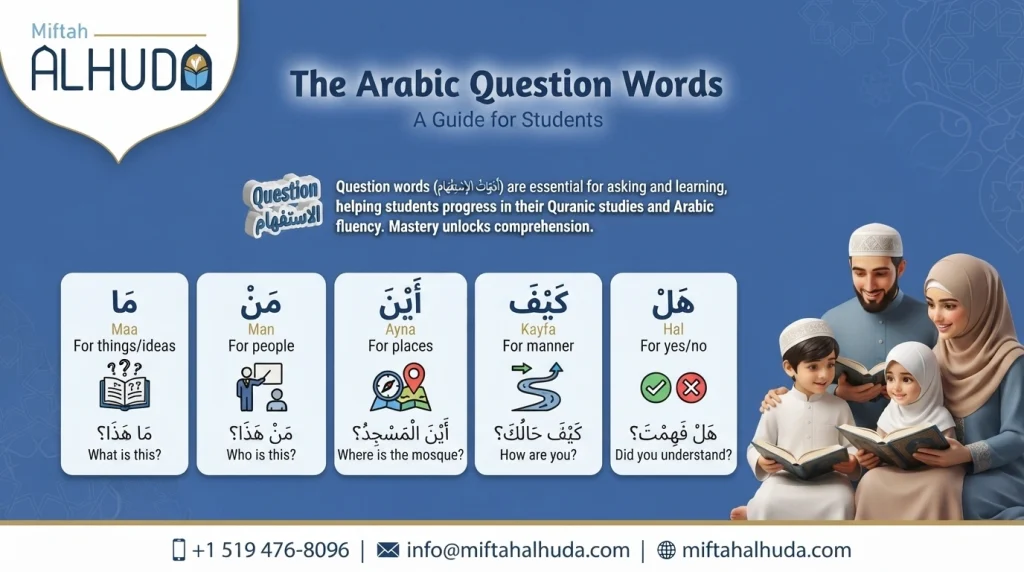
The majority of Arabic questions formed in Arabic use a limited set of frequently used words. These are the first ones to memorize and you’ll have a solid foundation for basic speech.
| Arabic | Transliteration | English |
| مَن؟ | Man? | Who? |
| ما؟ | Mā? | What? |
| ماذا؟ | Mādhā? | What? |
| أين؟ | Ayna? | Where? |
| متى؟ | Matā? | When? |
| لماذا؟ | Limādhā? | Why? |
| كيف؟ | Kayfa? | How? |
| كم؟ | Kam? | How many / how much? |
| أيّ؟ | Ayy? | Which? |
| هل؟ | Hal? | Do / does / is / are? |
من: Who
Use من to ask about a person.
مَن هذا؟ Who is this?
مَن معلّمك؟ Who is your teacher?
مَن معك؟ Who is with you?
It will be used in greetings, in the classroom, and when asking questions about family and friends.
ما وماذا: What
Learners often confuse the two expressions “ما” and “ماذا” because they have the same meaning “what”. As a useful beginner’s tip, the verb frequently precedes the noun in the sentence, and the noun typically follows the verb.
ما اسمك؟ What is your name?
ماذا تفعل؟ What are you doing?
ما هذا؟ What is this?
This is a rule to begin with, not one that one must always follow. The option may vary based on the sentence’s structure and the different types of Arabic being used. The more you hear the difference will seem more natural.
أين: Where
When asking for a location use أين.
أين تسكن؟ Where do you live?
أين المسجد؟ Where is the mosque?
أين كتابي؟ Where is my book?
متى: When
When asking about time use the word متى.
متى تبدأ الدراسة؟ When does class start?
متى تصل؟ When will you arrive?
متى ينتهي الدرس؟ When does the lesson finish?
لماذا: Why
When asking why, use the word “لما” (lit. “for why”).
لماذا تتعلم العربية؟ Why are you learning Arabic?
لماذا أنت هنا؟ Why are you here?
لماذا تأخرت؟ Why were you late?
كيف: How
Ask someone what’s happening to them or how something is done using كيف.
كيف حالك؟ How are you?
كيف تقرأ هذه الكلمة؟ How do you read this word?
كيف أذهب إلى السوق؟ How do I get to the market?
كم: How many, how much
When asking about a number, amount, age or price use the word كم.
كم عمرك؟ How old are you?
كم سعر هذا؟ How much is this?
كم كتابًا قرأت؟ How many books did you read?
It’s not always an easy thing to recall a long list of phrases. Learning Arabic question sentences in Arabic is a lot easier with situations that you experience.
Consider the types of questions you may have at home, school, in the store, or in the initial meeting with someone you do not know.
Discussing themselves and others
ما اسمك؟ What is your name?
من أنت؟ Who are you?
كيف حالك؟ How are you?
ما جنسيتك؟ What is your nationality?
هل أنت طالب؟ Are you a student?
These are helpful questions for initial conversations and introductions: As well, practice your response to these, as you will want to be prepared when someone asks you about it.
Asking About People
من هذا الرجل؟ Who is this man?
من معك؟ Who is with you?
أين والدتك؟ Where is your mother?
من صديقك؟ Who is your friend?
Asking About Time
كم الساعة؟ What time is it?
متى تبدأ الدروس؟ When do the lessons start?
متى ستعود؟ When will you return?
متى موعد الاختبار؟ When is the test?
Asking About Places
أين الحمّام؟ Where is the bathroom?
أين أقرب مسجد؟ Where is the nearest mosque?
إلى أين تذهب؟ Where are you going?
من أين أنت؟ Where are you from?
Invited to ask about a product in the Market or during eating.
كم سعر هذا؟ How much is this?
What is your favourite food?
هل هذا حلال؟ Is this halal?
أيّ نوع تريد؟ Which kind do you want?
These are the sorts of questions that get a beginner going in no time. You don’t need to have your grammar completely right before using them. Begin with the most common situations you encounter and then expand upon them.
Answering questions with Yes and No in Arabic
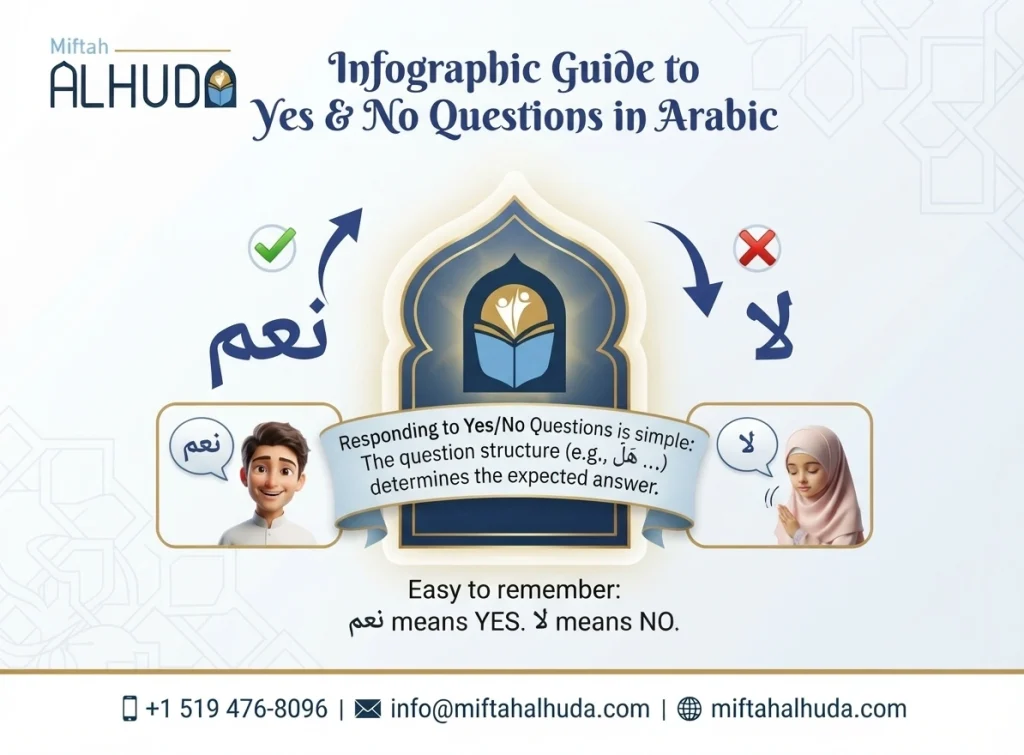
In the Arabic language not all question sentences are of the type which necessitate a question word. In Arabic, the word هل is sometimes used at the start of the sentence to indicate yes or no, for questions that can be answered accordingly.
The pattern is easy:
هل + sentence؟
Here are some common examples:
هل أنت بخير؟ Are you okay?
هل تتحدث العربية؟ Do you speak Arabic?
Maybe you’d like some tea?
هل صلّيت؟ Have you prayed?
Responding with a yes or no.Yes/no response.
There are two simple answers, easy to remember:
نعم means yes.
لا means no.
For example:
هل أنت طالب؟ نعم، أنا طالب.
Are you a student? Yes, I’m a student.
During practice, do NOT stop after asking a question. Say a possible answer as well. This will help you see the exchange as a real conversation, not as some words from a textbook.
How to ask questions in Arabic
Once you are familiar with the question words, you can begin to form Arabic question sentences in Arabic. These are the three common pattern questions that beginners ask:
Question word + place/verb: أين تسكن؟ Where do you live?
هل (yes) + complete sentence: هل تدرس العربية؟ Do you study Arabic?
Question word + noun: ما اسمك؟ What is your name?
The easiest thing to do is to have a pattern and try changing the words one by one.
For instance, you start with أين تسكن؟ and then remember to use in the following sentences: أين يعمل والدك؟ and أين يذهب أخوك؟ You’re learning the structure of the sentence and not trying to remember 3 totally unrelated examples.
Read the questions out loud. Speaking even when alone will help your mouth practice sounds which may be challenging if you read silently.
Repeating these exercises will help you spend less time on translating your thoughts and spend more time on spontaneous reaction.
Common mistakes while asking questions in Arabic
Most of the errors of the beginner are comprehensible. Typically occur when a student transfers a rule from English or attempts to use a new word into the language with insufficient exposure to the word in examples.
- Mixing up of the words “what” (مَا) and “what” (ماذا).
- Using more than one of the question words, even when adding a question word after the word هل creates a yes/no question.
- Literal translation of English word order to Arabic.
- Speaking or writing without using the question mark.
- Switching between Modern Standard Arabic and dialect without awareness.
For instance, Egyptian Arabic uses the forms مين, إيه, فين, إمتى, ليه and إزاي, which are not the forms used in this guide. Not all of the varieties are inherently bad. It is just as the learner should recognise the form he is learning and the normal use of the form.
Avoid these errors and don’t be afraid to speak. A teacher can correct them, however, it is equally important to provide yourself with ample opportunity to make them. Imperfect questions are more useful than perfect sentences that stay in your notebook.
The importance of asking questions in Arabic in Islam

The sincerity of questions are closely linked to the pursuit of knowledge in Islam. When asking is to understand and to do the right thing, it is not something that one should be embarrassed about.
The Prophet Muhammad ﷺ mentioned this rule after an acquaintance was injured due to being given wrong advice rather than being told to ask. Jabir said that the Messenger of Allah ﷺ said:
“Verily, the only cure for ignorance is to ask questions.” Sunan Abi Dawud 336, graded Sahih by Al-Albani.
Although the hadith is about religious guidance, it has relevance for the study of Arabic too. Asking “ماذا تقصد؟” (What do you mean?) provides the learner with an opportunity to understand the conversation rather than being silent when the explanation is not understood.
Anas ibn Malik said that the Messenger of Allah (saws) said:
“It is a duty of every Muslim to seek knowledge.” Sunan Ibn Majah 224, which is reported by multiple chains of narration.
Many Muslims learn Arabic as another step towards getting closer to the language of the Quran. Musa, peace be upon him, prayed to Allah to make his speech clear before he spoke with Pharaoh:
“رَبِّ اشْرَحْ لِي صَدْرِي وَيَسِّرْ لِي أَمْرِي وَاحْلُلْ عُقْدَةً مِّن لِّسَانِي يَفْقَهُوا قَوْلِي”
“My Lord, expand for me my breast and ease for me my task and untie the knot from my tongue that they may understand my speech.” Surah Ta-Ha 20:25-28
If you’re feeling anxious during Arabic question sentences drill session practice, remember that it’s a process and you will start to get better. Don’t have to sound fluent before starting. You must practice again and again, listen to advice and seek assistance if required.
Make These Arabic Question Sentences a part of authentic discourse.
It’s important to read examples, but it’s just the start of the process. The magic occurs when you interact with another person using these questions.
You can hear a pronunciation problem, correct a grammar error, and respond without translating each sentence, all without the teacher’s having to translate.
Select 3 questions that are appropriate for your life. Say the above words several times in Arabic: أين تسكن؟, ماذا تفعل؟, هل تتحدث العربية؟ Then practice them with a teacher, classmate, family member or language partner. When they get comfortable with those questions, switch those questions for questions about your own day.
Ready to move beyond memorizing lists and start speaking Arabic with greater confidence? Explore the Arabic courses at Miftah Alhuda.
Not sure where to begin? Book a free trial session and speak with a teacher who can help you choose a suitable starting point.
Contact Us
WhatsApp: +1 519 476-8096
E-Mail: in**@**********da.com
Facebook: https://www.facebook.com/MiftahAlhudaOfficial
Instagram: https://www.instagram.com/miftahalhudaa
Youtube: https://www.youtube.com/@MiftahAl-huda
Tiktok: https://www.tiktok.com/@miftahalhuda00“.
Frequently Asked Questions About Arabic Questions
How do you ask a question in Arabic?
Start with a question word such as أين or متى, or place هل before a sentence that expects a yes-or-no answer.
What are the most common Arabic question words?
They include من، ما، ماذا، أين، متى، لماذا، كيف، كم، أيّ, and هل.
What is the difference between ما and ماذا?
ما often comes before a noun, as in ما اسمك؟. ماذا commonly comes before a verb, as in ماذا تفعل؟.
How do you say “why” in Arabic?
“Why” is لماذا, as in لماذا تتعلم العربية؟.
What does هل mean in Arabic?
هل is a particle placed before a sentence to form a yes-or-no question.
How do you ask yes-or-no questions in Arabic?
Place هل before the sentence and answer with نعم for yes or لا for no.
A Small Habit That Changes How You Learn Arabic
Many learners collect vocabulary for months before they try asking a question aloud. It may feel safer to keep studying quietly, but it also keeps Arabic at a distance. Try changing the order. Ask a question first, then listen carefully to the answer and notice the new words that appear.
At your next study session, write three Arabic question sentences in Arabic about your own day. Ask where you are going, what you are doing, or when you will finish. Say the questions aloud and, if possible, use them with someone who can answer.
That small habit can make Arabic feel less like a subject you are studying and more like a language you are beginning to use.