
Your child sat down with you last week, you wrote واحد on a whiteboard, and they repeated it back perfectly. Then two days later, it was gone. You started over. That loop, the excited session, the forgetting, the restart, is something most parents experience in the first month of teaching Arabic numbers for kids, and almost no guide mentions it.
Most resources online give you a list of Arabic numbers and a few activities and call it a day. What they skip is the reason those activities work inconsistently: it isn’t the method, it’s the sequence.
Children need to meet a number in multiple forms before it sticks, sound first, then shape, then real-life use. Present them out of order and the retention doesn’t come.
This guide builds that sequence for you. By the time you reach the end, you’ll have a clear picture of how to introduce the numbers 1 to 10, how to extend to 20 and beyond, which activities actually hold a child’s attention past week one, and where to go when home practice reaches its natural limits.
The Arabic Numbers Your Child Needs to Know First
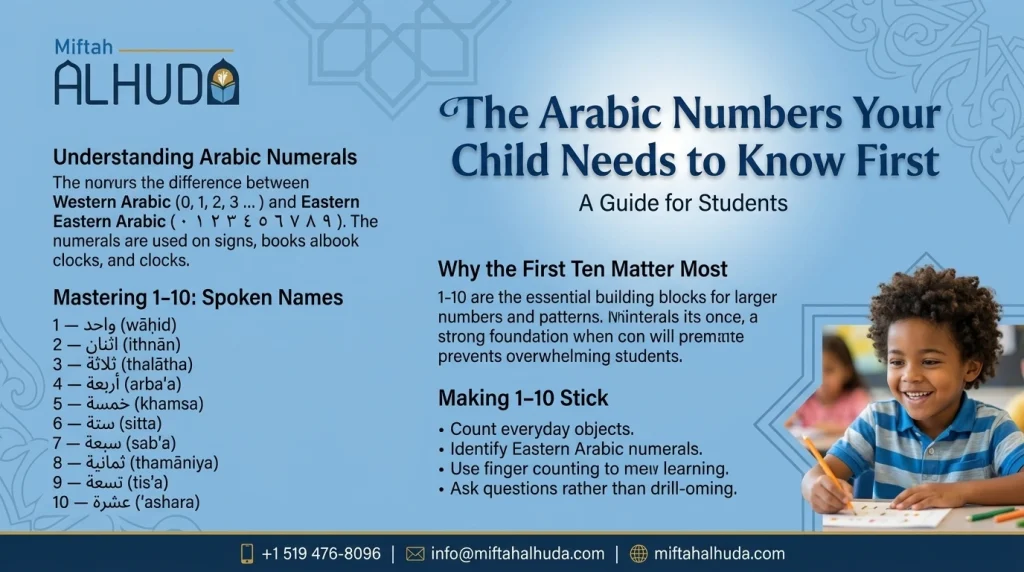
Arabic uses two numeral systems, and the difference is worth knowing before you start. The Western Arabic numerals (0, 1, 2, 3…) are the ones your child already uses in school. The Eastern Arabic numerals ( ٠ ١ ٢ ٣ ٤ ٥ ٦ ٧ ٨ ٩ ) are used widely across Arab countries on signs, books, clocks, and everyday text. Both systems exist in the real world, so children benefit from seeing both.
For most kids starting out, the spoken names are more immediately useful than the written symbols. Here are the numbers 1 to 10 with pronunciation:
1 — واحد (wāḥid)
2 — اثنان (ithnān)
3 — ثلاثة (thalātha)
4 — أربعة (arba’a)
5 — خمسة (khamsa)
6 — ستة (sitta)
7 — سبعة (sab’a)
8 — ثمانية (thamāniya)
9 — تسعة (tis’a)
10 — عشرة (‘ashara)
Once a child can say these ten with confidence, the numbers from 11 to 19 follow a predictable pattern (the single digit plus “ten”), and the tens from 20 to 90 follow their own pattern. The structure is logical, so children who master 1 to 10 thoroughly find the rest much less overwhelming than they expected.
Why the First Ten Matter More Than Parents Realize?
A family I’ve seen in Arabic teaching circles tried to teach their seven-year-old all the way to 100 in the first two weeks. The child could recite the sequence, but when asked to identify a random number on a flashcard, she hesitated at almost every one past five. The sequencing was rushed, and the foundation didn’t hold.
The numbers 1 to 10 are not just the beginning of counting. They are the building blocks every larger number is constructed from. Eleven in Arabic is literally “one and ten” (أحد عشر). Twenty is “two tens” (عشرون). A child who knows wāḥid cold will recognize it immediately inside the larger numbers. A child who doesn’t will meet it again as if it’s new every time.
Making 1–10 Stick
The most effective approach is repetition across different contexts, not repetition of the same activity. Here are specific ways to give each number more than one entry point:
- Count household objects during daily routines (spoons, steps, pieces of fruit)
- Point to Eastern Arabic numerals on clocks, calendars, or Arabic books
- Use finger counting with Arabic names during play, not just lessons
Ask questions with number answers rather than drills: “How many are left?”
The goal is for the child to hear and use the number in a real moment, not just in lesson time. That’s what moves it from short-term repetition to something more durable.
Activities That Actually Work for Arabic Number Learning
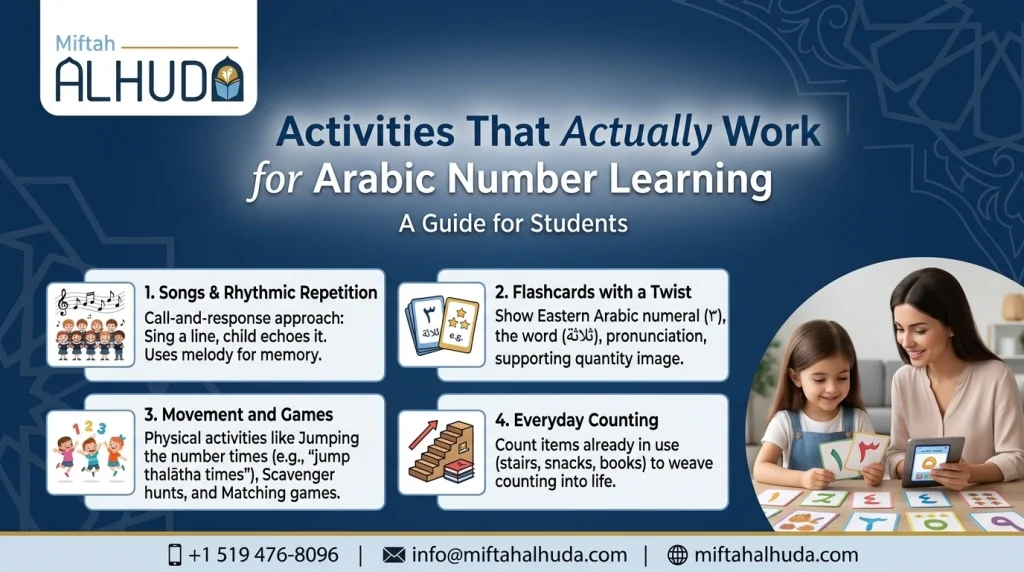
Here are some fun methods to teach Arabic numbers for kids in an easy way:
1. Songs and Rhythmic Repetition
Children recall sounds more reliably when they’ve heard them attached to music or rhythm. An Arabic counting song (even a simple one sung to a familiar nursery rhyme tune) helps kids form stronger sound-to-number connections than flashcard drills alone.
YouTube has several solid options when you search “Arabic numbers song for kids.” A call-and-response approach, where you sing a line and your child echoes it, keeps the activity active rather than passive.
2. Flashcards with a Twist
Standard flashcards work. But they work better when both numeral systems appear side by side: the Eastern Arabic numeral (٣) on one side, the word (ثلاثة) with pronunciation on the other, and an image that represents the quantity.
The image matters because it gives the child something to anchor the abstract sound to. Without it, the word and the symbol stay disconnected in the child’s mind longer than necessary.
3. Movement and Games
Physical engagement accelerates retention at this age. A few ideas that parents report lasting well past the first session:
- Jumping the number of times in Arabic (“jump thalātha times!”)
- Scavenger hunts where children find a specific number of items around the house
- Matching games pairing Arabic numeral cards with quantity cards
- Number puzzles with large, clear Eastern Arabic digits
4. Everyday Counting
This is underused and genuinely effective. Rather than setting aside “Arabic number time,” weave counting into what’s already happening. Count the stairs going up, count the strawberries before snack, count books being put away at night. The Arabic word appears in a moment the child actually cares about, which changes how the brain files it.
Moving Beyond 10: How to Introduce Larger Numbers
Once the numbers 1 to 10 are solid, not just recitable in order, but recognizable out of sequence, moving to 11 to 20 becomes much more approachable. The teens in Arabic follow a consistent pattern:
11 – أحد عشر (aḥad ‘ashar) – “one ten”
12 – اثنا عشر (ithnā ‘ashar) – “two ten”
13 – ثلاثة عشر (thalāthata ‘ashar) – “three ten”
Children who notice this pattern tend to enjoy it. There’s something satisfying about a number system that behaves predictably, and you can make a small game out of it: “If three is thalātha and ten is ‘ashara, what do you think thirteen is?” That small moment of discovery does more for retention than repetition.
For the tens (20, 30, 40…), the pattern continues:
20 – عشرون (ishrūn)
30 – ثلاثون (thalāthūn)
40 – أربعون (arba’ūn)
Worksheets with tracing exercises help with the written forms. Number dictation (you say a number in Arabic, the child writes it) is more challenging but builds strong recognition quickly.
When Home Practice Reaches Its Limits?
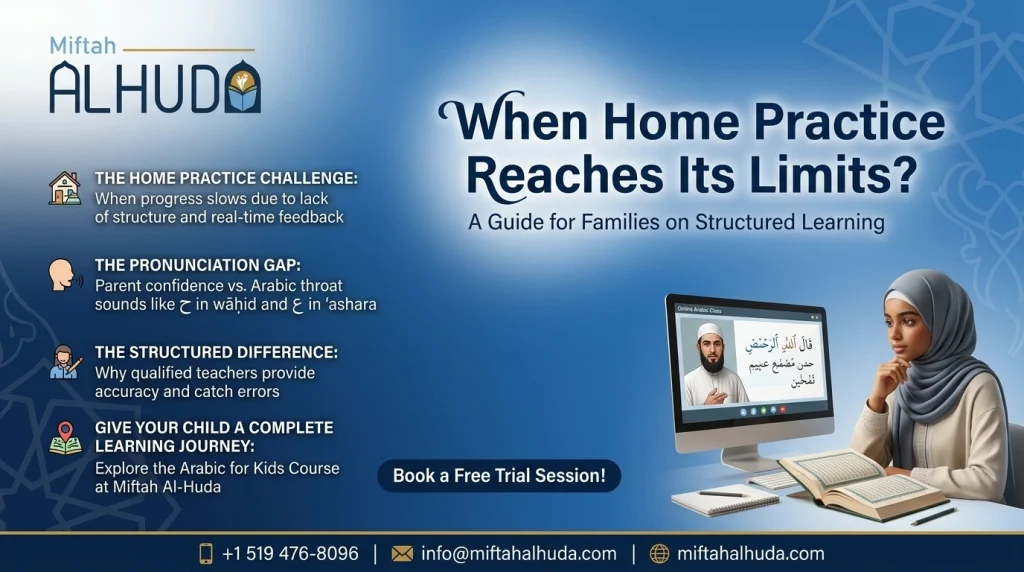
Home learning gets children remarkably far, especially in the early stages. But most parents hit a point where progress slows not because the child lacks ability, but because the learning environment lacks structure, feedback, and someone who can correct pronunciation in real time.
Arabic pronunciation has sounds that genuinely don’t exist in English. The ح in wāḥid, the ع in ‘ashara, these are throat sounds that children can learn but only if someone who knows them well demonstrates and corrects them.
A parent who isn’t confident in Arabic can’t do that. The child’s pronunciation drifts, reinforces incorrectly, and the problem compounds.
That’s where structured instruction makes a measurable difference. Not because home practice fails, but because the two approaches cover different things. Home practice builds exposure, comfort, and daily habit. A qualified teacher provides accuracy, progression, and the kind of responsive feedback that catches small errors before they become habits.
If you’re ready to give your child structured, age-appropriate Arabic learning beyond numbers, explore the Arabic for Kids Course at Miftah Alhuda, designed specifically for young learners at every level.
Not sure yet? Book a free trial session and let your child experience the class before committing.
Contact Us
WhatsApp: +1 519 476-8096
E-Mail: in**@**********da.com
Facebook: https://www.facebook.com/MiftahAlhudaOfficial
Instagram: https://www.instagram.com/miftahalhudaa
Youtube: https://www.youtube.com/@MiftahAl-huda
Tiktok: https://www.tiktok.com/@miftahalhuda00“.
Frequently Asked Questions
What age should kids start learning Arabic numbers?
Most children are ready to begin at 3 to 4 years old, starting with spoken counting from 1 to 5. By 5 or 6, they can usually handle the full 1 to 10 set and start recognizing written numerals.
Should I teach Eastern Arabic numerals or Western ones first?
Start with the spoken names regardless of numeral style. Once your child can say the numbers confidently, introduce Eastern Arabic numerals (٠ ١ ٢ ٣) alongside the words. They don’t need to choose one system, both appear in real-life Arabic text.
How long does it take for kids to memorize Arabic numbers 1 to 10?
With short, consistent daily practice (even five minutes), most children can recognize and say 1 to 10 within three to four weeks. Recognition out of order takes a bit longer, and that’s the real test.
My child keeps forgetting the numbers between sessions. What helps?
Forgetting between sessions usually means the numbers are being practiced only in one context. Try counting everyday objects in Arabic throughout the day instead of only during dedicated lesson time. The more contexts the child hears a number in, the more durably it sticks.
Can kids learn Arabic numbers without knowing the Arabic alphabet?
Yes. Numbers are a great entry point into Arabic precisely because they don’t require alphabet knowledge. Children can learn to say and recognize Arabic numerals well before they begin reading Arabic letters. The two skills develop in parallel over time, not in sequence.
Do online Arabic courses for kids cover numbers as part of the curriculum?
Good ones do, but as part of a broader language foundation rather than as a standalone topic. Numbers typically appear in early lessons and reappear throughout the curriculum as vocabulary builds. A structured course will also correct pronunciation in ways that home practice alone cannot.
The Moment That Tells You It’s Working
There’s a point most parents don’t expect. The child isn’t in a lesson, they’re eating breakfast, or getting dressed, or counting steps down the hallway, and out comes a number in Arabic, unprompted.
Not repeated back to you. Just used. That’s the sign that the word has moved from performance to actual language. It doesn’t happen from drilling alone.
The process of getting there is less about finding the perfect method and more about creating enough small encounters with the numbers that the child’s brain builds the connection gradually.
Some children get there in three weeks. Others take three months. The consistency matters far more than the speed, and the plateau most parents hit isn’t a failure of the child or the approach.
Arabic numbers for kids are genuinely one of the more accessible entry points into the language. They’re short, they’re musical, and they follow patterns that reward attention. Getting them right early gives a child a foundation they’ll draw on every time they encounter the language, whether in a classroom, on a trip, or in a book.