
Your child sits down with their pencil, looks at the Arabic numeral and stops as it does not look familiar. A hand that is able to write a number “3” without any problem suddenly finds difficulty writing ٣.
This is when most parents begin looking for Arabic number handwriting worksheets because it is difficult to watch your child face a challenge which should not be a difficult task.
It is good to know that this difficulty will pass once you have the proper worksheets. Arabic numerals become familiar to the hand after a few repetitions of the same.
Here’s all the information you’ll need: what these sheets are for, their usage at home, the availability of both paid and printable versions, and the little tricks that will help you develop handwriting skills in your young learner.
What Are Arabic Number Handwriting Worksheets?
These are practice sheets designed for learning how to trace and write the ten digits of Arabic numbers (from ٠ to ٩).
Most worksheets include:
- Large model numeral at the top of the page
- Dotted outlines for tracing
- Blank lines for independent practice
- Sometimes a matching picture or counting activity tied to that number
These pages exist because writing Arabic numerals is a different motor skill than writing English digits. The curves, the starting points, and the stroke direction are not the same, so a child needs dedicated repetition rather than assuming the skill transfers automatically.
Why Learning Arabic Numerals Is Important?
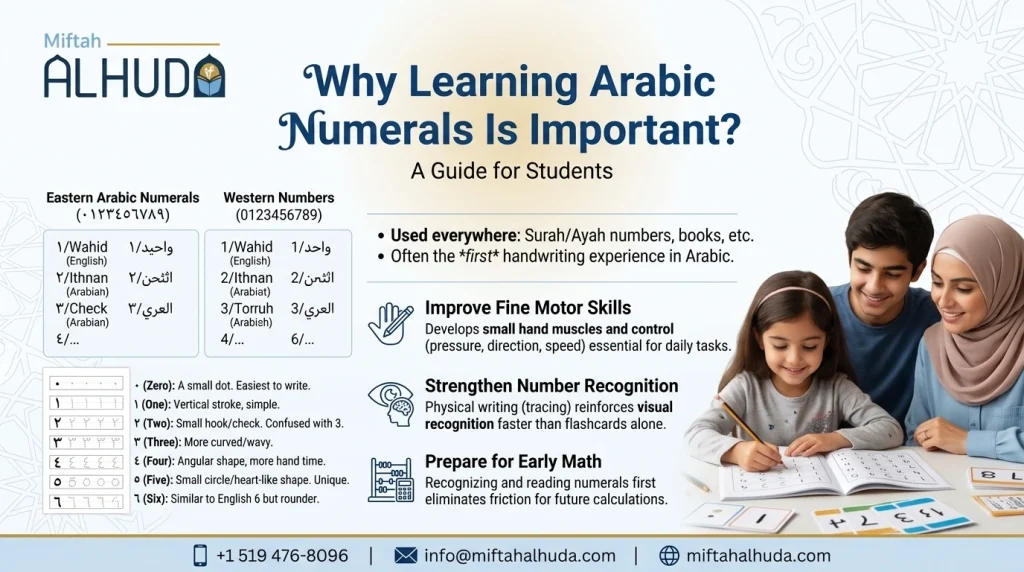
Numbers written in Arabic come up everywhere when learning about the Quran, in numbering Surahs and Ayahs, in Arabic language books and in general reading material from the Arab world.
If the child has no problems in recognizing and writing numbers ١، ٢، ٣, then one more obstacle to their becoming literate in Arabic does not exist anymore.
However, there is also a silent one. Writing numbers is often the first experience for a child with handwriting in Arabic, long before they start writing any letters or words.
Difference Between Arabic Numerals and English Numbers
Here is one surprising fact for many parents to know: The Arabic numbers used in the Arab countries, known as the Eastern Arabic numerals (٠١٢٣٤٥٦٧٨٩), look different from the Western numbers (012345678
Some main distinctions that are worth noting before you begin learning:
Arabic numerals are read and written from left to right, as in English, although the Arabic language itself is written from right to left.
A number of characters have no resemblance at all to what they would look like in English. For example, the number five (٥) looks like a little heart or a zero, while the number zero (٠) is just a dot.
There are some characters that may look alike, for example three (٣) and two (٢).
Once a child understands that these are genuinely new shapes rather than alternate versions of numbers they already know, the learning curve gets a lot less confusing.
Benefits of Using Arabic Number Writing Worksheets
Consistent worksheet practice does more than teach number shapes. It builds a set of foundational skills that show up well beyond the numeracy lesson itself.
1. Improve Fine Motor Skills
The act of drawing loops and curves through the use of Arabic numbers requires the control of pressure, direction, and speed altogether. This helps develop the fine motor skills in the small muscles of the hands and wrists, which is necessary when using scissors, tying shoes, and using utensils.
2. Strengthen Number Recognition
A child who has physically written a numeral several times recognizes it faster than one who has only seen it on a flashcard. The hand and the eye reinforce each other. This is part of why arabic number tracing worksheets are so commonly used in early Arabic curriculums rather than recognition flashcards alone.
3. Prepare Preschoolers for Early Math
However, before a kid can perform calculations using Arabic numbers, they must know how to recognize and read them first. Using worksheets for practice eliminates the friction, thus ensuring that future math classes will teach math only.
Arabic Number Tracing Worksheets (0–9)
Every number requires its own practice page instead of crammed in with other numbers. The following is an example of what should be practiced with every number and what you need to look out for as your child does so.
Worksheet for Number ٠ (Zero)
Zero is written as a small dot or a tiny filled circle, not as an open oval like the English 0. This is often the easiest numeral for beginners because the motion is so small and contained.
Worksheet for Number ١ (One)
A single vertical stroke, similar to the English 1 but without the small flag at the top. Children usually pick this one up within a single practice session.
Worksheet for Number ٢ (Two)
Two looks like a small hook or check mark. It is frequently confused with three (٣) early on, so worksheets that place these two numerals side by side for comparison practice are especially useful.
Worksheet for Number ٣ (Three)
Three has a slightly wavier, more curved shape than two. Slowing the tracing down here, rather than rushing through it, helps the distinction stick.
Worksheet for Number ٤ (Four)
The number four is one of the numbers in Arabic that have an angular shape compared to others. Four takes more time to be learned by the hand compared to others because of its angular shape.
Worksheet for Number ٥ (Five)
Five is written as a small circle or heart-like shape, completely unlike the English 5. This is usually the numeral that surprises parents most, since there is no visual link to fall back on.
Worksheet for Number ٦ (Six)
The number six is similar to a little closed circle that can be likened to English 6, though rounder and smaller.
Worksheet for Number ٧ (Seven)
The number seven looks like a V-shaped curve that is unlike both English 7 and any other Arabic digit, making it one of the easiest ones to learn.
Worksheet for Number ٨ (Eight)
Number eight looks like a long-rounded digit. It often seems quite small when children write it down initially, which is why large practice boxes are good.
Worksheet for Number ٩ (Nine)
Nine is like the number 9 in English except that its top part is more rounded than the English one. This one seems easy for most kids after they learn five and six.
Teaching Kids to Write Arabic Numbers
Using worksheets should be within a methodology, rather than random use. Here is an example sequence that works well.
1. Start with Dotted Tracing Lines
Always begin with dotted or faded outlines rather than asking a child to copy a numeral freehand. The dots remove guesswork about stroke direction and starting point, which is where most early mistakes happen.
2. Practice One Number at a Time
Resist the urge to introduce all ten numerals in one sitting. Mastering one numeral, then layering in the next, builds real retention instead of surface-level recognition that fades by the next day.
3. Use Repetition and Short Sessions
Ten to fifteen minutes of focused practice beats an hour of distracted tracing. Young children retain handwriting skills better through frequent short sessions spread across a week than through one long marathon session.
4. Combine Writing with Counting Activities
Pair each numeral with a matching counting task, like counting five buttons right after tracing ٥. This connects the abstract symbol to a concrete quantity, which is exactly the kind of association that makes the number “stick” rather than being memorized as a shape alone.
5. Printable Arabic Number Handwriting Worksheets PDF
Printable, downloadable worksheets remain the most practical option for home and classroom use, since they can be reused, copied, and adapted to a specific child’s pace.
6. Single-Number Practice Pages
These dedicate an entire page to one numeral, often with twenty or more repetitions on the same sheet. They are ideal for a child who needs extra time on a specific shape, like ٢ or ٣.
7. Multiple-Number Tracing Sheets
These combine several numerals on one page, usually after a child has already practiced each one individually. They work well as a review tool once initial mastery is in place.
8. Large Print Worksheets for Preschoolers
Younger children, especially those just starting to hold a pencil correctly, benefit from worksheets with larger tracing boxes and thicker dotted lines. Smaller print tends to frustrate developing fine motor control rather than build it.
Fun Activities to Reinforce Arabic Number Writing
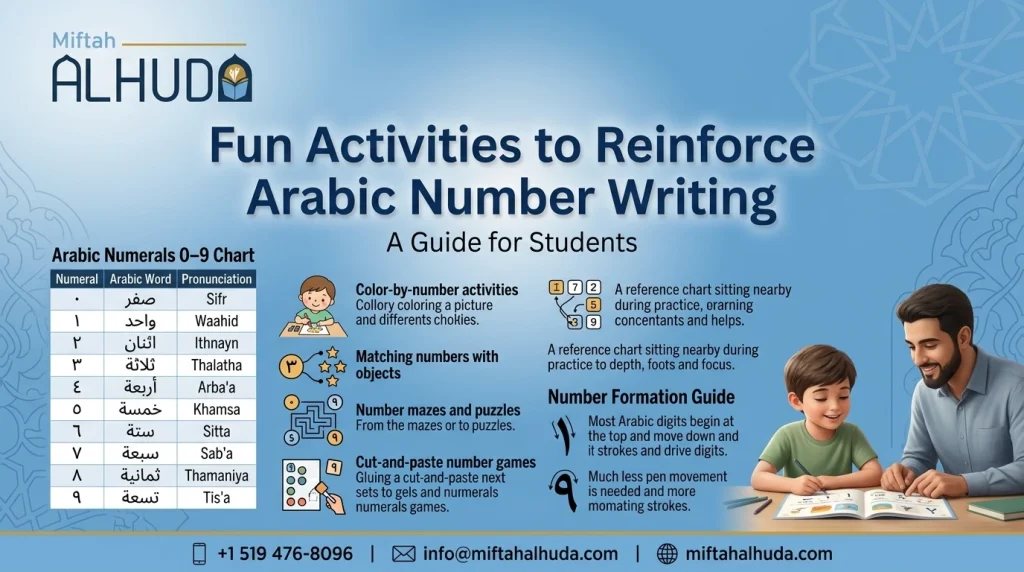
Worksheets do not need to be the only tool in the rotation. A few playful additions keep practice from becoming repetitive, especially for energetic preschoolers.
- Color-by-number activities, where a child colors a picture based on identifying each Arabic numeral correctly
- Matching numbers with objects, connecting ٣ to a group of three stars or three apples on the page
- Number mazes and puzzles, where a child follows numerals in sequence from ٠ to ٩ to complete a path
- Cut-and-paste number games, gluing the correct numeral next to a matching set of objects
- Rotating in one of these every few sessions keeps motivation steady without slowing down actual handwriting progress.
Arabic Numbers 0–9 Chart
A reference chart sitting nearby during practice gives a child something to check against without needing to ask an adult every time.
Here is the Arabic Numerals with Pronunciation:
| Numeral | Arabic Word | Pronunciation |
| ٠ | صفر | Sifr |
| ١ | واحد | Waahid |
| ٢ | اثنان | Ithnayn |
| ٣ | ثلاثة | Thalatha |
| ٤ | أربعة | Arba’a |
| ٥ | خمسة | Khamsa |
| ٦ | ستة | Sitta |
| ٧ | سبعة | Sab’a |
| ٨ | ثمانية | Thamaniya |
| ٩ | تسعة | Tis’a |
Number Formation Guide
How to easily remember the direction of the formation of numbers: most of the Arabic digits begin at the top and move down to the bottom in one straight line. Much less pen movement is needed within an individual digit than is required for writing such numbers as 4 or 5 in English.
Arabic Number Writing Tips for Preschool and Kindergarten Students
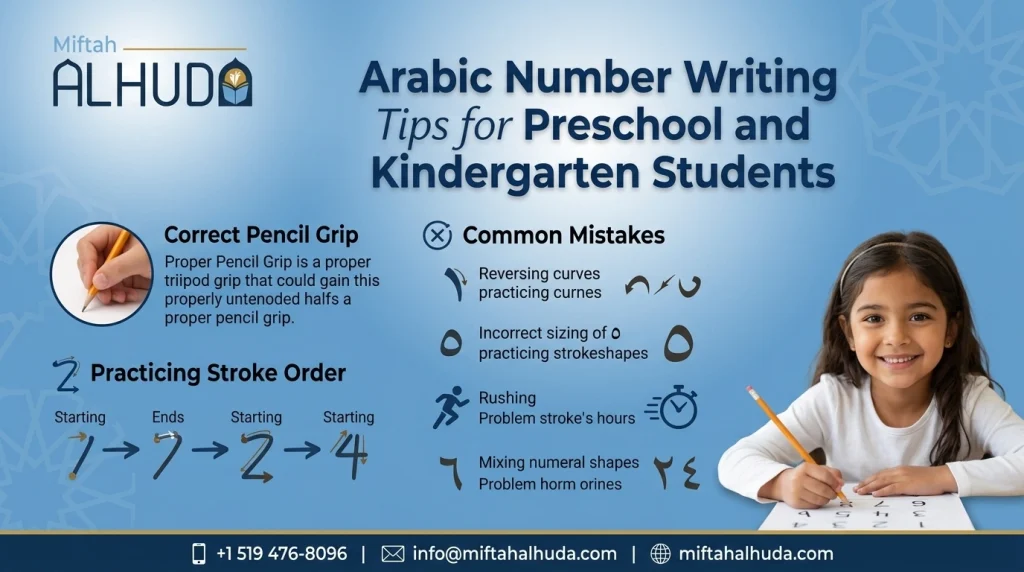
A few small adjustments make a noticeable difference in how quickly young learners build confidence with Arabic numeral worksheets.
Correct Pencil Grip
A proper tripod grip, pencil resting between thumb and first two fingers, gives far more control over curved strokes than a fist grip. If a child is struggling with shape accuracy, grip is often the real issue before the numeral itself is.
Practicing Stroke Order
Encourage starting each numeral from the same point every time, rather than letting the child begin wherever feels natural. Consistent stroke order builds the kind of automatic muscle memory that eventually lets a child write quickly without thinking about each curve.
Common Mistakes Children Make
A few patterns show up again and again in early practice:
- Reversing the direction of curved numerals like ٢ and ٣
- Drawing ٥ too large or too round, making it hard to distinguish from a zero
- Rushing through repetitions without actually looking at the model numeral
- Mixing Arabic and English numeral shapes together on the same line
None of these are signs of a struggling learner. They are simply the normal bumps that show up before a new motor pattern becomes automatic.
If you are looking for guided practice rather than self-directed worksheets alone, the Arabic for Kids Course at Miftah Alhuda builds numeral and letter writing into a structured, teacher-led curriculum designed specifically for young beginners.
Not sure where your child’s level is yet? Book a Free Trial Session and find out together.
Contact Us
WhatsApp: +1 519 476-8096
E-Mail: in**@**********da.com
Facebook: https://www.facebook.com/MiftahAlhudaOfficial
Instagram: https://www.instagram.com/miftahalhudaa
Youtube: https://www.youtube.com/@MiftahAl-huda
Tiktok: https://www.tiktok.com/@miftahalhuda00“.
Frequently Asked Questions
How do you write Arabic numbers from 0 to 9?
Each numeral has its own distinct stroke pattern, mostly written top to bottom in one motion. Zero is a small dot, five is a circle-like shape, and the rest fall somewhere between simple lines and gentle curves.
Are Arabic numerals different from Western numbers?
Yes. Eastern Arabic numerals (٠١٢٣٤٥٦٧٨٩) look different from Western numerals (0123456789), even though both are written left to right.
What age should children start learning Arabic numbers?
Most children are ready to begin around age four or five, once they can hold a pencil with reasonable control. Some preschools introduce simple tracing as early as three.
Where can I find printable Arabic number handwriting worksheets?
Printable PDFs are widely available through Islamic education sites, homeschool resource libraries, and Arabic learning platforms, often organized by single-number practice pages or full 0–9 sets.
How can kids practice writing Arabic numbers at home?
A dotted tracing worksheet, a pencil with a comfortable grip, and ten to fifteen minutes a day are enough. Pairing each numeral with a small counting activity speeds up retention.
Is tracing enough, or do children need to write numbers freehand too?
Tracing builds the initial motor pattern, but freehand writing is what confirms the skill has actually transferred. A good worksheet sequence moves from dotted tracing to guided lines to fully independent writing.
The Page Stops Being Intimidating
Somewhere around the third or fourth worksheet, something shifts. The hesitation that showed up on day one starts to disappear, replaced by a kind of quiet, repetitive confidence. The numeral that looked foreign now looks familiar, simply because the hand has drawn it enough times to remember it without thinking.
That shift is really the whole point of structured practice. Not perfection on the first page, but a steady, low-pressure climb toward a skill that eventually stops requiring conscious effort at all.
Give your child structured, teacher-guided Arabic practice with the Arabic for Kids Course at Miftah Alhuda.