
You open up your language application and enter “hello” in the search box. You get one word in return which looks entirely different from the one that is used during a normal conversation where individuals exchange three to four lines before even getting to “how are you.” In case you tried learning Arabic greeting sentences in Arabic from a vocabulary list, you must be aware of the difference.
The majority of learners face a similar problem. They will know how to say marhaban or as-salamu alaykum individually, but when the native says something back that they weren’t taught, it throws them off.
Greetings in Arabic are never just one word. They are made up of a sentence, and after that comes a reply.
The following is an Arabic language guide containing sentences that express greetings in Arabic. These sentences are in Arabic script, transliteration, and in plain English, together with the answers for each.
This guide will enable you to be able to say complete sentences that you can actually use in a real conversation.
What Are Common Arabic Greeting Sentences in Arabic?
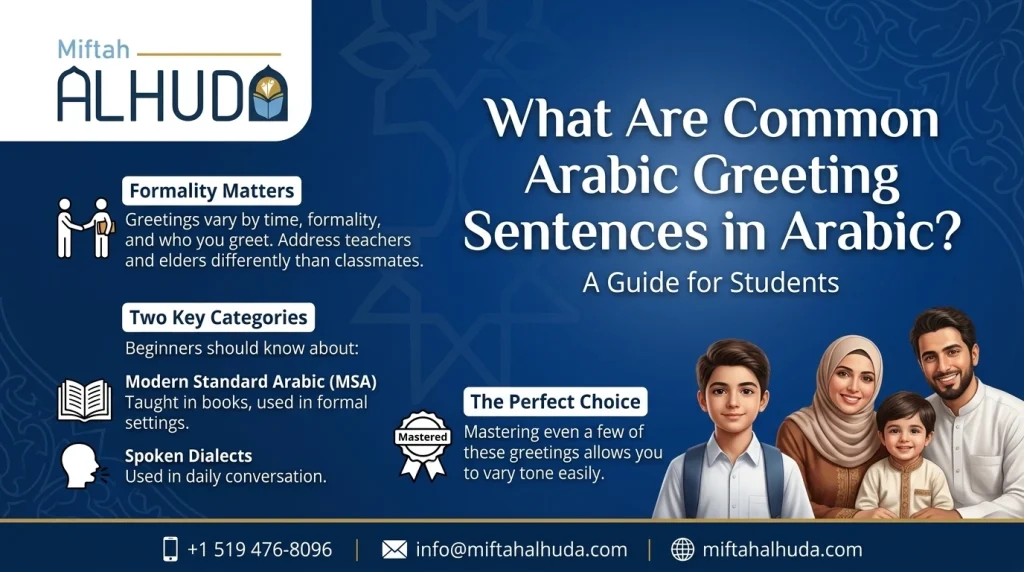
Greetings in Arabic vary according to time of the day, degree of formality involved, and who you greet. There are certain greetings that you may use when addressing your classmates but are not appropriate for use when addressing your teachers and older relatives.
Two broad categories matter most for beginners:
Modern Standard Arabic (MSA), the form taught in books and used in formal settings.
Spoken dialects, which vary by country and are used in daily conversation.
The majority of Arabic greetings fall into both these categories, and that’s precisely what makes them the perfect choice to start your studies with. Having mastered even a few of these greetings, you can easily vary the tone according to the situation.
Common Arabic Greeting Sentences for Everyday Conversations
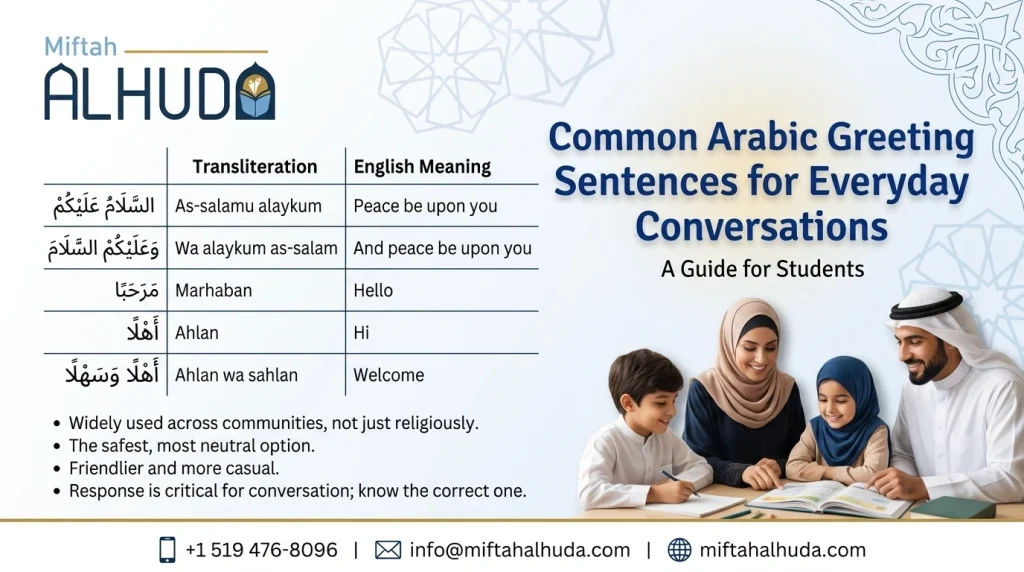
These are the phrases you will hear most often, whether you are studying MSA or picking up a regional dialect.
| Arabic | Transliteration | English Meaning |
| السلام عليكم | As-salamu alaykum | Peace be upon you |
| وعليكم السلام | Wa alaykum as-salam | And peace be upon you |
| مرحبًا | Marhaban | Hello |
| أهلًا | Ahlan | Hi |
| أهلًا وسهلًا | Ahlan wa sahlan | Welcome |
A few notes worth remembering as you use these:
“As-salamu alaykum” and its response are widely used across Arabic-speaking communities as a general greeting, not only in religious settings.
“Marhaban” is the safest, most neutral option if you are unsure what fits the situation.
“Ahlan” sounds friendlier and more casual, closer to saying “hi” than “hello.”
Learning just the greeting alone is not sufficient. The natives will definitely give you a response to the greeting you give and you may fail miserably if you don’t know the appropriate response.
Arabic Greetings for Different Times of Day
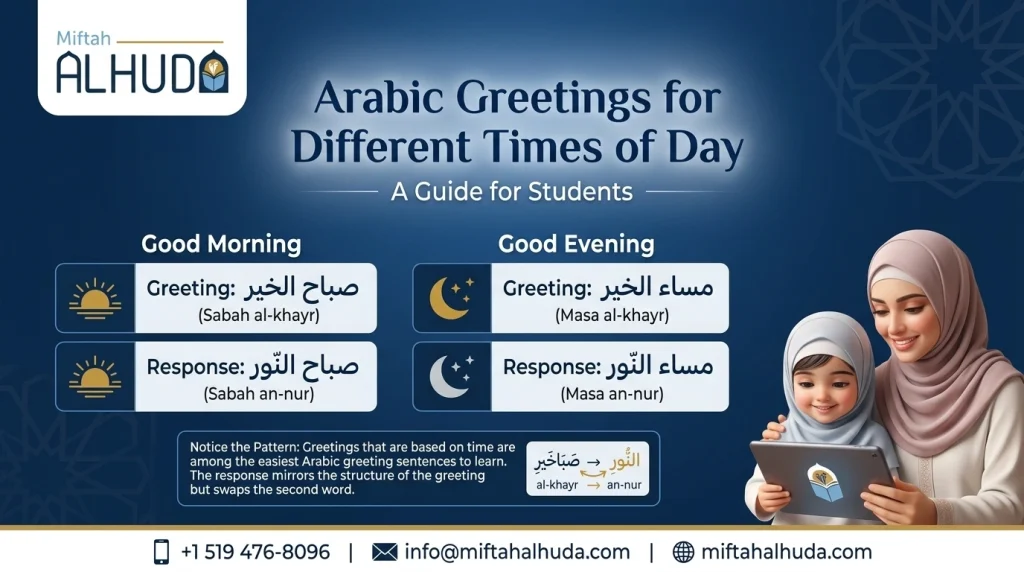
Greetings that are based on time are among the easiest Arabic greeting sentences to learn at an early stage since they follow a definite pattern.
Good morning
صباح الخير (Sabah al-khayr) – Good morning
صباح النور (Sabah an-nur) – Response to good morning
Good evening
مساء الخير (Masa al-khayr) – Good evening
مساء النور (Masa an-nur) – Response to good evening
Notice the pattern. The response mirrors the structure of the greeting but swaps the second word. Once you catch that pattern, you stop having to memorize each pair separately, and you start predicting how a response should sound before you even hear it.
How to Ask “How Are You?” in Arabic
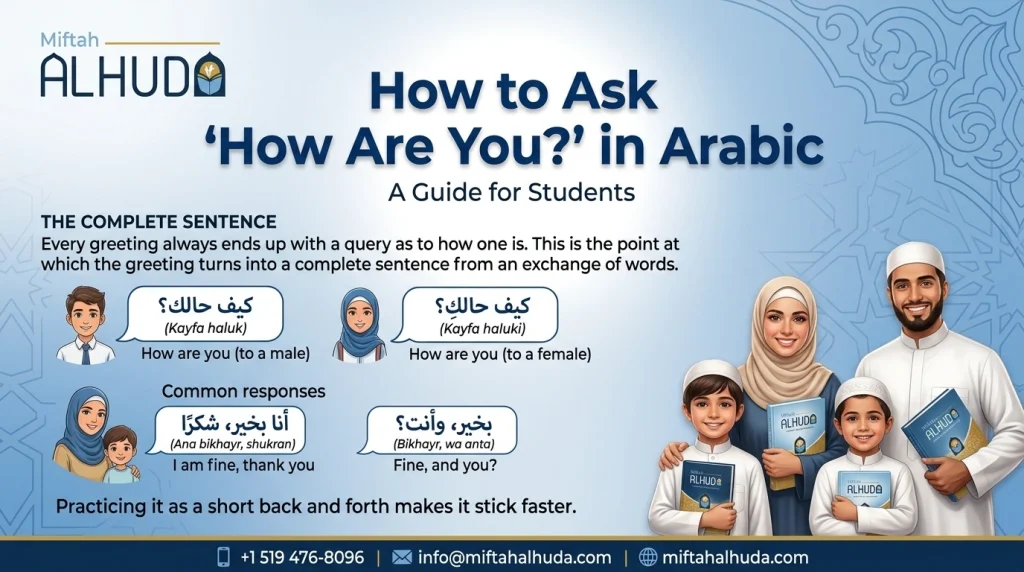
Every greeting always ends up with a query as to how one is. This is the point at which the greeting turns into a complete sentence from an exchange of words.
كيف حالك؟ (Kayfa haluk) – How are you (to a male)
كيف حالكِ؟ (Kayfa haluki) – How are you (to a female)
Common ways to respond:
أنا بخير، شكرًا (Ana bikhayr, shukran) – I am fine, thank you
بخير، وأنت؟ (Bikhayr, wa anta) – Fine, and you?
This exchange is usually where beginners stall, because it requires producing a sentence rather than repeating a fixed phrase. Practicing it as a short back and forth, rather than as isolated vocabulary, makes it stick faster.
Formal and Casual Arabic Greeting Sentences
The same idea can sound completely different depending on who is standing in front of you.
Formal situations (teachers, employers, first meetings)
السلام عليكم
مرحبًا بكم (Marhaban bikum) – Welcome (to a group or formally)
تشرفت بلقائك (Tasharraftu biliqa’ik) – Pleased to meet you
Casual situations (friends, classmates, family)
أهلًا
هلا (Hala) – Hi
كيفك؟ (Kifak / Kifik) – How are you? (dialect form)
Another common mistake that beginners commit is that of mixing up the tone. For example, a beginner can use an informal tone for a formal sentence. Or he or she may use a formal tone for an informal sentence. Native speakers of Arabic language tend to notice such mistakes immediately. The learner can keep silent in respect of the elders. However, the mistake will be obvious anyway.
Arabic Greetings by Dialect
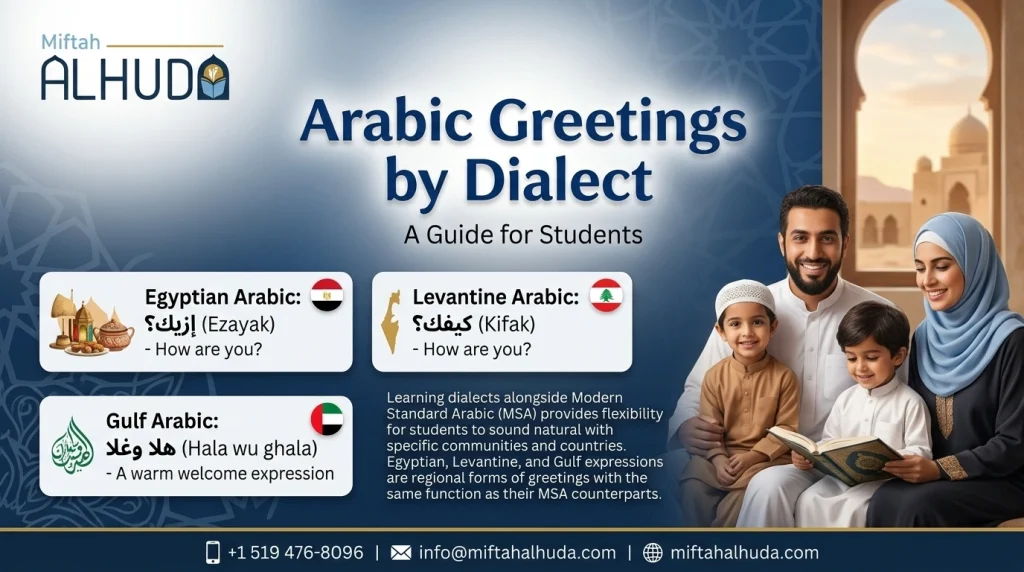
Arabic greeting sentences in Arabic shift slightly from country to country, and beginners benefit from recognizing a few regional variations early, even if Modern Standard Arabic remains the foundation.
Egyptian Arabic: إزيك؟ (Ezayak) – How are you?
Levantine Arabic: كيفك؟ (Kifak) – How are you?
Gulf Arabic: هلا وغلا (Hala wu ghala) – A warm welcome expression
These dialect forms serve the same function as their MSA equivalents. Learning both gives you flexibility, since MSA is understood everywhere, while dialect greetings help you sound natural in a specific country or with a specific community.
Short Arabic Greeting Dialogues for Beginners
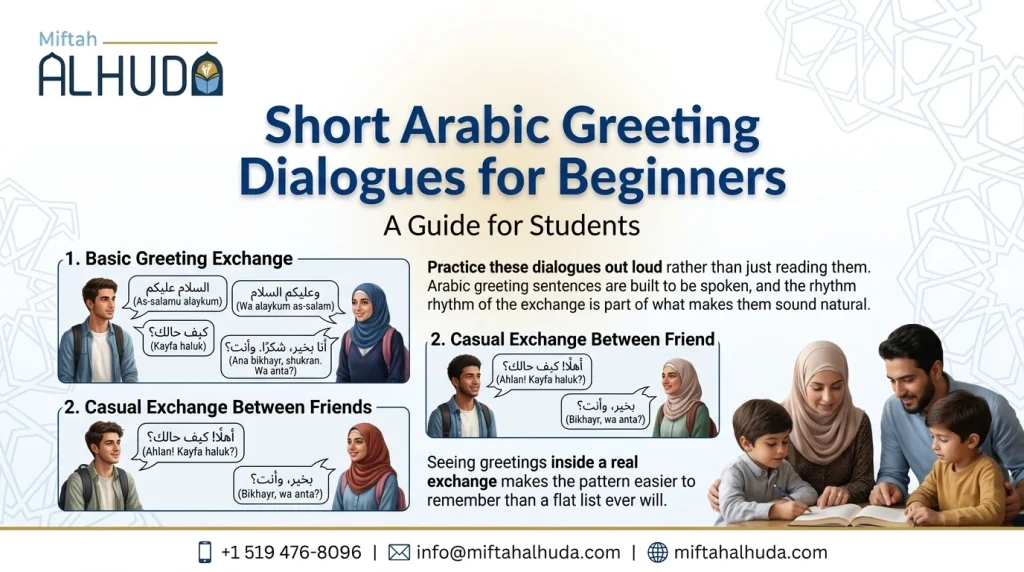
Seeing greetings inside a real exchange makes the pattern easier to remember than a flat list ever will.
Basic greeting exchange
Person A: السلام عليكم (As-salamu alaykum)
Person B: وعليكم السلام (Wa alaykum as-salam)
Person A: كيف حالك؟ (Kayfa haluk)
Person B: أنا بخير، شكرًا. وأنت؟ (Ana bikhayr, shukran. Wa anta?)
Casual exchange between friends
Person A: أهلًا! كيف حالك؟ (Ahlan! Kayfa haluk?)
Person B: بخير، وأنت؟ (Bikhayr, wa anta?)
Practice these dialogues out loud rather than just reading them. Arabic greeting sentences are built to be spoken, and the rhythm of the exchange is part of what makes them sound natural.
Common Mistakes When Using Arabic Greetings
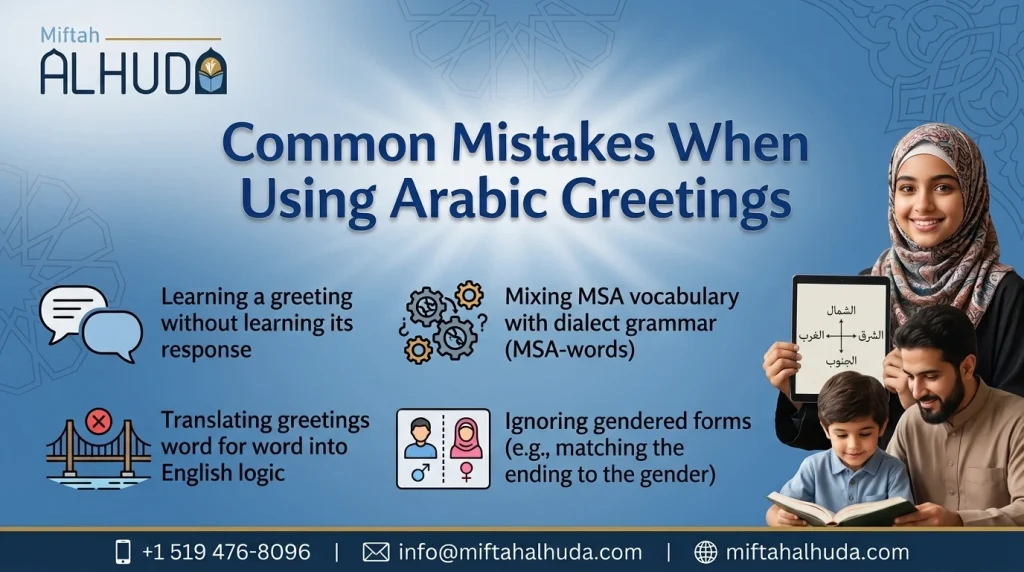
A few habits slow beginners down more than anything else:
Learning a greeting without learning its response, which leaves half a conversation missing
Mixing MSA vocabulary with dialect grammar in the same sentence
Translating greetings word for word into English logic, which strips away their social function
Ignoring gendered forms, which matter more in Arabic than in English
None of these mistakes are hard to fix. They mostly disappear once you start practicing full Arabic greeting sentences in Arabic instead of single words in isolation, which is exactly the habit this guide is meant to build.
Ready to move past the phrase list stage? Explore Miftah Alhuda’s Arabic courses and build real conversation skills with a live teacher.
Not sure where to start? Book a free trial session and get personal guidance on your current level.
Contact Us
WhatsApp: +1 519 476-8096
E-Mail: in**@**********da.com
Facebook: https://www.facebook.com/MiftahAlhudaOfficial
Instagram: https://www.instagram.com/miftahalhudaa
Youtube: https://www.youtube.com/@MiftahAl-huda
Tiktok: https://www.tiktok.com/@miftahalhuda00“.
Frequently Asked Questions
How do you greet others using ‘hello’ in Arabic language?
The most common choices are ‘marhaban’ meaning ‘hello’, and ‘ahlan’ meaning ‘hi’ both used formally and informally.
Which is the most common greeting sentence in Arabic?
“As-salamu alaykum,” followed by “wa alaykum as-salam,” is among the most common Arabic greetings.
How do you say ‘good morning’ in Arabic?
‘Sabah al-khayr’ means ‘good morning’ and the common response is ‘sabah an-nur’.
Difference between “Marhaba” and “Ahlan”?
“Marhaba” is neutral and can be used anywhere, whereas “ahlan” comes off as more informal and warm.
Is there a difference in Arabic greetings according to different countries? Yes, Egyptian, Levantine, and Gulf Arabic all have unique informal greetings despite the similarity in Modern Standard Arabic greetings.
Which is the best Arabic greeting sentence for beginners?
“Marhaban” together with “kayfa haluk” (how are you) is appropriate in most situations.
Your First Real Conversation Starts Here
It is good to learn some sentences for greeting in Arabic, but the fact is that it cannot be considered a skill until it is used with another person, and their reaction comes back. This is where the words turn into language.
There is no way around the initial awkwardness. However, there is an upside because greetings are the safest place to go through it because everyone knows you will be awkward when greeting at first.