
As parents we all desire that our children should read the Quran and they should also recite with good Tajweed. Nonetheless, it may be hard to balance school, extra-curricular and spiritual growth.
This is where Tajweed practice exercises for children comes in; a structured and fun method of helping children learn their Quranic abilities as well as enhance their passion to the words of Allah.
Let’s discover the best Tajweed practice exercises to help your kids learn Tajweed and have fun!
The Reason Tajweed is Important: The Foundation of Faith and Ibadah
Tajweed is the art of mastering the Quran pronunciation every letter in the right way, the numbering of elongations (Madd), pauses and other rules that bring Tilawah a real kind of worship (Ibadah).
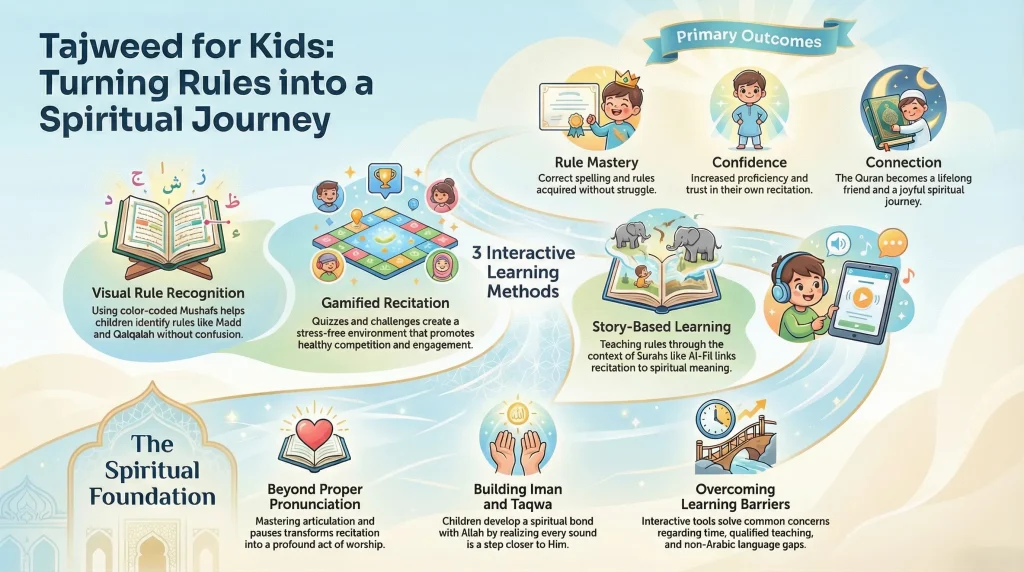
Tajweed is not only about rules but also learning to instill Iman (faith) and Taqwa (God-consciousness) in children. Recitation creates joy and spiritual development when the children realize that each sound, pause, articulation point will bring them closer to Allah (SWT).
Some of the parents are concerned about time, qualified teachers, or efficient materials, particularly with the non-Arabic speakers. The solution is found in interactive Tajweed practice exercises for children to make learning structured, consistent and fun.
Fun and Interactive Tajweed Practice For Children.
Here are the best Tajweed Exercises For kids to learn Quran recitation perfectly:
1. Easy Rule Recognition Color-Coded Mushafs.
All the letters and Tajweed are written in colored-coded manner so children should not mistake the Noon Mushaddadah, Madd, Qalqalah, and other rules.
Visual representation makes children absorb rules as it should be, and thus they would not get confused and will recite more correctly.
Parents find it easy to monitor the progress because the child becomes aware of the rules and uses them during the reading process.
2. Fun Tajweed Games and Quizzes.
Tajweed is not just the reading process, but an entertaining and fun adventure.
Interactive games assist children to engage in pronunciation, elongation (Madd), and letter pronunciation in a stress free atmosphere.
Contests and small challenges will promote healthy competition and will encourage children to keep on reciting in order to enforce the learned rules that they have learned.
4. Stories to improve understanding.
The best way to teach Tajweed rules is through the use of stories and actual cases as found in Quran like Surahs Al-Fil, Al-Ikhlas, and An-Nas.
Children get to know not only the rules of correct recitation, but also the sense and the spiritual significance.
This approach supports the idea that Tilawah is more a worship (Ibadah) and assists children to relate more intensely with the words of Allah.
5. Motivation and Rewards
Encourage children by rewarding successes: the art of mastering a letter to a Surah.
Such rewards as recognition, certificates, and tracking of the progress will make kids excited and interested in long-term learning.
Through an integration of visual aids, games, story-based learning, live recitation and feedback, our interactive Tajweed exercises will make sure that children:
- Acquire correct spelling and rules without struggle.
- Develop trust and proficiency in Quran reciting.
- Love the Quran and view it as a lifelong friend.
Understand that Tilawah is an act of worship, strengthening Iman and Taqwa
With these interactive exercises, learning Tajweed becomes more than memorization, it becomes a joyful spiritual journey, preparing children to recite the Quran beautifully while internalizing its guidance for both Dunya and Akhirah.
8 Best Tajweed Practice Exercises for Children
Here is how you can teach your child Tajweed in a fun and interactive way:
1. Color-Coded Mushaf Games
Objective: Help kids recognize Tajweed rules visually.
- Use a Mushaf where each rule is highlighted in different colors (e.g., Noon Mushaddadah, Madd, Qalqalah).
- Ask children to find and recite all letters with a certain rule, like a treasure hunt.
- Reward them with stickers or small incentives to keep motivation high.
2. Madd (Elongation) Melody Challenge
Objective: Master elongation (Madd) while making recitation fun.
- Recite a verse together and stretch the Madd like a musical note.
- Let the child imitate the melody, turning recitation into a playful song.
- Helps with fluency, rhythm, and pronunciation.
3. Tajweed Story Time
Objective: Teach rules like Idgham, Ikhfaa, and Qalqalah through storytelling.
- Create a story around each rule (e.g., letters “merging” for Idgham or “bouncing” for Qalqalah).
- Ask the child to recite while acting out the story, using gestures or fun voices.
- Reinforces memory and makes abstract rules concrete.
4. Parent-Child Recitation Challenge
Objective: Build confidence and fluency.
- Recite a verse or short Surah alternately with the child.
- Use a timer or scoring system for friendly competitions.
- Praise progress using Islamic encouragements: MashaAllah, SubhanAllah, Alhamdulillah.
5. Audio Recording & Playback
Objective: Self-assessment and correction.
- Children record their recitation and listen to it.
- Teachers or parents provide constructive feedback, highlighting mistakes gently.
- Helps children track progress and develop independence in practicing Tajweed.
6. Tajweed Flashcards
Objective: Learn rules in short, interactive bursts.
- Make flashcards with Tajweed symbols, letters, or rules.
- Ask the child to identify the rule and recite a word or verse with that rule.
- Can be played in quiz style or memory matching games, making practice quick and fun.
7. Recitation Bingo or Board Games
Objective: Encourage daily practice in a playful way.
- Create a board game with spaces like “Recite a verse with Madd,” “Recite a Qalqalah letter,” etc.
- Children advance on the board for each correct recitation.
- Combines learning, repetition, and reward in a structured game.
8. Tajweed Role-Playing
Objective: Make learning social and engaging.
- Children pretend to be teachers, explaining a rule to a parent or sibling.
- Reinforces knowledge and boosts confidence, speaking, and teaching skills.
Tips for Parents For Supporting Your Child’s Tajweed Journey
Learning Tajweed is a beautiful journey for your child, but parents play a key role in guiding and encouraging them. Here are practical tips to make the process smooth, effective, and spiritually rewarding:
1. Make Daily Practice a Fun Routine
Encourage short, consistent sessions rather than long, exhausting ones. Even 10–15 minutes daily helps children retain rules and build fluency.
Use interactive tools like color-coded Mushafs, Tajweed games, or audio recordings to make practice enjoyable.
Celebrate small achievements with phrases like MashaAllah or a sticker chart, fostering a positive attitude toward learning.
2. Lead by Example
Children often emulate their parents. Recite Quran with Tajweed and love in front of them.
- Include Tilawah during family Salah or at bedtime, showing that recitation is a joyful part of daily life.
- Share your own learning moments and encourage questions about the meaning of verses (Tafsir) to spark curiosity.
3. Focus on Quality, Not Quantity
It’s better for a child to perfect a few verses than rush through many.
- Emphasize correct pronunciation, elongation (Madd), and pauses over speed.
- Remind your child that Tilawah is an act of Ibadah, and Allah rewards sincere effort.
4. Use Interactive Tools and Online Support
Leverage online Tajweed courses for kids like Miftah Alhuda to access qualified teachers, structured lessons, and personalized feedback.
Record your child’s recitation and play it back together, gently pointing out improvements.
Encourage them to participate in Tajweed challenges or games, keeping motivation high.
5. Be Patient and Encouraging
Every child learns at their own pace. Avoid comparisons with siblings or classmates.
- Correct mistakes gently and reinforce successes with praise, even small improvements matter.
- Teach children that perseverance in Tilawah strengthens Iman and Taqwa and brings spiritual reward.
The “Beginner to Confident Reciter” Roadmap at Miftah Alhuda
Our Tajweed-for-kids program is a course that has been structured as a journey, beginning with basic skills to the confident reading of the Quran.
1. Creating a Powerful Foundation.
Children start with the Arabic alphabet on which they learn Makharij (points of articulation) and Sifaat (letter qualities). Using fun activities, color pictures, and repetition activities, children learn sounds, which are not present in English, like Ayn (ع), Ghayn (غ), and Qaaf (ق).
This stage ensures:
- Proper pronunciation at the beginning.
- Knowledge in reading Mushaf.
- Strong foundation for future Tajweed rules.
Even the shyness in children is boosted by practicing with the help of a friendly online space which enables children to practice Quran recitation without the fear of participating.
2. Mastering Core Tajweed Rules for Kids.
After the foundation is established, children proceed on to some of the major Tajweed rules, including:
- Noon and Meem Mushaddadah (emphasized sounds).
- Madd (elongation)
- Qalqalah (echoing letters)
- Idgham, Ikhfaa, and Iqlab
These rules are instructed by means of recitation, by sounds and actual illustrations of short Surahs such as Al-Falaq, Al-Ikhlas and An-Nas. And in this manner, learning will become intuitive and enjoyable, and children will learn that rules are the mechanisms to make recitation more beautiful, not a theory.
The parents may not be well versed with Tajweed, but they can easily monitor the child progress and hence the process becomes inclusive and motivating.
3. Tajweed in Recitation in the Real Sense.
Children are also taught the rules, and, knowing how to practice Tajweed, start reading selected Surahs with its application. Our teachers provide:
- Personalized correction of errors.
- Motivation to get rid of stage fright or reading aloud fear.
- Instructions on how to be more fluent and consistent, even at the school when it is busy enough.
At this level, Tilawah is a form of happiness and it helps one to love the Quran as well as building spiritual confidence.
4. Building a Love for the Quran
We do more than teach Tajweed; we cultivate a passion for Allah’s words.
- Children listen to the beautiful recitations and stories of short Tafsir.
- They are taught how the Quran directs life in Dunya (this world) as well as Akhirah (Hereafter).
- They establish a personal relationship with the Quran enhancing Iman and Taqwa.
At the conclusion of the course, children come to regard the Quran as a friend throughout their life, as a source of help, comfort, and inspiration.
5. The use of Quran in Everyday Life.
Tajweed is best learned when it is carried out in everyday life. Our program will foster children to:
- Practice Tajweed in Salah (prayer).
- Participate in family prayers.
- Consider recitation as a way of Ibadah, which will bring them closer to Jannah (Paradise).
Even parents who are not specialists of Tajweed are given easy tips on how to encourage their child to develop spiritually.
FAQs
1. What are Tajweed practice exercises for children?
Tajweed practice exercises for children are structured and interactive activities designed to teach kids proper Quranic recitation. They focus on correct pronunciation, letter articulation (Makharij), elongation (Madd), stopping rules (Waqf), and other Tajweed rules, making learning fun and effective.
2. Why is Tajweed important for children?
Tajweed ensures that every letter of the Quran is pronounced correctly, transforming Tilawah into a form of Ibadah (worship). Learning Tajweed also strengthens Iman, Taqwa, and helps children develop a lifelong love for the Quran while building spiritual confidence.
3. Can non-Arabic speaking children learn Tajweed effectively?
Yes. Tajweed practice exercises for children use visual aids, color-coded Mushafs, storytelling, games, and interactive tools that make learning intuitive for children of all language backgrounds. This ensures they grasp the rules and recite accurately.
4. How can Tajweed be made fun and interactive for kids?
Through activities like color-coded Mushaf games, Madd melody challenges, Tajweed story time, parent-child recitation challenges, flashcards, board games, role-playing, and audio recording exercises. These methods keep children engaged while reinforcing correct recitation.
5. How often should children practice Tajweed?
Short, consistent daily sessions of 10–15 minutes are ideal. Regular practice helps children retain rules, improve fluency, and build confidence without feeling overwhelmed. Gamified exercises and rewards make daily practice enjoyable.
Conclusion
Helping your child master Tajweed is more than learning rules, it’s a journey of spiritual growth, confidence, and love for Allah’s words.
With Tajweed practice exercises for children, your child can develop accuracy, fluency, and a lifelong passion for Tilawah, while strengthening their Iman and Taqwa.
At Miftah Alhuda, our online Tajweed classes are designed to make this journey fun, interactive, and spiritually rewarding. Through color-coded Mushafs, engaging games, story-based lessons, and personalized feedback, children learn to recite the Quran beautifully while understanding its meaning and importance in daily life.
Start your child’s journey today, InshaAllah, and watch them thrive in Tilawah, confidence, and love for the Quran!